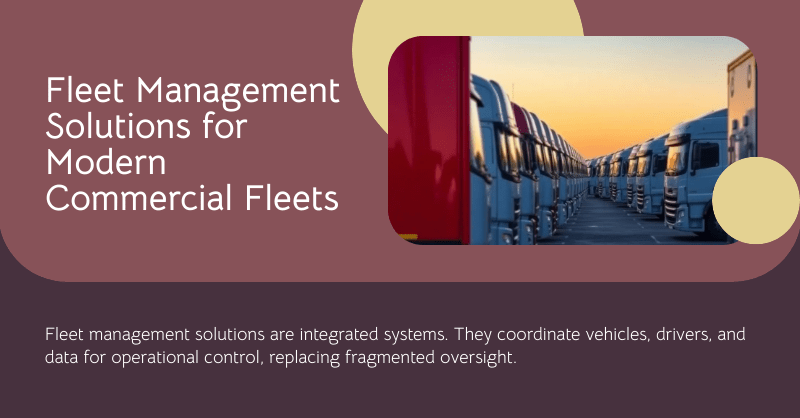
Fleet Management Solutions for Modern Commercial Fleets
Fleet management solutions refer to integrated systems that coordinate vehicles, drivers, assets, compliance, safety, and operating data into a single management framework. Modern fleets rely on these platforms to translate daily vehicle activity into measurable operational control rather than fragmented oversight. The defining characteristic is centralization, not any single tool or device.
At an operational level, these solutions unify vehicle location, driver behavior, maintenance status, incident history, and regulatory requirements. The goal is not just visibility, but the ability to act quickly when performance, risk, or costs drift outside acceptable thresholds.
Why fleet management solutions matter as fleets scale
Fleet complexity increases nonlinearly as vehicles, routes, and drivers are added. Without centralized systems, managers rely on delayed reports, manual checks, and incomplete data streams that obscure real conditions. Fleet management solutions exist to compress reaction time and remove guesswork from daily decisions.
As fleets grow, small inefficiencies compound into material exposure across fuel spend, accident risk, compliance gaps, and asset tracking. A unified solution allows operators to detect emerging issues early, standardize corrective actions, and maintain control even as operational scale expands.
Core problems fleet management solutions are designed to solve
Fleet management solutions are built to address recurring operational breakdowns that appear across industries and fleet sizes. These breakdowns are structural, not situational, and tend to persist until systems replace manual oversight.
Common problems include:
- Limited real-time visibility into vehicle and driver activity
- Inconsistent safety enforcement and incident documentation
- Reactive maintenance instead of condition-based servicing
- Fragmented compliance records across vehicles and drivers
- Difficulty correlating operational decisions to financial outcomes
By consolidating these domains, fleet management solutions reduce dependency on individual managers and informal processes.
How centralized fleet data changes operational decision-making
Centralized fleet data shifts decisions from intuition-based to evidence-based. When vehicle behavior, driver actions, and outcomes are tracked consistently, management decisions become repeatable rather than subjective. This is particularly important in safety, maintenance prioritization, and route optimization.
Over time, patterns emerge that reveal systemic inefficiencies rather than isolated incidents. Fleet management solutions make these patterns visible, enabling structural improvements instead of reactive fixes.
Vehicle tracking as a foundational fleet management capability
Vehicle GPS tracking provides the physical backbone of most fleet management solutions. Location data establishes accountability for route adherence, arrival times, asset utilization, and unauthorized use. Without reliable tracking, many higher-level analytics lose context.
Modern tracking systems support more than simple location pings. They allow managers to compare planned versus actual routes, identify idle time, and understand how vehicles are truly being used across operating hours.
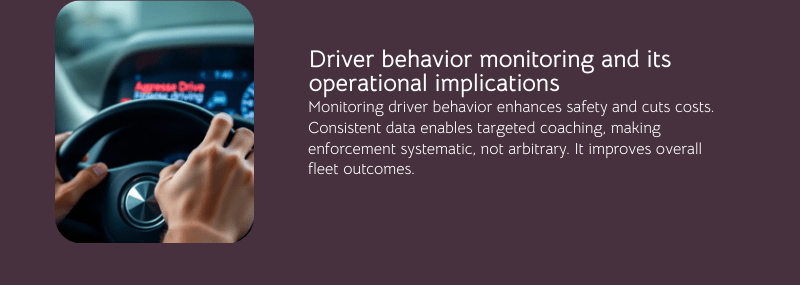
Driver behavior monitoring and its operational implications
Driver behavior monitoring connects human actions to fleet outcomes. Speeding, harsh braking, rapid acceleration, and distracted driving materially increase risk and operating costs. Fleet management solutions surface these behaviors consistently rather than relying on post-incident reviews.
When behavior data is standardized, coaching becomes targeted and defensible. Drivers receive feedback tied to specific events, and organizations can demonstrate that safety enforcement is systematic rather than arbitrary.
Maintenance optimization through operational visibility
Maintenance failures often stem from delayed signals rather than mechanical complexity. Fleet management solutions aggregate mileage, engine alerts, and usage patterns to trigger service at the right time. This reduces both breakdowns and unnecessary early maintenance.
Condition-based maintenance planning improves vehicle uptime while extending asset life. Over time, maintenance schedules become predictive rather than calendar-driven.
Compliance management within fleet management solutions
Regulatory compliance is a persistent operational risk for fleets operating across jurisdictions. Fleet management solutions centralize inspection records, driver certifications, incident documentation, and service logs. This reduces the likelihood of missing records during audits or post-incident investigations.
Centralized compliance data also enables faster internal reviews when incidents occur. Documentation is accessible immediately rather than reconstructed under pressure.
Cost control as an outcome, not a feature
Fleet management solutions do not reduce costs directly; they create the conditions for cost discipline. By making fuel usage, maintenance patterns, downtime, and incidents visible, they allow management to intervene earlier and more precisely.
Cost improvements tend to follow better decisions rather than isolated savings initiatives. Over time, fleets that operate from centralized data experience fewer surprises and more predictable financial performance.
Dashcams as a core pillar of modern fleet management
Dashcams have evolved into a central pillar of fleet management solutions because they provide objective, event-level context that no other system can replicate. Video evidence transforms incidents from disputed narratives into documented facts. This fundamentally changes how fleets manage risk, safety, and accountability.
In modern fleets, dashcams are no longer isolated recording devices. They integrate with fleet management platforms to align video events with vehicle data, driver behavior metrics, and incident workflows. This integration allows fleets to move from reactive incident response to proactive risk mitigation.
Why video context changes fleet risk management
Video captures the conditions surrounding an event, including traffic behavior, road conditions, and driver response. This context prevents misclassification of incidents and reduces reliance on secondhand accounts. As a result, fleets gain greater confidence in their incident assessments.
Over time, video-based insights help identify recurring risk scenarios. These insights inform route planning, driver coaching, and policy updates without speculation.
Dashcams and driver accountability
Dashcams create balanced accountability by protecting both drivers and the organization. Objective footage can exonerate drivers when they are not at fault while also highlighting coaching opportunities when behavior deviates from policy. This balance supports a safety culture rooted in fairness rather than punishment.
When drivers understand that evaluations are evidence-based, trust in safety programs tends to improve. This improves participation and reduces resistance to monitoring.
Integration with broader fleet management systems
Dashcams deliver their full value when integrated with fleet management solutions rather than operating in isolation. Video events tied to telematics data enable faster incident workflows and clearer reporting. This integration reduces administrative overhead while improving data accuracy.
Integrated systems also allow organizations to prioritize video review based on risk thresholds rather than reviewing footage indiscriminately.
Telematics versus fleet management solutions in practice
Telematics is a component of fleet management solutions, not a replacement. Telematics focuses on vehicle data transmission, while fleet management solutions interpret and operationalize that data. Confusing the two often leads to underutilized systems.
A complete solution connects telematics inputs with policy enforcement, reporting, coaching, and compliance workflows. Without this structure, data remains underused.
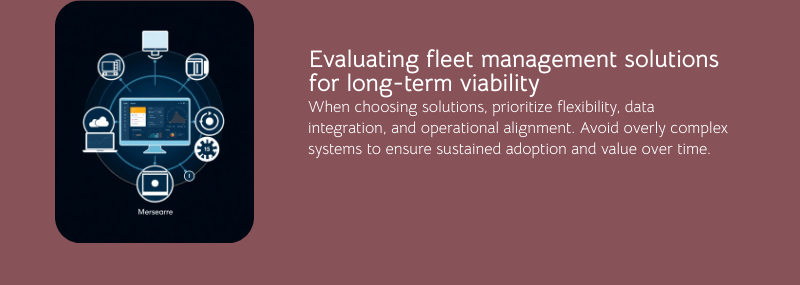
Evaluating fleet management solutions for long-term viability
Not all fleet management solutions scale effectively over time. Evaluation should focus on system flexibility, data integration, and operational alignment rather than feature volume. Overly complex platforms often introduce friction that limits adoption.
Key evaluation criteria include:
- Ability to integrate video, telematics, and maintenance data
- Clear reporting that supports operational decisions
- Scalable user permissions and workflows
- Transparent data ownership and retention policies
Solutions that align with real operational processes tend to deliver sustained value.
Implementation realities that affect adoption
Implementation determines whether fleet management solutions succeed or stall. Systems introduced without process alignment often become underused dashboards rather than operational tools. Clear expectations, defined workflows, and consistent enforcement are critical.
Adoption improves when systems reduce manual work rather than adding administrative burden. Automation of routine tasks increases acceptance across management and drivers.
Data governance and operational trust
Fleet data influences disciplinary decisions, insurance claims, and compliance outcomes. Fleet management solutions must support reliable data governance to maintain internal trust. Inconsistent or inaccessible data undermines confidence in the system.
Strong governance includes clear access controls, standardized reporting, and documented data handling practices.
Industry-specific considerations for fleet management solutions
Different industries prioritize different outcomes within fleet management solutions. Service fleets emphasize route efficiency and customer response time, while logistics fleets focus on utilization and compliance. Construction and utility fleets often prioritize asset protection and incident documentation.
Effective solutions accommodate these differences without forcing one-size-fits-all workflows.
Future-facing expectations for fleet management solutions
Fleet management solutions are evolving toward deeper integration rather than standalone modules. Decision-makers increasingly expect systems that connect safety, operations, and finance without manual reconciliation. Video data, in particular, is becoming a standard input rather than a supplemental feature.
As expectations rise, solutions that cannot integrate across domains risk obsolescence.
Common misconceptions that limit fleet management effectiveness
A frequent misconception is that fleet management solutions are primarily tracking tools. In reality, tracking is only valuable when connected to action. Another misconception is that monitoring inherently reduces trust, when evidence-based systems often improve fairness.
Addressing these misconceptions early improves organizational buy-in and long-term results.

Measuring effectiveness beyond surface metrics
Effectiveness should be measured through consistency of outcomes rather than isolated improvements. Reduced incident frequency, faster incident resolution, predictable maintenance cycles, and stable compliance records indicate mature system usage.
Surface metrics without operational follow-through rarely translate into sustained improvement.
Organizational alignment enabled by unified fleet management systems
Fleet management solutions influence more than vehicles and drivers; they shape how organizations align responsibility across departments. When operations, safety, compliance, and finance rely on the same data environment, decision-making becomes coordinated rather than siloed. This alignment reduces internal friction and accelerates resolution when issues arise.
Unified systems establish a shared operational truth. Disputes over incidents, performance, or policy enforcement diminish when evidence is consistent and accessible across teams.
Incident response workflows and operational resilience
Effective fleet management solutions define what happens immediately after an incident occurs. Automated alerts, standardized documentation, and centralized records reduce confusion during time-sensitive situations. This consistency improves response speed while lowering administrative burden.
Dashcam-integrated workflows further strengthen resilience by attaching visual context to incident records. Video-linked events reduce investigation cycles and support faster, more confident decisions under pressure.
Risk scoring and prioritization across the fleet
Fleet management solutions increasingly rely on risk-based prioritization rather than equal treatment of all events. By aggregating behavior data, incident history, and contextual signals, fleets can identify which vehicles, routes, or drivers require intervention first. This approach prevents resource dilution.
Dashcam data enhances prioritization by distinguishing high-risk behaviors from false positives. Fleets avoid overcorrecting benign events while focusing attention where exposure is real.
Standardization without operational rigidity
One challenge fleets face is balancing standardization with operational flexibility. Fleet management solutions address this by enforcing core policies while allowing role-based variation. Drivers, managers, and safety teams interact with the same system through different lenses.
Dashcams support this balance by applying consistent documentation standards without prescribing outcomes. Evidence is standardized, while interpretation and response remain situational.
Cultural impact of evidence-based fleet oversight
Fleet culture is shaped by how monitoring is applied. Systems perceived as opaque or punitive tend to erode trust, while transparent, evidence-based solutions reinforce fairness. Fleet management solutions that rely on objective data reduce perceptions of bias.
Dashcams contribute to this cultural shift by grounding evaluations in observable events. Over time, safety discussions become factual rather than personal, improving engagement and acceptance.
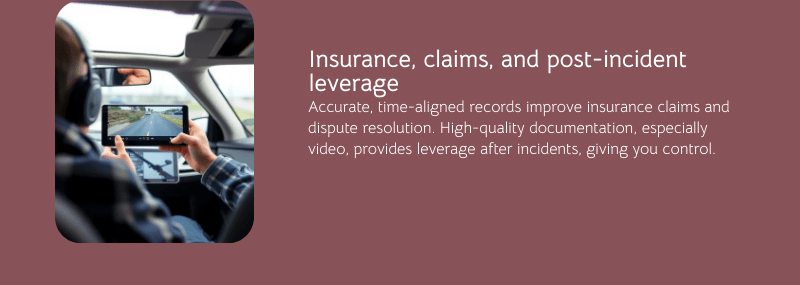
Insurance, claims, and post-incident leverage
Fleet management solutions influence downstream outcomes beyond daily operations. Insurance claims, legal exposure, and dispute resolution all benefit from accurate, time-aligned records. Documentation quality often determines leverage after an incident.
Video-supported incident records strengthen this position by preserving context that written reports cannot fully capture. Fleets gain greater control over narratives that would otherwise be externally defined.
Scalability across mixed vehicle types and use cases
Many fleets operate mixed vehicles, routes, and duty cycles. Fleet management solutions must scale across these variables without fragmenting data. Systems that support configurable policies maintain consistency while adapting to operational differences.
Dashcams scale effectively across vehicle classes because video relevance does not depend on route complexity or duty cycle. This universality reinforces their role within broader fleet systems.
Long-term maturity versus short-term optimization
Short-term gains from fleet management solutions often come from visibility improvements. Long-term maturity comes from institutionalizing data-driven behavior. Fleets that reach this stage treat systems as operational infrastructure rather than technology projects.
Dashcams play a sustained role at higher maturity levels by continuing to surface context as conditions change. Their value compounds as historical footage informs training, planning, and policy evolution.
Fleet Management Solutions – Frequently Asked Questions
What are fleet management solutions used for?
Fleet management solutions are used to centralize vehicle, driver, safety, maintenance, and compliance operations into a unified system that supports informed decision-making.
Do fleet management solutions include dashcams?
Many modern fleet management solutions incorporate dashcams as a core component because video provides objective context for incidents, driver behavior, and risk assessment.
How do fleet management solutions improve safety?
They improve safety by monitoring driver behavior, documenting incidents with evidence, enabling targeted coaching, and identifying recurring risk patterns.
Are fleet management solutions only for large fleets?
Fleet management solutions are used by fleets of all sizes, though the operational impact becomes more pronounced as fleet complexity increases.
What is the difference between telematics and fleet management solutions?
Telematics collects vehicle data, while fleet management solutions interpret that data and connect it to workflows, policies, and decisions.
How long does it take to see value from fleet management solutions?
Value typically emerges as systems become embedded in daily operations rather than treated as reporting tools.
Do fleet management solutions reduce operating costs?
They enable cost control by improving visibility and decision-making, which leads to fewer incidents, optimized maintenance, and better utilization.