Dash Cams for Refrigerated Trucks in Food Transport
What dash cams for refrigerated trucks actually mean in food logistics
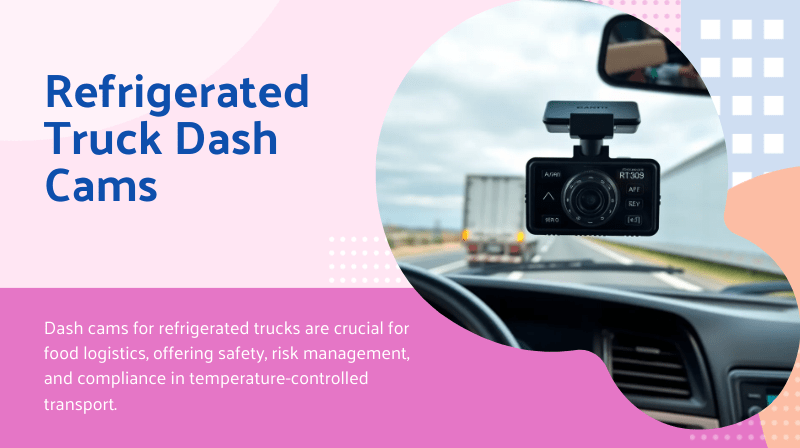
Dash cams for refrigerated trucks are vehicle camera systems designed to monitor driving activity, cargo conditions, and operational compliance within temperature-controlled transport fleets. Unlike standard commercial dash cameras, refrigerated truck systems must support continuous operation, multi-camera integration, and compatibility with telematics and temperature monitoring platforms.
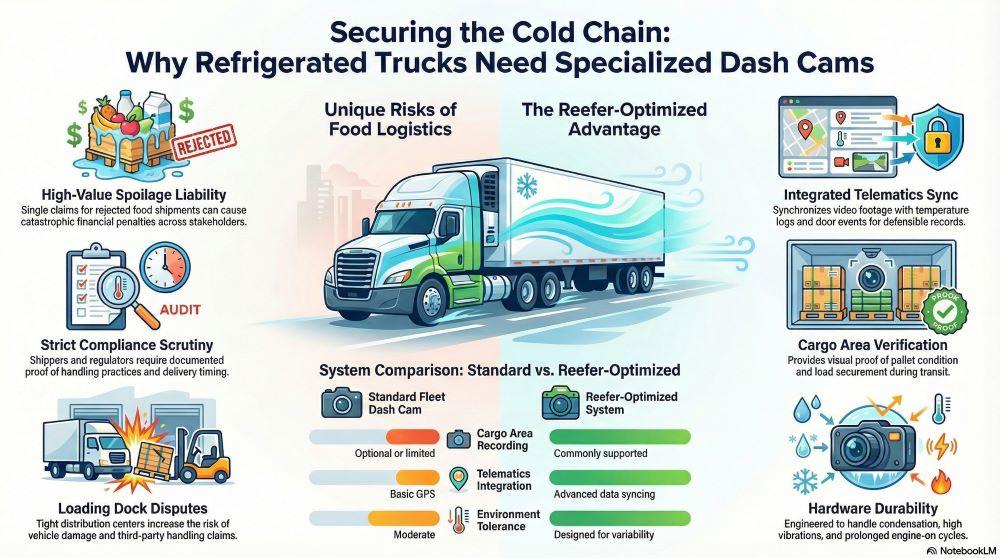
Food and beverage transport introduces elevated liability exposure. Spoilage claims, cold-chain failures, cross-contamination disputes, and delivery timing conflicts increase documentation requirements. Camera systems in this segment serve as both a safety tool and a risk verification asset.
Refrigerated fleets operate in higher scrutiny environments. Grocery chains, food distributors, pharmaceutical shippers, and restaurant supply networks often require documented compliance. Camera footage provides defensible evidence when disputes arise.
Why refrigerated fleets face unique risk exposure
Refrigerated trucking carries higher financial and regulatory risk than general freight hauling. Cargo value is often time-sensitive and perishable, and liability does not end at vehicle safety.
The following risk categories are common in temperature-controlled logistics:
- Temperature deviation disputes during transit
- Allegations of delayed delivery affecting product integrity
- Cross-dock or warehouse damage claims
- Driver behavior incidents affecting insurance premiums
- Cold-chain compliance audits
- Cargo contamination accusations
Unlike dry van operations, a single claim can affect supplier contracts. A rejected food shipment can cascade into financial penalties across multiple stakeholders.
Dash camera systems reduce uncertainty in these scenarios by preserving objective records.
Operational impact of camera systems in cold-chain transport
Dash cam deployment directly influences operational stability in refrigerated fleets. The effect is not limited to accident documentation.
Primary operational impacts include:
- Reduced insurance disputes through verified footage
- Faster incident resolution timelines
- Driver accountability improvement
- Enhanced delivery verification
- Reduced fraudulent cargo damage claims
- Safer reversing and docking procedures
Insurance carriers increasingly evaluate fleets based on risk mitigation tools. Documented safety technology often stabilizes premium volatility.
Camera visibility also discourages unsafe maneuvering in tight loading docks common in food distribution centers.
Front-facing versus dual-facing cameras in reefer trucks
Front-facing cameras document roadway events. Dual-facing cameras document both roadway and driver behavior.
The primary differentiator is liability scope.
| Camera Type | Primary Function | Risk Mitigation Scope |
| Front-Facing | Records road events and collisions | External liability |
| Dual-Facing | Records road and in-cab driver activity | External + internal |
| Multi-Camera | Includes side/rear/cargo coverage | Full operational |
Refrigerated fleets often prefer dual-facing or multi-camera systems. Food distribution contracts may require driver conduct verification during high-value deliveries.
Driver monitoring does not imply surveillance. It supports coaching, distraction reduction, and compliance documentation.
What determines dash cam effectiveness in refrigerated trucks
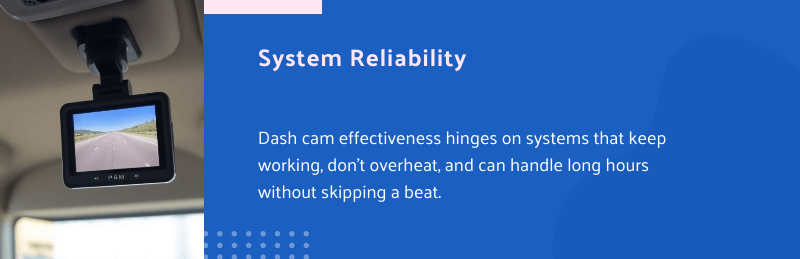
Dash cam effectiveness depends on system reliability, integration depth, and storage capability.
The following factors determine performance quality:
- Continuous recording without overheating
- High dynamic range for low-light docks
- Cloud-based video retrieval
- Tamper resistance
- GPS integration
- Event-triggered clip protection
- Expandable channel support
Refrigerated trucks frequently operate in overnight schedules. Systems must handle prolonged engine-on time without performance degradation.
Video resolution alone does not determine effectiveness. Stability and retrieval speed determine fleet value.
Integration with telematics and temperature monitoring systems
Camera systems become significantly more valuable when integrated with telematics and reefer monitoring platforms.
Integration enables correlation between:
- Temperature logs
- Door open/close events
- Vehicle speed
- Idle duration
- Harsh braking events
- Route deviations
Cold-chain compliance increasingly demands verifiable documentation. A temperature fluctuation claim becomes defensible when synchronized with time-stamped video.
Without integration, fleets must manually reconcile systems. Integrated architecture reduces administrative overhead.
Cargo-area camera considerations for perishable transport
Cargo cameras provide documentation of product condition during loading and unloading.
They support:
- Pallet condition verification
- Load securement documentation
- Door activity confirmation
- Theft deterrence
- Cross-dock accountability
Food distribution centers often involve third-party handlers. Video evidence clarifies responsibility in case of rejected shipments.
Cargo cameras must operate in low-light, vibration-heavy conditions. Temperature fluctuations also affect hardware durability.
Compliance visibility in regulated food transport
Food transport compliance extends beyond driver logs and ELD systems. Documentation increasingly requires visual verification.
Dash cameras assist in:
- Delivery time validation
- Handling practice verification
- Driver hygiene compliance in some operations
- Accident reconstruction
- Incident documentation for regulators
Refrigerated carriers operating under federal and state oversight benefit from objective records during audits.
Camera footage does not replace compliance systems. It reinforces them.
Insurance leverage and claims defense in refrigerated fleets
Insurance exposure in food transport often exceeds standard freight due to cargo value.
Dash cameras influence claims outcomes by:
- Providing accident reconstruction clarity
- Disproving staged collision claims
- Validating driver reaction time
- Confirming environmental conditions
- Reducing settlement ambiguity
Insurance adjusters prioritize objective footage. Fleets without documentation rely solely on testimony.
Over time, claims reduction impacts long-term fleet economics.
Storage architecture and data retention standards
Refrigerated fleets require structured data retention policies. Video storage must balance accessibility and compliance duration.
Key storage models include:
- On-device SD storage
- Cloud-managed storage
- Hybrid storage systems
Cloud systems allow centralized fleet management. Hybrid models provide redundancy during connectivity loss.
Retention periods vary by fleet policy, but high-value food transport often benefits from extended archival windows.
Selecting a solution for food and beverage fleets
Food and beverage fleets require a dash cam system engineered for temperature-controlled logistics rather than generic trucking use.
CommercialDashcams.com provides camera systems tailored specifically to refrigerated and food distribution operations. Solutions include multi-channel configurations, cloud-based video retrieval, GPS integration, and compatibility with broader fleet monitoring systems.
Systems offered support:
- Front, cabin, and cargo cameras
- Real-time fleet oversight
- Centralized management dashboards
- Expandable channel options
- Durable hardware suitable for long-haul reefer routes
For refrigerated fleets seeking a structured, compliance-aligned camera system, category-specific deployment ensures operational alignment.

Edge cases refrigerated fleets must account for
Refrigerated truck camera deployment includes unique operational variables.
Common edge considerations:
- Condensation exposure during dock loading
- Extended idle time affecting power draw
- Night-shift operations
- Cross-border documentation requirements
- Mixed dry and temperature-controlled routes
Hardware durability and electrical configuration must support these realities.
Improper installation can compromise footage integrity.
Return on investment in cold-chain camera deployment
ROI in refrigerated fleets derives from risk reduction rather than fuel efficiency or route optimization alone.
Primary ROI drivers include:
- Fewer disputed cargo claims
- Faster insurance case resolution
- Reduced fraudulent third-party claims
- Improved driver retention through coaching
- Lower litigation exposure
Food distribution networks operate on contract reliability. Documentation strengthens contractual standing.
Camera systems represent defensive infrastructure.
Dash cam features refrigerated truck operators search for most
Refrigerated truck operators most often search for reliability, remote access, and multi-camera capability when evaluating dash cam systems. Search behavior consistently centers on durability in temperature-controlled environments and the ability to defend cargo claims.
Common high-intent search themes include:
- “Best dash cam for refrigerated trucks”
- “Fleet dash cams for food delivery trucks”
- “Reefer truck camera system with GPS”
- “Dash cam with cargo camera for box truck”
- “Commercial dash cam for cold chain transport”
- “Food transport vehicle monitoring system”
These queries indicate buyers are not looking for basic consumer-grade equipment. Fleet managers are evaluating infrastructure-level systems designed for operational accountability.
Camera selection in this segment is driven by risk management priorities rather than driver convenience.
Best dash cam features for food delivery and reefer trucks
The most effective dash cam systems for refrigerated trucks prioritize resilience, integration, and scalability.
Core features that align with frequent buyer searches include:
- Wide-angle, high-dynamic-range lenses for dock lighting
- Multi-channel recording for front, cabin, and cargo areas
- GPS tracking with route history playback
- Event-triggered uploads during harsh braking or collisions
- Secure cloud-based video access
- Lockable hardware to prevent tampering
Food delivery operations frequently involve dense urban routing. Dock congestion, tight reversing conditions, and high pedestrian exposure increase incident probability.
System responsiveness and clip retrieval speed matter more than raw video resolution. Fleet managers need access to footage within minutes, not hours.
Reefer truck camera systems versus standard fleet dash cams
Reefer truck camera systems differ from standard fleet dash cams in environmental durability and documentation scope.
The primary distinctions are outlined below:
| Capability Area | Standard Fleet Dash Cam | Reefer-Optimized System |
| Cargo Area Recording | Optional or limited | Commonly supported |
| Integration with Telematics | Basic GPS | Advanced data syncing |
| Cold-Environment Tolerance | Moderate | Designed for variability |
| Extended Idle Operation | Not always optimized | Continuous operation |
| Multi-Camera Expansion | Limited | Designed for expansion |
Refrigerated trucks operate under longer engine-on cycles. Idle time during dock loading is common, and electrical stability must be maintained.
Systems not designed for commercial reefer conditions may experience performance degradation over time.
Video documentation in food transport accident claims
Video documentation significantly strengthens defense in food transport accident claims.
Refrigerated fleets benefit in the following claim scenarios:
- Multi-vehicle highway collisions
- Low-speed dock incidents
- Alleged sudden lane changes
- Rear-end collisions in urban routes
- Pedestrian interaction disputes
Objective footage eliminates conflicting narratives. Claims resolution accelerates when video evidence removes ambiguity.
Food distributors often operate on strict service-level agreements. Faster claim resolution protects vendor relationships.
Monitoring driver behavior in temperature-controlled transport
Driver behavior monitoring improves safety consistency in refrigerated fleets.
Behavior monitoring supports:
- Distraction reduction
- Speed adherence
- Safer following distance
- Compliance with delivery protocols
- Reduced harsh braking events
Coaching programs become data-driven when supported by video. Fleets move from reactive discipline to structured performance improvement.
Behavioral accountability reduces risk exposure in dense delivery environments.
Food and beverage fleet compliance visibility
Food and beverage fleet compliance increasingly includes verifiable operational transparency. Search queries such as “cold chain compliance monitoring” and “food transport safety monitoring system” show rising regulatory awareness.
Dash cams reinforce compliance documentation by:
- Confirming on-time delivery arrivals
- Validating dock handling procedures
- Recording driver interaction with receiving facilities
- Supporting cold-chain documentation during disputes
Video does not replace temperature sensors. Video provides contextual evidence when temperature data is questioned.
Contractual compliance strengthens when operational visibility is layered.
Multi-camera systems for box trucks and refrigerated straight trucks
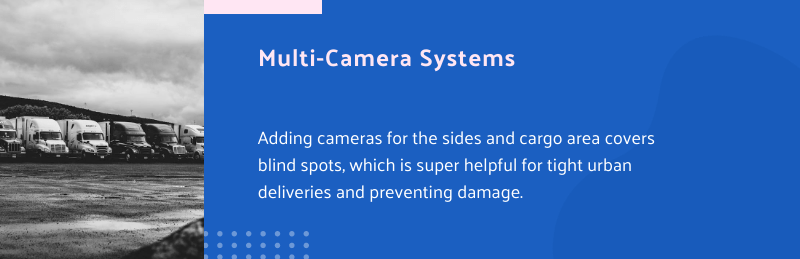
Multi-camera systems address blind spots common in refrigerated straight trucks and box trucks.
Expanded coverage typically includes:
- Front road-facing camera
- In-cab driver-facing camera
- Rear cargo or backup camera
- Optional side-view cameras
Urban grocery and restaurant delivery routes involve tight alleyways and congested commercial zones. Side impact incidents frequently occur during low-speed maneuvers.
Comprehensive camera coverage reduces avoidable risk during complex delivery patterns.
Cloud-based fleet video management for reefer operations
Cloud-based fleet video management supports centralized oversight across distributed refrigerated fleets.
Cloud systems enable:
- Immediate remote video retrieval
- Centralized policy enforcement
- Automated event alerts
- Fleet-wide performance reporting
- Secure archival storage
Refrigerated carriers often operate across regional territories. Cloud architecture eliminates dependency on manual SD card retrieval.
Real-time oversight enhances executive visibility into risk exposure.
Evaluating long-haul versus regional refrigerated fleet needs
Long-haul refrigerated fleets and regional food delivery operations require different camera configurations.
Long-haul priorities include:
- Extended storage capacity
- Stable long-duration recording
- Highway incident documentation
- Cross-state compliance documentation
Regional delivery priorities include:
- Urban maneuver visibility
- Dock interaction documentation
- Pedestrian risk mitigation
- Frequent stop-and-go monitoring
Fleet configuration must align with route structure.
Cold chain liability documentation as competitive advantage
Cold chain liability documentation strengthens a fleet’s competitive standing in food distribution contracts.
Shippers increasingly prioritize carriers with structured monitoring infrastructure. Dash camera deployment demonstrates operational maturity.
Documentation provides confidence to grocery chains, distributors, and institutional buyers. Risk transparency becomes part of vendor evaluation criteria.
Refrigerated trucking increasingly requires documented operational integrity rather than assumed compliance.
Dash Cams for Refrigerated Trucks – People Also Ask
Are dash cams required for refrigerated trucks?
Dash cams are not universally mandated for refrigerated trucks, but many food distribution contracts and insurance carriers strongly recommend or incentivize camera deployment due to elevated cargo risk.
Do refrigerated trucks need cargo cameras?
Cargo cameras are not legally required in most jurisdictions, but they provide valuable documentation during loading and unloading and help defend against product damage claims.
Can dash cams record temperature data?
Dash cams do not independently measure temperature, but integrated systems can synchronize video with telematics and reefer temperature logs to create verifiable compliance records.
How long should refrigerated fleets store video footage?
Video retention periods depend on fleet policy and contract requirements, but high-value food transport operations often benefit from extended storage to defend against delayed claims.
Do dash cams reduce insurance costs for reefer fleets?
Dash cams can influence insurance negotiations by reducing claim ambiguity and demonstrating proactive risk management, which may stabilize or improve long-term premium structures.
Are dual-facing cameras necessary for food transport?
Dual-facing cameras are not mandatory, but they provide additional protection by documenting driver behavior during high-liability delivery environments.