

Fleet Dashcams: Essential How-To Guide for Fleets
How to define the right fleet dashcam strategy from the outset
A fleet dashcam strategy is established by aligning safety goals, operational visibility, and risk exposure with the capabilities of a connected camera system. The objective is not simply to record footage, but to create a structured system for accountability and decision-making.
A clear strategy includes:
- Identifying primary use cases such as liability protection, driver coaching, or compliance
- Determining which vehicles require coverage and why
- Defining how footage will be reviewed and by whom
- Establishing acceptable use policies and internal governance
- Setting measurable outcomes tied to safety and operations
Without this foundation, even advanced systems become underutilized.
How to choose the right fleet dashcam system for your vehicles
The correct system is selected by matching vehicle type, operating conditions, and required visibility with the appropriate hardware and software configuration. Selection should reflect operational realities, not generalized feature lists.
Key decision criteria include:
- Number of cameras required per vehicle (forward, interior, side, rear)
- Video quality requirements based on driving conditions
- Connectivity needs for real-time versus delayed access
- Compatibility with existing fleet management systems
- Durability requirements for environmental conditions
A system that is too basic limits insight. A system that is overly complex creates unnecessary friction.
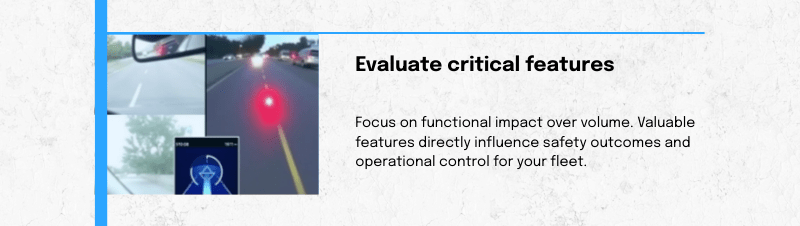
How to evaluate critical features before making a purchase decision
Feature evaluation should focus on functional impact rather than feature volume. The most valuable features are those that directly influence safety outcomes and operational control.
Core features to prioritize:
- High-definition video clarity under varying light conditions
- Reliable event detection for unsafe driving behaviors
- Cloud-based storage and centralized access
- GPS tracking with accurate location data
- Real-time alerts for critical incidents
- Secure data access and permission controls
Additional features should be considered only after core requirements are satisfied.
How to properly install fleet dashcams across multiple vehicles
Fleet dashcam installation requires consistency, precision, and standardized procedures to ensure reliable performance across all vehicles. Improper installation introduces long-term data gaps and hardware issues.
A structured installation approach includes:
- Mounting cameras with unobstructed and consistent field of view
- Connecting to stable power sources within the vehicle
- Securing wiring to prevent wear or interference
- Configuring connectivity and system activation
- Validating video quality and event detection functionality
Installation consistency across the fleet
Uniform installation is critical for reliable data:
- Use defined mounting positions for each vehicle class
- Document installation procedures for repeatability
- Conduct post-installation audits to confirm alignment
Consistency ensures that footage is usable and comparable across vehicles.
How to configure system settings for operational effectiveness
System configuration determines how effectively the dashcam performs in real-world conditions. Default settings rarely align with specific fleet needs.
Key configuration elements include:
- Event sensitivity thresholds for braking, acceleration, and impact
- Recording parameters such as resolution and frame rate
- Data upload settings based on connectivity availability
- Alert triggers and notification routing
- User permissions and access controls
Proper configuration reduces noise while ensuring critical events are captured and surfaced.
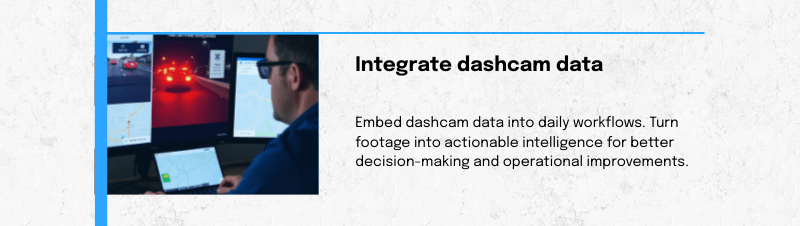
How to integrate dashcam data into daily fleet operations
Dashcam data becomes valuable when it is embedded into daily workflows rather than treated as a passive archive. Operational integration turns footage into actionable intelligence.
Common integration points include:
- Daily review of flagged driving events
- Use of footage in safety meetings and coaching sessions
- Cross-referencing incidents with route and dispatch data
- Monitoring adherence to company driving policies
- Supporting internal investigations and reporting
Consistency in usage drives measurable improvements over time.
How to onboard drivers without creating resistance
Driver onboarding succeeds when dashcams are positioned as a safety and protection tool rather than a surveillance mechanism. Clear communication reduces resistance and improves adoption.
Effective onboarding practices include:
- Explaining the purpose and benefits in practical terms
- Demonstrating how footage protects drivers in disputes
- Clarifying when and how recording occurs
- Outlining data usage and access policies transparently
- Providing opportunities for questions and feedback
Trust is established through clarity, not enforcement.
How to stay compliant with privacy and recording regulations
Compliance is achieved by aligning recording practices with legal requirements and internal policies. Non-compliance introduces unnecessary risk.
Essential compliance actions include:
- Documenting driver consent where required
- Defining clear data retention policies
- Limiting access to authorized personnel
- Communicating recording practices to all stakeholders
- Adjusting settings for jurisdictions with stricter privacy laws
Interior camera considerations
Interior recording requires additional control:
- Limit activation to specific events where possible
- Avoid continuous monitoring unless operationally justified
- Clearly communicate purpose and boundaries
Compliance must be built into system design, not added later.
How to manage and review footage efficiently at scale
Efficient footage management prevents data overload and ensures that critical events receive attention. Scale requires prioritization and structured workflows.
A practical review framework includes:
- Using event-based triggers to filter footage
- Assigning responsibility for review and escalation
- Establishing timelines for incident review
- Categorizing events by severity and action required
- Archiving or deleting footage based on retention policies
Manual review without structure quickly becomes unsustainable.
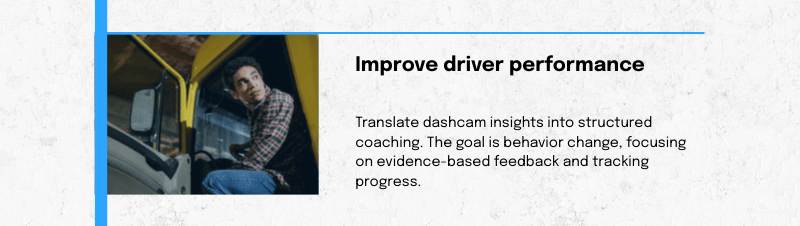
How to use dashcam insights to improve driver performance
Driver performance improves when insights are translated into structured coaching rather than isolated feedback. The goal is behavior change, not surveillance.
Effective performance management includes:
- Identifying recurring risky behaviors
- Providing targeted, evidence-based coaching
- Tracking improvement over time
- Recognizing safe driving patterns
- Aligning performance metrics with company policies
Consistency in feedback creates long-term behavioral shifts.
How to measure return on investment from fleet dashcams
ROI is measured through reductions in risk, operational inefficiencies, and administrative overhead. The value is cumulative and becomes more visible over time.
Primary indicators include:
- Reduction in accident-related costs
- Decrease in disputed claims
- Time saved in incident investigations
- Improvements in driver behavior metrics
- Enhanced operational visibility across the fleet
Structured ROI evaluation
A clear evaluation model includes:
| Metric Category | Pre-Implementation Baseline | Post-Implementation Indicator |
| Incident Frequency | Historical average | Reduced occurrence rate |
| Claims Resolution | Time and cost | Faster, evidence-based |
| Driver Behavior | Untracked or anecdotal | Measurable and improving |
Tracking these metrics ensures the system delivers measurable value.
How to avoid common mistakes that reduce system effectiveness
Most failures occur due to process gaps rather than technology limitations. Avoiding these mistakes preserves system value.
Common pitfalls include:
- Treating dashcams as passive recording devices
- Failing to establish review workflows
- Overloading teams with unfiltered data
- Neglecting driver communication and training
- Choosing hardware without long-term scalability
Avoidance requires intentional planning and consistent oversight.
How to scale a fleet dashcam system as operations grow
Scaling requires systems that maintain performance and usability as the number of vehicles increases. Growth introduces complexity that must be managed.
Scaling considerations include:
- Ensuring platform capacity for increased data volume
- Maintaining consistent installation and configuration standards
- Expanding review processes and responsibilities
- Integrating with broader fleet management systems
- Monitoring system performance across all vehicles
A scalable system evolves with the operation rather than limiting it.
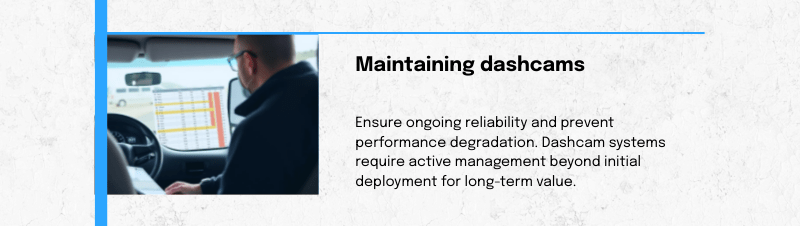
How to maintain and support fleet dashcams over time
Ongoing maintenance ensures reliability and prevents performance degradation. Dashcam systems require active management beyond initial deployment.
Maintenance practices include:
- Regular inspection of camera positioning and condition
- Updating firmware and software as needed
- Monitoring connectivity and data transmission
- Replacing aging or damaged hardware
- Auditing system performance periodically
Lifecycle management protects the long-term value of the system.
People Also Ask
How do you install a fleet dashcam system?
Installation involves mounting cameras correctly, connecting to vehicle power, configuring connectivity, and validating performance across all vehicles.
What features should a fleet dashcam have?
Essential features include high-quality video, GPS tracking, cloud storage, real-time alerts, and reliable event detection.
How do fleet dashcams improve safety?
They provide visibility into driving behavior, enable coaching, and create accountability through recorded evidence.
Are fleet dashcams difficult to manage?
They are manageable when supported by structured workflows and event-based filtering systems.
Do drivers accept dashcams easily?
Acceptance improves when the system is clearly positioned as a safety and protection tool.
How long should dashcam footage be stored?
Retention typically ranges from 30 to 90 days depending on operational and legal requirements.
Can fleet dashcams be integrated with other systems?
Yes, many platforms integrate with telematics, dispatch, and fleet management systems for broader visibility.