
Are Camera Systems Legal in Commercial Trucks?
What makes camera systems legal or illegal in commercial trucks
Camera systems are legal in commercial trucks when their placement, function, and use comply with transportation safety rules, privacy laws, and employer monitoring standards. Legality hinges on whether the system interferes with driver visibility, unlawfully records audio, or violates reasonable expectations of privacy. Most disputes arise not from the presence of cameras, but from how data is captured, stored, and used.
Regulators generally accept cameras as safety devices rather than surveillance tools when they are clearly tied to accident prevention, driver protection, or incident documentation. Problems surface when systems are installed without notice, record continuously in private contexts, or collect information unrelated to vehicle operation. Compliance is therefore functional, not symbolic, and depends on execution rather than intent.
Why regulators allow cameras inside and outside commercial vehicles
Cameras are permitted because they address documented safety and liability gaps inherent in commercial driving. Large vehicles have blind spots, long stopping distances, and disproportionate exposure to claims after collisions. Video evidence clarifies fault, discourages unsafe behavior from surrounding motorists, and supports consistent enforcement of safety standards.
From a regulatory standpoint, cameras do not replace driver responsibility or mechanical compliance. They are treated as passive recording devices that supplement existing rules rather than override them. Acceptance is rooted in their alignment with roadway safety objectives, not in fleet management convenience.
Windshield placement rules and visibility constraints
Cameras are legal only if they do not obstruct the driver’s view of the road. Most jurisdictions restrict objects on windshields to narrow zones near the top center or passenger side, often defined by inches from the edge or percentage of glass coverage. A camera that blocks sightlines, mirrors, or warning indicators can render an otherwise compliant system illegal.
Enforcement focuses on visibility impact rather than device type. A small forward-facing camera placed improperly can violate the same rules as oversized decals or hanging accessories. Fleets are responsible for installation accuracy, not just equipment selection.
How mounting location affects compliance
Mounting behind rearview mirrors or within manufacturer-approved sensor housings generally meets visibility standards. Problems arise when aftermarket installs ignore cab geometry or driver height variability. A compliant mount for one driver may obstruct another if adjustability is not considered.
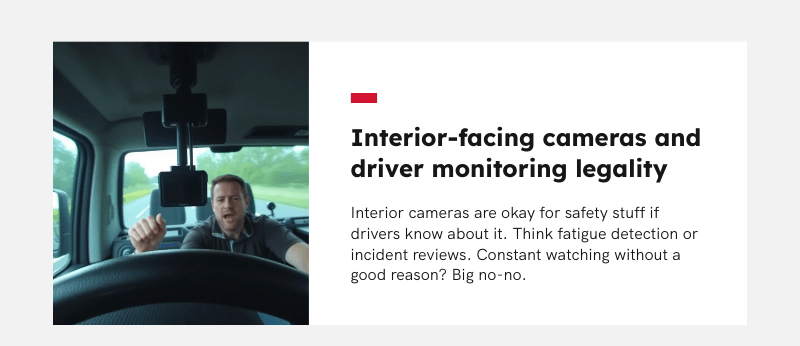
Interior-facing cameras and driver monitoring legality
Interior-facing cameras are legal when they are used for safety-related purposes and drivers are properly informed. These systems are often justified for fatigue detection, incident reconstruction, or training review following specific events. Continuous behavioral surveillance without a safety rationale raises legal and labor concerns.
The key legal distinction lies between event-triggered recording and constant monitoring. Systems that activate during hard braking, collisions, or safety alerts are viewed more favorably than those recording uninterrupted footage. Transparency and proportionality determine acceptability.
When driver consent becomes a requirement
Consent requirements vary by jurisdiction and by what the camera records. Video-only interior cameras often require notice but not explicit consent, while audio recording typically triggers stricter consent standards. Fleets must distinguish between implied consent through employment policies and explicit consent required by law.
Audio recording restrictions that frequently cause violations
Audio recording is the most common reason camera systems become illegal. Many regions prohibit recording conversations without consent from one or all parties, regardless of location. A camera that captures sound inside the cab can therefore violate wiretapping or eavesdropping laws even if video recording is lawful.
Because of this risk, many commercial camera systems disable audio by default. Fleets that enable sound recording must implement jurisdiction-specific consent procedures and ensure drivers understand when audio is active. Failure to manage this detail exposes operators to significant penalties.
Federal oversight versus state-level enforcement differences
In the United States, federal transportation authorities focus on vehicle safety and operational standards, not privacy enforcement. States retain authority over privacy, consent, and employment monitoring rules, creating a fragmented compliance landscape. A camera legal in one state may violate rules in another depending on recording scope.
This division requires fleets operating across state lines to adopt the most restrictive applicable standard. Uniform policies reduce risk, while state-by-state configurations increase administrative burden and error potential.
Cross-border operations and compliance risk
Interstate carriers face heightened exposure because enforcement can occur where the vehicle is stopped, not where the company is based. A lawful installation at headquarters does not protect against violations elsewhere. Conservative configuration is often the only scalable approach.
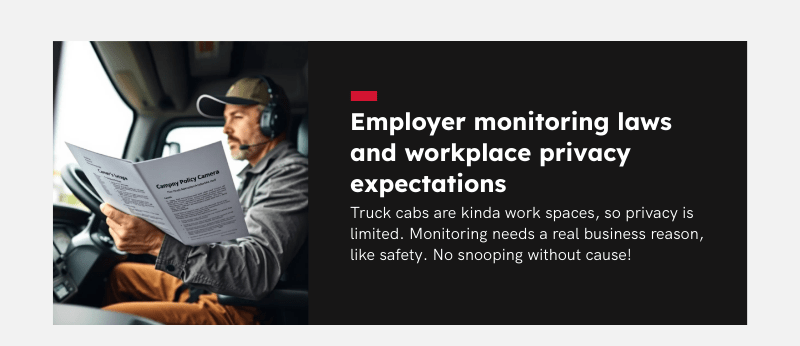
Employer monitoring laws and workplace privacy expectations
Commercial truck cabs occupy a gray area between workplace and private space. Courts often treat them as workplaces, which limits privacy expectations, but not as spaces devoid of personal rights. Monitoring must relate to legitimate business interests such as safety, compliance, or asset protection.
Employers who use cameras for discipline unrelated to safety, or who access footage without cause, risk claims of invasive monitoring. Clear policy boundaries and documented use cases are essential to sustain legality.
How notice and disclosure determine legality
Notice is a cornerstone of lawful camera use. Drivers must be informed that cameras exist, what they record, when they activate, and how footage may be used. Disclosure transforms monitoring from covert surveillance into acknowledged safety practice.
Written policies, onboarding acknowledgments, and visible cab signage strengthen compliance. Silence or ambiguity undermines legality even if the hardware itself meets technical standards.
Data retention rules that affect camera compliance
Footage retention must be proportional to its purpose. Keeping video indefinitely without justification increases legal exposure, particularly if footage captures drivers during non-driving moments. Many fleets limit retention to days or weeks unless an incident occurs.
Retention policies should define deletion timelines, access controls, and audit trails. The longer data exists, the harder it becomes to defend its necessity.
Access control and internal misuse risk
Unauthorized viewing or sharing of footage can violate privacy laws even when recording is lawful. Restricting access to trained personnel and logging usage protects both drivers and employers.
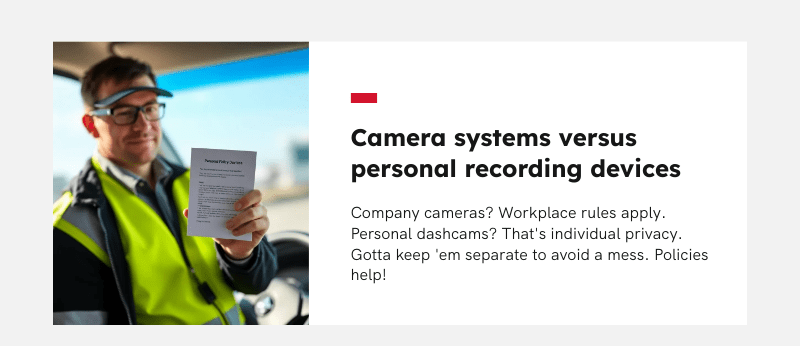
Camera systems versus personal recording devices
Fleet-installed cameras differ legally from personal dashcams or mobile phones used by drivers. Employer-owned systems fall under workplace monitoring rules, while personal devices implicate individual consent and privacy obligations. Conflicts arise when drivers install their own cameras without company approval.
Employers may restrict personal recording devices to avoid inconsistent compliance. Clear policies help prevent disputes over ownership, evidence, and liability.
Litigation, evidence admissibility, and camera legality
Lawful cameras produce admissible evidence that can resolve claims efficiently. Illegally obtained footage may be excluded or trigger counterclaims, negating its value. Courts often scrutinize how footage was captured more than what it shows.
Compliance therefore has direct financial implications. A system that reduces accidents but creates legal exposure fails its intended purpose.
Insurance perspectives on truck camera legality
Insurers generally support camera use when systems meet legal standards. Footage can accelerate claims resolution and reduce fraud. However, insurers may deny benefits or increase premiums if camera practices violate laws and increase litigation risk.
Insurance alignment reinforces the importance of compliant configuration rather than maximal recording capability.
International considerations for non-domestic fleets
Outside the United States, privacy frameworks are often stricter. Some regions treat driver video as personal data subject to enhanced protections. Consent, data minimization, and cross-border data transfer rules can apply.
Fleets operating internationally must reassess assumptions that apply domestically. What is routine in one country may be restricted in another.
Common misconceptions about legality and cameras
Cameras are often assumed illegal because they feel intrusive, or universally legal because they are widespread. Both assumptions are flawed. Legality is conditional, not categorical.
Another misconception is that legality depends on whether drivers object. In reality, compliance depends on statutory standards, not individual comfort, though objections can signal policy weaknesses.
Practical indicators that a camera system is compliant
A compliant system is unobtrusive, purpose-limited, and transparent. It avoids audio recording unless explicitly required and permitted. It activates based on safety triggers rather than continuous monitoring.
Policies exist, drivers are informed, and data is controlled. These operational signals matter more than brand or feature set.
Evaluating legality during procurement decisions
Legal compliance should be assessed before installation, not after disputes arise. Procurement teams must review camera specifications, default settings, and configurability against applicable laws.
Legal review at this stage prevents costly retrofits or system abandonment. The cheapest system can become the most expensive if it cannot be configured lawfully.
Future regulatory trends affecting truck camera systems
Regulation is trending toward clearer acceptance of video paired with stronger privacy safeguards. Expect tighter rules around data use, retention, and algorithmic monitoring rather than outright bans on cameras.
Fleets that design policies around restraint and transparency will adapt more easily than those relying on permissive interpretations.
Frequently Asked Questions
Are dash cameras legal in commercial trucks in all states?
Dash cameras are generally legal, but legality depends on placement, recording scope, and state privacy laws. Audio recording and improper windshield mounting are common sources of violations.
Can trucking companies record drivers at all times?
Continuous recording is legally risky and often discouraged. Event-based or safety-triggered recording is more defensible under workplace monitoring standards.
Is driver consent required for in-cab cameras?
Notice is usually required, while explicit consent depends on jurisdiction and whether audio is recorded. Written acknowledgment is commonly used to demonstrate compliance.
Are camera systems allowed to record when the truck is parked?
Recording during off-duty periods can raise privacy concerns. Many fleets disable interior recording when vehicles are parked or drivers are off duty.
Can camera footage be used to discipline drivers?
Footage can be used when discipline relates to safety or policy violations disclosed in advance. Using footage for unrelated monitoring increases legal risk.
Do camera systems violate driver privacy laws?
They can if implemented improperly. Lawful systems balance safety objectives with reasonable privacy expectations and clear limitations.
Are audio-enabled cameras legal in commercial trucks?
Audio recording is often restricted and may be illegal without consent. Many compliant systems disable audio entirely.