
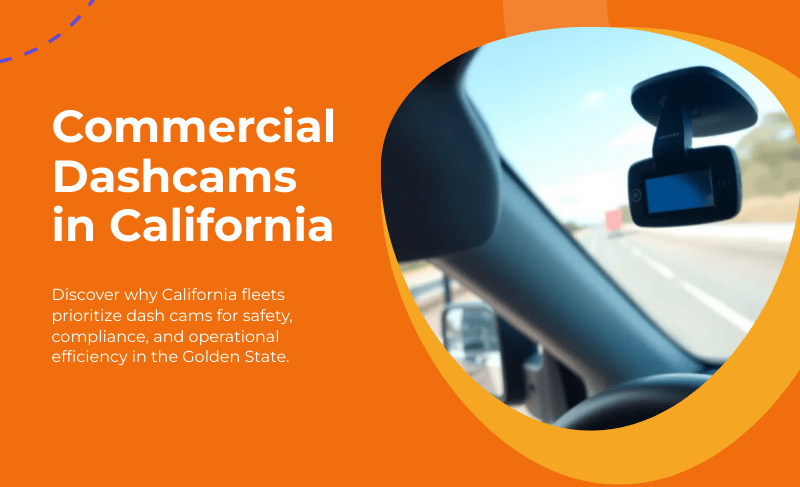
Commercial Dash Cams in California: Requirements, Standards, and Choosing the Right System
Why California Fleets Prioritize Commercial Dash Cams
Commercial dash cams have become a core operational tool across California’s transportation, delivery, logistics, and field-service sectors. Companies rely on them to document road activity, reduce liability exposure, strengthen training, and meet internal safety benchmarks. In California, the use of dash cams is shaped not only by operational needs but also by legal considerations that require clear, compliant practices.
Fleets install these systems to create a consistent record of vehicle movement, driving events, and roadway interactions. This documentation provides clarity when incidents occur and gives fleets a stable foundation for resolving disputes with insurers, regulators, or other parties. Many organizations deploy dash cams as part of larger risk-management programs because uninterrupted visibility improves accountability and defensive-driving performance.
As California traffic density increases and delivery timelines tighten, visual data gives companies greater command over daily operations. Dash cams serve as a direct link between fleet managers and the realities of the road, creating a real-time operational asset rather than a passive recording tool.
The Role of Dash Cams in California’s Commercial Transportation Environment
California’s transportation landscape presents challenges that make visual monitoring essential. Congestion, complex freeway systems, high-risk traffic zones, and frequent lane-change conflict areas increase exposure to avoidable incidents. Commercial drivers face demanding environments where precise maneuvering and constant situational awareness are required.
Dash cams help companies establish consistency across their fleet’s on-road behavior. Footage shows how drivers respond to merging traffic, aggressive braking patterns, pedestrian zones, and construction areas. Managers track these patterns to identify behaviors that need reinforcement or correction. A data-driven safety program becomes more accurate when supported by video rather than subjective interpretation.
Fleets also integrate dash cams into claims management workflows. Visual evidence shortens investigation timelines and reduces the frequency of contested claims. When footage verifies a driver’s account, the company gains a defensible position during insurance reviews. Insurers increasingly recognize the value of camera-verified incidents because they eliminate ambiguity and accelerate settlement decisions.
California’s Regulatory Environment for Fleet Dash Cams
California allows commercial vehicles to use dash cams, but the use must follow established privacy and safety rules. These rules govern placement, visibility, driver awareness, and the limits of onboard monitoring.
Dash cams must be installed in a way that avoids obstructing the driver’s primary field of view. California transportation rules specify that any equipment on the windshield must stay within designated mounting zones that preserve road visibility. Fleets typically mount cameras behind the rearview mirror or in the far corners of the windshield where they do not interrupt driver sight lines.
Driver awareness is a consistent requirement. California expects employers to notify drivers of any in-cab recording or monitoring devices. Most commercial fleet policies include written acknowledgment during onboarding, ensuring operators understand what is being recorded and how footage is used.
When dash cams include audio recording, fleets must follow California’s consent requirements. This reinforces the importance of clear internal policies, training documentation, and operational transparency. Fleets that maintain straightforward guidelines avoid compliance complications and reinforce good working relationships with drivers.
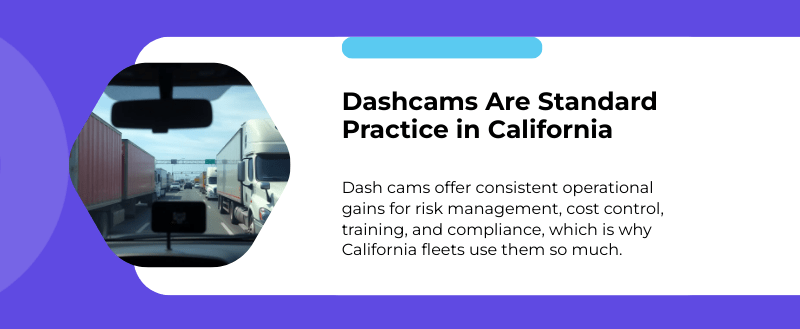
Why Commercial Fleet Dash Cams Are Increasingly Standard in California
Fleets adopt commercial dash cams because the systems deliver consistent operational gains. These gains appear across risk management, cost control, training, and compliance.
Dash cams reduce uncertainty in event reconstruction. Managers evaluate collisions, near-misses, and roadside interactions with reliable documentation. This allows them to determine whether an incident arises from external factors or driver error. Fleets use this information to adjust training expectations and reinforce behaviors that improve long-term performance.
Commercial dash cams also strengthen customer engagement. Delivery-based organizations rely on accurate timelines and verifiable arrival data. Video confirmation supports delivery claims, helps resolve customer questions, and provides clarity when timelines are disputed. This protects the company from unnecessary service credits or chargebacks.
For fleets with complex routing patterns, video verification supports route accuracy. Managers use footage to evaluate loading zones, drop-off access points, and areas where drivers face recurrent obstacles. These insights help refine routing strategies and reduce avoidable delays.
Characteristics of the Best Commercial Dash Cams in California
The systems that consistently perform well for California fleets share common functional characteristics. These features support high-traffic environments, extended driving hours, and varied operating conditions found across the state.
Core characteristics include:
- High-resolution front-facing capture for clear incident replay
- Integrated driver-facing cameras when behavior coaching is needed
- Infrared or low-light capability for night operations
- Secure cloud storage with controlled access
- Reliable event-based recording triggered by braking, impact, or rapid acceleration
- Strong in-vehicle connectivity for real-time upload
- Tamper-resistant housings and stable mounting hardware
- Systems designed to withstand heat exposure in California’s summer climate
The best systems maintain stable performance during long driving shifts and deliver consistent footage regardless of lighting or weather. High-quality dash cams also include advanced compression technology to preserve video quality while minimizing storage requirements.
How California Fleets Evaluate Dash Cam Reliability
Reliability is a primary consideration because commercial vehicles operate in demanding conditions. Fleets assess dash cam durability by reviewing how well the system holds up under continuous vibration, temperature swings, and frequent ignition cycles.
A reliable system produces uninterrupted footage without frame loss, audio distortion, or unexpected power failures. Consistency ensures managers receive complete video files when incidents occur. Gaps in recording create vulnerability during claims evaluation or risk assessments, making reliability a defining factor in purchasing decisions.
Fleets also evaluate how well the system integrates with existing telematics platforms. A dependable dash cam provides synchronized time stamps, stable GPS data alignment, and seamless upload behavior. When video integrates cleanly with telematics alerts, managers gain a unified view of fleet activity that supports rapid decision-making.
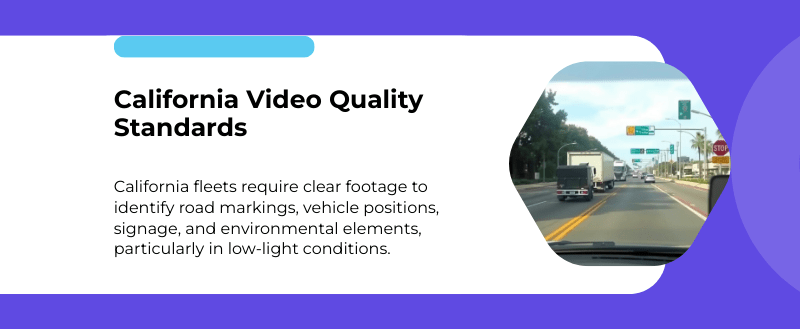
Video Quality Standards That Matter for California Fleets
Video clarity is essential for incident review. Footage must provide enough detail to identify road markings, vehicle positions, signage, and environmental elements. Systems with lower resolution often fail to verify key details in high-speed or low-light environments.
California’s road network includes tunnels, shaded corridors, and rapidly shifting daylight conditions. Good dynamic range helps cameras adjust to changing light so footage remains usable. Infrared functionality supports fleets that operate early mornings, evenings, or night shifts.
Commercial dash cams with wide-angle lenses capture more of the roadway without distorting critical details. A balanced field of view avoids blind spots while preserving depth perception and object clarity. These image standards help fleets reconstruct events with greater accuracy and confidence.
The Importance of Driver-Facing Dash Cams for Safety Programs
Some California fleets incorporate driver-facing dash cams to support coaching and safety development. These cameras record driver posture, distraction events, seat belt use, and overall cabin behavior. When used responsibly, the footage strengthens training programs and identifies risks that are difficult to detect through telematics data alone.
Driver-facing video is most effective when paired with clear communication and operational fairness. Fleets typically avoid punitive or overly broad use of interior footage. Instead, they focus on high-value behaviors that influence safety outcomes, such as phone use, drowsiness, or improper eye scanning.
When these systems help drivers improve technique rather than create tension, compliance levels remain high. Many fleets find that early engagement and open discussion lead to better adoption and long-term success.
Event-Triggered Recording and Real-Time Data Advantages
Event-triggered recording captures specific driving moments that indicate elevated risk. Commercial dash cams activate events during sudden braking, rapid changes in speed, lane deviations, or impact forces. These recordings pinpoint moments when something unusual occurred, helping managers understand the context surrounding the event.
Real-time upload allows supervisors to review critical incidents without waiting for vehicles to return to a depot. This accelerates internal responses, especially when companies need to contact drivers, reach involved third parties, or notify leadership. For fleets operating across California’s major highways, immediate visibility supports faster action during breakdowns, collisions, or roadside hazards.
Event-based data also helps create driver scorecards that reflect actual behavior rather than general assumptions. Training becomes more focused when coaching relies on verified patterns, improving efficiency and overall fleet discipline.

Cloud Video Management and California’s Operational Needs
Cloud-based storage provides stability and scalability for commercial dash cam programs. Fleets avoid the maintenance burden associated with SD cards or onboard storage, which can degrade or fail under continuous operation. Cloud systems automatically archive footage and make retrieval straightforward, even when vehicles travel long distances.
California fleets benefit from centralized storage because operations often span multiple regions, hubs, or divisions. Managers in different cities can access footage without relying on physical hardware transfers. This efficiency becomes critical when addressing time-sensitive claims or compliance inquiries.
Cloud systems also support tiered access, limiting who can retrieve, download, or erase video. This controlled environment helps companies maintain the integrity of their documentation and meet internal audit standards.
Using Dash Cams to Reduce Liability Risk
Commercial dash cams help fleets navigate California’s legal and insurance environment by reducing ambiguity during disputes. Video evidence offers a clear view of how an event unfolded, removing guesswork from claims evaluation. When third-party accounts conflict with driver statements, footage provides an objective record.
Liability reduction appears most clearly when an incident involves contested fault. Video helps clarify whether another vehicle made unsafe maneuvers or whether road conditions created unavoidable hazards. By presenting documented evidence, companies reduce the likelihood of unfavorable judgments or prolonged litigation.
Dash cams also support proactive safety communications. Fleets use verified data to show insurers their commitment to risk mitigation, which often leads to more stable long-term cost structures. In high-frequency claims environments, video-based accountability becomes a meaningful advantage.
Training, Coaching, and Driver Development
Video-enhanced coaching helps California fleets maintain high standards despite diverse operating conditions and driver experience levels. Footage provides practical examples that illustrate both strong and weak behaviors. When drivers see real-world scenarios involving their own vehicles, training becomes more relatable and actionable.
Coaching programs grounded in video reduce misunderstandings because they eliminate subjective interpretation. Managers show drivers exactly where they misjudged spacing, overlooked signage, or responded late to a hazard. Over time, these improvements translate into smoother driving patterns and fewer risky maneuvers.
Experienced drivers also benefit from video insight. Even well-trained operators develop habits that drift from ideal performance. Dash cams help identify these patterns and correct them before they lead to more serious events.
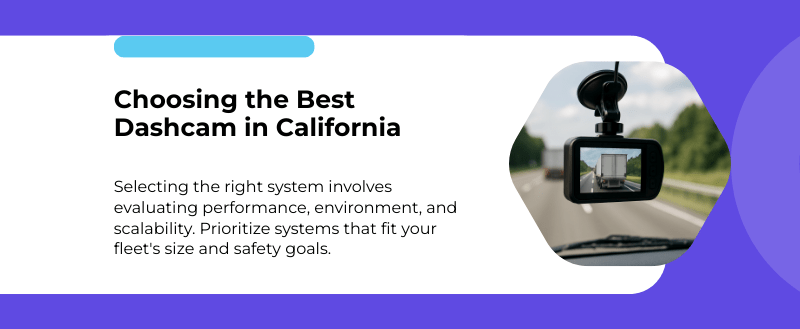
Choosing the Best Commercial Dash Cam System in California
Commercial fleets evaluating dash cam systems should begin with platforms designed specifically for high-demand fleet environments. Consumer-grade cameras often fail under continuous use, while fleet-grade systems are built for long operating hours, stable performance, and consistent image quality.
The systems available through CommercialDashCams.com align with these requirements, making them suitable for California fleets operating in dense traffic, high heat, and variable lighting conditions. This foundation is especially important for fleets upgrading from outdated or non-commercial hardware.
Built for California’s Driving Conditions
California fleets operate across some of the most demanding driving environments in the country. From congested urban corridors to high-speed interstates and prolonged sun exposure, dash cam systems must perform reliably under constant stress.
Fleet-grade dash cams are engineered to handle:
- Continuous vibration from long driving hours
- Direct heat exposure inside vehicle cabins
- Rapid shifts in lighting caused by tunnels, fog, and glare
Systems built for professional use maintain stability and clarity where general-purpose alternatives often degrade or fail.
Video Quality and Evidence Reliability
Video quality is a core decision factor when selecting a commercial dash cam system. Fleets rely on footage to accurately document incidents, driver behavior, and roadway conditions.
High-resolution capture is especially important on California highways, where high speeds and dense traffic can quickly obscure details. Systems that maintain consistent frame rates and sharp image clarity allow fleets to:
- Identify lane markings and signage
- Track merging and passing vehicles
- Reconstruct incidents with confidence
Reliable footage reduces ambiguity during claims review, training, and internal investigations.
Multi-Camera Support for Complex Vehicles
Many California fleets operate vehicles that require more than a front-facing camera. Box trucks, service vans, and flatbeds benefit from additional visibility around the vehicle.
Multi-camera configurations support:
- Side-view monitoring for blind spots
- Rear-view documentation during backing and loading
- Improved oversight in tight delivery or service areas
A system that supports multiple camera channels without performance loss provides a more complete operational picture and strengthens safety programs.
Hardware Durability in High-Heat Environments
California’s climate introduces prolonged cabin heat that can damage lower-quality dash cam hardware. Fleet-grade systems are built with heat-tolerant components, reinforced housings, and secure mounting solutions.
These design features help:
- Prevent system shutdowns due to overheating
- Maintain stable camera positioning over time
- Extend overall system lifespan
The dash cam systems offered through CommercialDashCams.com reflect these durability standards, supporting long-term deployment across varied regions and vehicle types.
Connectivity Across Diverse Terrain
Reliable connectivity is critical for fleets operating across California’s diverse geography. Vehicles frequently move through mountainous regions, rural corridors, and coastal areas where cellular coverage fluctuates.
Fleet-focused platforms manage these conditions by:
- Buffering video during signal loss
- Automatically uploading footage when connectivity returns
- Preventing data gaps during extended routes
This approach ensures consistent documentation even when coverage is intermittent.
Software and Video Management Capabilities
Dash cam hardware is only part of the system’s value. Fleet managers need software that supports fast retrieval, stable cloud access, and predictable upload behavior.
Effective platforms provide:
- Intuitive search and filtering tools
- Consistent event classification
- Reliable access during audits, claims, or disputes
Streamlined video management reduces administrative workload and improves response time when footage is needed quickly.
Integration With Fleet Telematics Systems
Most fleets rely on multiple data sources to manage routing, compliance, and performance. A dash cam system that integrates cleanly with existing telematics platforms creates a more unified operational framework.
Integrated systems allow fleets to:
- Correlate video with vehicle data
- Reduce platform fragmentation
- Simplify oversight and reporting
The platforms available through CommercialDashCams.com support this level of integration, helping fleets avoid disconnected systems.
Driver Acceptance and Long-Term Adoption
Driver buy-in plays a major role in the success of any dash cam program. Systems that perform consistently and capture accurate footage are more likely to gain acceptance.
Drivers tend to respond positively when footage:
- Protects them from disputed claims
- Provides objective clarity during incident reviews
- Operates predictably without disruption
Stable hardware and reliable performance contribute to smoother onboarding and stronger long-term compliance.
Scalability for Growing California Fleets
As fleets expand, dash cam systems must scale without performance degradation. Fleet-grade platforms are designed to handle increased vehicle counts, higher upload volumes, and extended storage needs.
Scalable systems support:
- Additional camera channels
- Larger fleets without re-platforming
- Long-term video retention requirements
Solutions in this category allow fleets to grow without replacing their entire camera infrastructure.
Implementation and Change Management
Successful deployment depends on structured onboarding and clear communication. Fleets benefit from rollout plans that define installation timelines, driver notifications, and policy updates.
Effective policies explain:
- How footage is collected and stored
- Who can access video data
- How recordings are used operationally
Change management is strongest when leadership emphasizes driver protection, using real examples where footage resolved disputes or exonerated operators.
Commercial Dash Cam Usage Across California’s Major Fleet Hubs
Commercial dash cam adoption is highest in California’s busiest transportation regions, where traffic density and delivery volume create constant documentation needs.
Los Angeles and Southern California
Fleets operating in Los Angeles, Long Beach, and surrounding areas face heavy congestion, fast merges, and unpredictable traffic flow. Reliable video helps verify incidents and maintain accountability, especially near port facilities.
Bay Area
San Francisco, Oakland, and San Jose routes involve narrow streets, steep grades, and high pedestrian activity. Dash cams with strong dynamic range perform better in fog, shadows, and coastal lighting.
Central Valley and Inland Empire
Sacramento, Fresno, Bakersfield, Riverside, and San Bernardino operations combine high speeds with prolonged heat exposure. Systems must remain stable across highways, warehouses, and industrial zones.
Coastal and Mountain Regions
San Diego, Santa Barbara, Napa Valley, Lake Tahoe, and Mammoth Lakes introduce glare, snow, and inconsistent connectivity. Fleets benefit from systems with buffering capability, low-light performance, and cold-tolerant components.
Selecting a System for Statewide Operations
California fleets require dash cam systems that adapt to urban congestion, high-speed interstates, coastal glare, mountain weather, and extreme heat. Platforms designed for these conditions deliver stronger documentation, improved accountability, and long-term reliability.
Fleet-ready systems, including those available through CommercialDashCams.com, are built to meet these operational realities while supporting growth and consistency across the state.
Commercial Dashcams in Florida — FAQ
Are commercial dash cams legal in California?
Yes. California allows the use of commercial dash cams when they are properly mounted, drivers are notified, and audio recording follows required consent rules.
Where can dash cams be mounted in a commercial vehicle?
Cameras must be installed in designated windshield zones that do not obstruct the driver’s primary field of view. Most fleets use the area behind the rearview mirror.
Do California drivers need to be informed about dash cams?
Yes. Companies must notify drivers of any recording or monitoring equipment in the vehicle, especially when audio or interior video is involved.
Do commercial fleets need driver-facing cameras in California?
Driver-facing cameras are optional. Fleets choose them for coaching, accountability, or high-safety programs, but they are not a universal requirement.
What features matter most for commercial dash cams in California?
High-resolution video, low-light capability, event-triggered recording, cloud storage, durable construction, and strong integration with telematics platforms.
How do dash cams reduce liability for California fleets?
They provide clear visual evidence during collisions or disputes, reducing uncertainty and supporting faster, more accurate claims resolution.
Do dash cams help improve driver training?
Yes. Video-based coaching provides specific, actionable insights that improve driving technique and reduce risky behaviors.
What is the best type of dash cam for California fleet environments?
Systems with reliable heat resistance, consistent connection quality, and strong video clarity perform best in California’s varied operating conditions.