
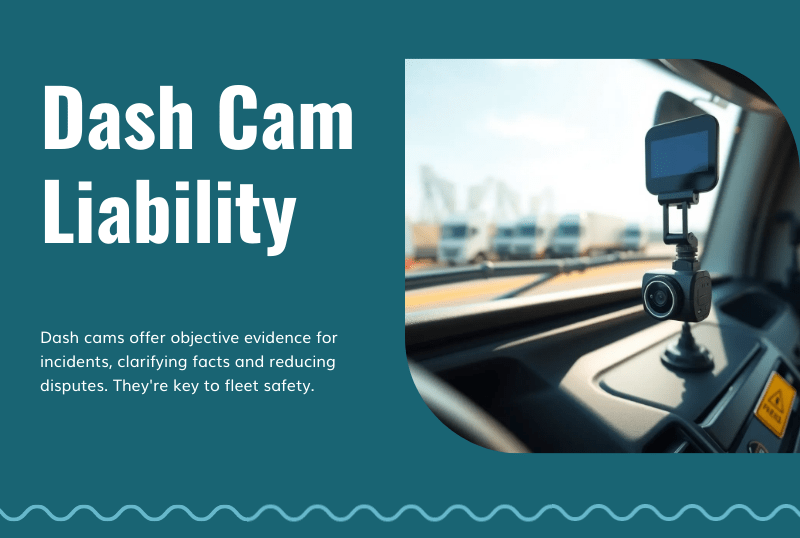
Dash Cams for Accident Liability Reduction
What dash cams objectively document in vehicle incidents
Dash cams document real-time visual evidence of roadway conditions, driver actions, and surrounding traffic behavior at the moment an incident occurs. This documentation creates a time-stamped, objective record that replaces conflicting narratives with verifiable facts.
Modern fleet-grade systems capture forward roadway footage, and often interior and rear views, with synchronized overlays including speed, GPS coordinates, braking events, and acceleration patterns. When combined, these inputs reconstruct not just what happened, but how it happened.
Objective documentation narrows interpretive ambiguity. Reduced ambiguity lowers exposure.
How video evidence influences determination of fault and liability
Video evidence directly affects liability determination by clarifying right-of-way, lane positioning, signal compliance, and driver attentiveness. Clear footage enables insurers and legal counsel to assess causation quickly and decisively.
Without video, fault determination frequently relies on post-impact vehicle positioning, damage patterns, and witness testimony. These sources are inherently interpretive. Video replaces inference with visibility.
When fault clarity increases, settlement timelines shorten. Shorter timelines reduce administrative cost and legal friction.
Preventing false claims and staged accidents with recorded footage
Dash cam footage deters fraudulent claims because it eliminates opportunities for misrepresentation. Visual documentation exposes staged braking, fabricated lane changes, and exaggerated impact narratives.
Fraud exposure increases when incidents lack recorded evidence. In contrast, fleets equipped with cameras can immediately validate or refute allegations. This defensive posture discourages opportunistic claims before they escalate.
Fraud mitigation is not incidental; it is a structural liability advantage.
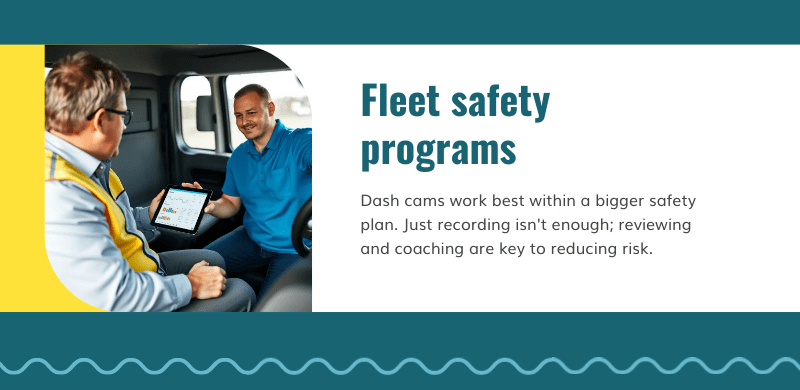
Dash cams as part of a fleet’s safety and risk management program
Dash cams function most effectively when embedded within a broader safety fleet management framework. Recording alone does not reduce liability; structured review and coaching do.
Effective programs typically include:
- Defined review protocols for triggered events
- Driver scorecards linked to observed behavior
- Coaching interventions for repeat risk patterns
- Escalation policies for non-compliance
- Documented corrective action records
These controls demonstrate active risk management. Demonstrable oversight strengthens defensibility in regulatory or litigation contexts.
Insurance implications: claim resolution, premiums, and underwriting posture
Dash cam deployment influences how insurers evaluate operational risk. Underwriters assess both historical loss ratios and present risk controls.
When fleets provide consistent documentation of:
- Reduced preventable incidents
- Formalized safety reviews
- Corrective driver coaching
- Structured evidence retention
Risk categorization becomes more favorable. Faster claim validation also reduces carrier administrative burden, which strengthens renewal negotiations.
Insurance outcomes depend on demonstrated operational discipline. Cameras contribute when integrated into disciplined systems.
Legal admissibility and procedural standards for liability footage
Dash cam footage carries legal weight when authenticity, continuity, and chain of custody are preserved. Courts prioritize evidence that is time-stamped, securely stored, and protected from tampering.
Procedural integrity requires:
- Encrypted storage environments
- Access logs and audit trails
- Defined retention timelines
- Controlled export protocols
- Preservation upon litigation notice
Improper handling weakens evidentiary value. Proper handling strengthens credibility.
When documentation integrity is clear, litigation posture improves before trial dynamics escalate.
Technical characteristics that determine evidentiary strength
Evidentiary value depends on recording quality, reliability, and system design. Consumer-grade devices often fail under scrutiny due to incomplete capture or data corruption.
Fleet-grade systems typically incorporate:
- High-definition forward-facing cameras
- Wide dynamic range for low-light clarity
- Wide field-of-view lenses
- Event-triggered recording buffers
- Secure cloud synchronization
- Integrated telematics overlays
Resolution alone is insufficient. Context, continuity, and redundancy define reliability.
Poor footage undermines defense. Clear footage reinforces it.
Interior and exterior camera configurations for comprehensive coverage
Camera configuration determines the scope of liability protection. Forward-facing systems document roadway conditions, while interior cameras capture driver behavior.
Common deployment configurations include:
- Forward-facing only
- Forward plus driver-facing
- Forward, rear, and cargo area
- Multi-angle 360-degree coverage
Driver-facing systems are particularly valuable in disputed distraction claims. Exterior multi-angle coverage clarifies blind-spot incidents and merging conflicts.
Coverage selection should reflect operational exposure rather than minimal compliance.
When rapid evidence preservation becomes a liability control
Rapid preservation of incident footage reduces liability because data loss can create avoidable exposure even when the driver acted reasonably. A fleet that cannot produce relevant video after an incident may be forced into defensive explanations instead of presenting objective proof.
Preservation starts with an internal “legal hold” trigger tied to severity thresholds, injury potential, police response, or any allegation of fault. The trigger should automatically prevent overwrite and lock related clips, including the buffered pre-event window and post-event continuation.
A preservation workflow should also capture adjacent evidence that often matters as much as video. Relevant inputs typically include GPS breadcrumb trails, speed history, harsh braking events, driver log status, and maintenance records for brakes, tires, lights, and load securement.
Chain of custody practices that protect footage from credibility challenges
Chain of custody protects footage by proving that the video is authentic, complete, and handled in a controlled way. Footage that appears edited, missing key seconds, or transferred informally can be attacked as unreliable.
A defensible chain-of-custody process usually includes:
- Restricted access roles with named owners
- Automatic audit logs showing every view, download, and export
- Standardized export formats that preserve metadata
- Hashing or integrity checks at export where supported
- Centralized storage rather than local device copying
- Clear documentation of who released footage and why
Credibility improves when the organization treats footage like evidence rather than a convenience file. Evidence handling discipline is a liability strategy.
Audio recording, mounting rules, and multi-jurisdiction compliance
Compliance risk increases when vehicles operate across multiple states with different rules for windshield obstruction, camera placement, and audio consent. A camera that creates an obstruction issue or captures audio improperly can introduce friction during claims and litigation.
Audio should be treated as a deliberate decision, not a default setting. Organizations that keep audio enabled should pair it with documented disclosure, written acknowledgments, and clear limits on use.
Mounting standards should be formalized and audited. A consistent approach reduces safety concerns, prevents field improvisation, and avoids later arguments that the camera setup itself contributed to visibility impairment.
What “driver exoneration” requires beyond having a camera installed
Driver exoneration requires usable footage, quick retrieval, and a review process that surfaces the most relevant clips without delay. A camera that records but is difficult to access in time-sensitive claims provides limited protection.
Operationally strong programs define who reviews footage first, who escalates to legal or insurance, and what the response timeline must be. Clear responsibility assignments prevent gaps during the first critical hours after an incident.
Exoneration also depends on context. Video that shows a lead vehicle cutting in, a sudden stop, or an unsafe pass can shift fault allocation decisively when paired with speed and distance information.
The “duty to act” problem created by continuous monitoring
Continuous monitoring creates an operational responsibility to respond to known risk patterns. A fleet that collects evidence of repeated distracted driving, harsh cornering, or close following but fails to intervene can face harder questions after a serious loss.
Accountability improves when video insights feed a documented coaching and corrective-action pipeline. The pipeline should specify when coaching is required, when retraining is mandatory, and when driving privileges are restricted.
A practical coaching structure focuses on precision rather than volume. Short clips tied to one behavior change outperform generic reminders and reduce internal defensibility risk.
Incident response playbooks that reduce downstream exposure
A structured incident response reduces liability because early missteps often become costly later. Confusion about who contacts the insurer, who preserves footage, and who speaks externally creates inconsistencies that opposing parties can exploit.
A playbook should define immediate actions for drivers, supervisors, and safety leadership. A consistent process reduces improvisation and improves evidence quality.
Core elements typically include:
- Driver checklist for safety, emergency services, and scene documentation
- Mandatory notification thresholds and escalation contacts
- Automatic video preservation rules for defined incident types
- Single channel for external communication and media inquiries
- Documentation standards for post-incident driver statements
Operational maturity shows up in repeatability. Repeatability reduces exposure.
Data retention policies that balance defense readiness and risk
Retention policies reduce liability when they preserve what matters and delete what does not, on purpose and on schedule. Indefinite retention increases privacy and breach exposure, while overly short retention increases evidence loss risk.
A defensible policy separates “routine” footage from “incident” footage. Routine footage can be retained briefly, while incident footage is preserved longer under defined criteria.
Retention governance should also address deletion. Documented deletion rules demonstrate that the organization manages data systematically rather than selectively.
Redaction, sharing controls, and protecting sensitive footage
Liability protection can be undermined when footage is shared informally or without redaction. Uncontrolled sharing increases privacy exposure and can create reputational and legal risk unrelated to the collision itself.
Sharing controls should be explicit about who can release footage to insurers, counsel, law enforcement, or third parties. Redaction capability matters when footage includes bystanders, minors, medical events, or sensitive interior views.
A controlled release process improves credibility and reduces the chance that partial clips circulate without context. Context loss is a liability multiplier.
Data governance, privacy policies, and workforce considerations
Dash cam programs require clear governance to balance accountability and employee privacy. Transparent policy reduces resistance and legal risk.
Effective governance frameworks define:
- Recording purpose and scope
- Access authorization levels
- Data retention duration
- Acceptable use boundaries
- Employee disclosure and acknowledgment
Unstructured deployment creates organizational friction. Structured governance stabilizes implementation and strengthens compliance posture.
Privacy concerns do not negate safety benefits; they require disciplined policy design.
Measuring liability reduction impact in operational terms
Liability reduction can be evaluated through operational indicators rather than abstract assumptions. Objective measurement validates investment decisions.
Common indicators include:
- Preventable accident frequency
- Average claim resolution time
- Legal defense expenditure
- Insurance premium trend direction
- Driver risk score stabilization
Measurement must be longitudinal. Short-term fluctuations obscure structural trends.
Sustained reductions demonstrate systemic improvement rather than isolated benefit.
Integration with telematics and safety analytics platforms
Dash cam systems deliver greater defensive value when integrated with telematics and safety analytics platforms. Data correlation enables event prioritization and pattern recognition.
Integrated platforms provide:
- Automated event tagging
- Behavioral trend analysis
- Route-specific risk mapping
- Real-time alerts
- Coaching documentation linkage
Video without data limits analysis. Data without video limits context. Integration closes evidentiary gaps.
System cohesion reduces operational blind spots.
Organizational policies that maximize liability protection
Liability protection is strongest when operational policy aligns with technological capability. Cameras alone do not create defensibility; disciplined processes do.
High-functioning organizations formalize:
- Mandatory review of high-severity events
- Standardized coaching documentation
- Escalation thresholds for repeated violations
- Preservation protocols for serious incidents
- Executive oversight reporting
Policy maturity signals seriousness to insurers and courts alike. Documented oversight establishes a pattern of responsible governance.
Defensive credibility is cumulative.
Frequently Asked Questions – Accident Liability Reduction Dashcams
Do dash cams reduce liability in accidents where the fleet driver is at fault?
Dash cams do not eliminate liability when fault is clear, but they clarify responsibility and prevent exaggerated claims. Accurate documentation often reduces dispute duration and associated legal costs.
Can dash cam footage be used in court?
Dash cam footage is generally admissible when authenticity and chain of custody are preserved. Proper storage and access controls strengthen evidentiary credibility.
Do insurers require dash cams for commercial fleets?
Insurers do not universally require dash cams, but many view structured video programs as evidence of proactive risk management. This perception can influence underwriting posture.
Is driver-facing recording necessary for liability protection?
Driver-facing recording strengthens defense against distraction allegations and false impairment claims. Deployment decisions should reflect operational risk tolerance and privacy governance.
How long should dash cam footage be retained?
Retention policies should align with regulatory requirements, insurance guidance, and internal litigation risk thresholds. Automatic overwrite without event preservation undermines protection.
Do dash cams prevent accidents or only document them?
Dash cams influence behavior through accountability, which can reduce preventable collisions. Prevention and documentation operate together in comprehensive programs.
Are consumer dash cams sufficient for commercial liability defense?
Consumer devices often lack encrypted storage, event tagging, and reliable retention controls. Commercial-grade systems are designed for evidentiary durability.