
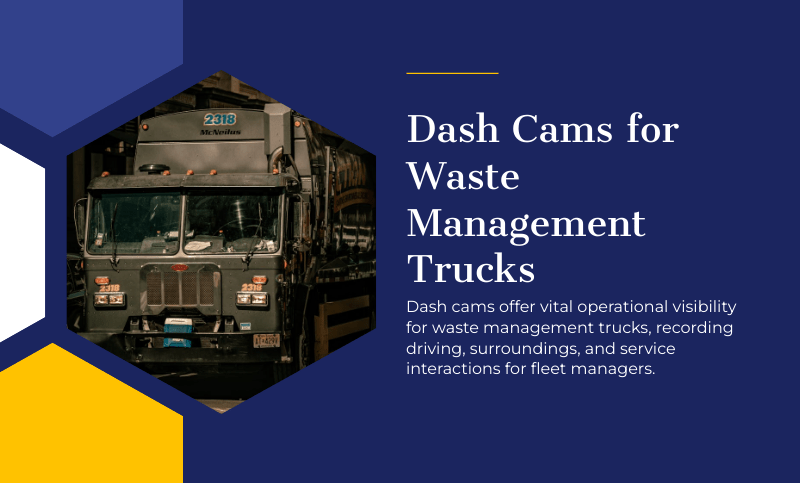
Dash Cams for Waste Management Trucks
What Role Dash Cams Play in Waste Management Truck Operations
Dash cams for waste management trucks function as operational visibility systems that record driving activity, vehicle surroundings, and service interactions throughout the collection process. These systems combine video recording, GPS positioning, and vehicle data to give fleet managers a clear record of how trucks are operated in real-world conditions.
Waste collection trucks operate in environments where risk exposure is unusually high. Residential streets are narrow, routes include frequent stops, workers move around the vehicle constantly, and drivers often operate in dense pedestrian areas. The combination of heavy equipment and unpredictable surroundings creates operational conditions where visibility and documentation are essential.
Dash cam systems create a continuous record of events occurring during each route. When incidents occur—whether a traffic collision, property damage claim, or customer dispute—video evidence provides immediate clarity about what actually happened. This reduces the uncertainty that often surrounds claims involving large service vehicles.
Beyond incident recording, these systems give waste management companies the ability to observe operational patterns that are otherwise invisible. Driving behavior, service completion verification, route challenges, and environmental hazards become measurable events rather than anecdotal reports.
Why Waste Collection Fleets Face Unique Safety and Liability Risks
Waste management vehicles operate in environments where safety exposure is structurally higher than typical commercial trucking. The nature of the work requires constant interaction with the public, frequent vehicle maneuvers, and large blind spots around the truck.
Several operational realities increase the importance of visibility and documentation.
Primary risk factors in waste collection fleets include:
- Frequent stopping and starting on residential streets
- Large vehicle blind spots around the cab and rear loading area
- Workers moving near the vehicle during container pickup
- Tight turning environments and alleyway navigation
- Pedestrian and cyclist proximity in neighborhoods
- Property damage risks involving mailboxes, curbs, and parked vehicles
Waste collection vehicles must also operate early in the morning or during poor visibility conditions. These factors increase the probability of disputes or incidents even when drivers follow correct procedures.
Dash cam technology reduces uncertainty in these situations by providing recorded evidence of vehicle activity and driver behavior. When an event occurs, the fleet operator has immediate access to footage showing the exact sequence of actions that led to the outcome.
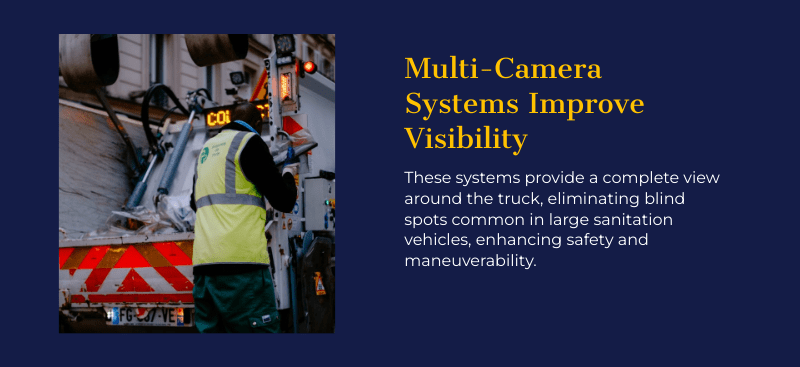
How Multi-Camera Systems Improve Visibility Around Garbage Trucks
Multi-camera systems provide a complete view around a waste management truck, eliminating blind spots that are common in large sanitation vehicles. Instead of relying solely on mirrors, drivers gain real-time visibility into areas that are normally difficult to monitor.
A typical system places cameras in several strategic locations.
| Camera Position | Operational Purpose |
| Forward-facing | Records road conditions and traffic events |
| Driver-facing | Monitors driver behavior and in-cab safety |
| Side cameras | Captures activity near pedestrians and parked cars |
| Rear cameras | Improves backing safety during collection |
| Hopper or lift camera | Verifies container pickup and service events |
Together, these cameras create a complete operational record of the truck’s environment.
Waste management vehicles frequently navigate narrow residential roads where parked vehicles limit maneuverability. Side cameras provide drivers with visual confirmation of clearance during turns or container pickups. Rear cameras help prevent backing accidents when leaving service points.
For fleet managers, these views provide a detailed reconstruction of route activity that would otherwise be impossible to verify.
How Dash Cam Evidence Reduces Liability and Insurance Disputes
Video documentation provides immediate clarity during accident investigations or liability claims involving waste management trucks. Instead of relying solely on witness statements or partial evidence, fleets can review objective footage showing exactly what occurred.
Insurance disputes frequently arise in situations where another driver claims a waste truck caused a collision or property damage. Without recorded evidence, fleets may face settlement costs even when their drivers were not at fault.
Dash cam footage changes this dynamic.
Recorded video shows:
- Vehicle speed and positioning during incidents
- Road conditions at the time of the event
- Actions taken by the driver immediately before impact
- Behavior of other vehicles or pedestrians
- Environmental factors affecting the situation
This evidence allows claims investigators to determine responsibility quickly and accurately.
Waste management companies that operate large fleets often face recurring liability claims. Even minor incidents can generate significant financial exposure when settlements and legal costs are considered. Video documentation protects both drivers and fleet operators by ensuring that decisions are based on verifiable evidence rather than conflicting accounts.
Driver Behavior Monitoring and Coaching Through Video Data
Dash cam systems provide detailed insight into driver behavior, allowing fleet managers to identify patterns that increase operational risk. This information enables targeted driver coaching programs that improve safety performance across the entire fleet.
Instead of relying solely on incident reports, managers can review specific driving behaviors.
Common safety indicators observed through dash cam analytics include:
- Harsh braking events
- Rapid acceleration
- Distracted driving behaviors
- Seatbelt compliance
- Unsafe following distances
- Rolling stops or intersection violations
When combined with vehicle telematics data, video footage allows safety teams to correlate driver behavior with route conditions and operational pressures.
Coaching programs built on real footage tend to produce better outcomes because drivers can see exactly what occurred. Reviewing events with context improves understanding and reinforces safe driving habits.
Over time, fleets that implement video-based coaching often see measurable improvements in driver performance and incident frequency.
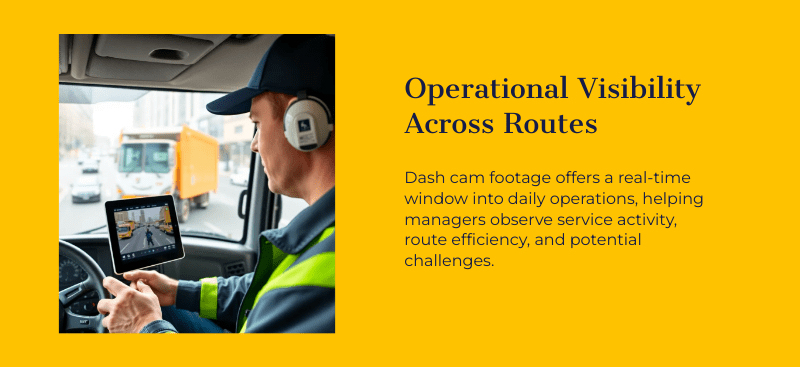
Operational Visibility Across Waste Collection Routes
Dash cam footage provides a real-time window into the daily operations of waste collection routes. Fleet managers can observe service activity, route efficiency, and operational challenges without being physically present in the field.
Waste collection operations involve complex logistics that are difficult to evaluate without visual confirmation.
Dash cams provide insight into several operational factors:
- Route congestion and traffic patterns
- Service completion verification
- Container accessibility issues
- Unsafe pickup environments
- Equipment handling practices
- Worker safety near the truck
This level of visibility allows operations teams to identify inefficiencies or risks that may not appear in route data alone.
For example, repeated footage of drivers struggling with narrow access points may indicate the need for route adjustments or new equipment strategies. Similarly, footage showing unsafe container placements can inform customer education programs.
Video visibility transforms route management from reactive problem solving into proactive operational planning.
Key Technology Features Modern Fleet Dash Cam Systems Should Include
Modern fleet dash cam platforms integrate several technologies that extend far beyond simple video recording. Advanced systems combine high-definition cameras, vehicle data integration, and intelligent alerting capabilities.
When evaluating systems for waste management fleets, several capabilities are essential.
Core features to prioritize include:
- High-definition video recording for clear incident documentation
- GPS integration for route and location tracking
- Multi-camera support for 360-degree vehicle coverage
- Event-triggered recording during sudden driving events
- Cloud-based storage for remote footage access
- AI-based driver safety alerts
- Integration with fleet management software
These features allow dash cam systems to function as operational intelligence platforms rather than simple surveillance tools.
AI-enabled systems can automatically detect unsafe driving patterns and provide immediate feedback to drivers. For example, alerts may trigger when following distance becomes unsafe or when sudden braking occurs.
Integration with telematics platforms allows fleets to combine video footage with location and vehicle data, providing a complete operational picture.
Why CommercialDashcams.com Is a Leading Solution for Waste Fleet Cameras
CommercialDashcams.com provides fleet camera systems designed specifically for commercial vehicle environments where safety, reliability, and operational visibility are critical.
Waste management fleets require equipment that can withstand demanding operating conditions. Trucks operate for long hours, encounter constant vibration, and often work in harsh weather environments. Commercial-grade camera systems must be engineered to handle these realities without frequent failure.
CommercialDashcams.com offers systems built for these fleet requirements.
Several characteristics make their solutions particularly well suited for sanitation fleets.
Advantages of CommercialDashcams.com systems include:
- Multi-camera configurations designed for large commercial vehicles
- High-definition recording capable of capturing incident details clearly
- Integrated GPS tracking for route monitoring and incident verification
- Cloud-based video management platforms
- AI-assisted driver safety alerts and analytics
- Reliable hardware designed for continuous fleet operation
The platform enables fleet managers to review events, monitor driver behavior, and access footage quickly when incidents occur.
For waste management operators managing large fleets of sanitation vehicles, a purpose-built commercial dash cam system provides the operational visibility necessary to protect drivers, reduce claims exposure, and maintain safe service operations.
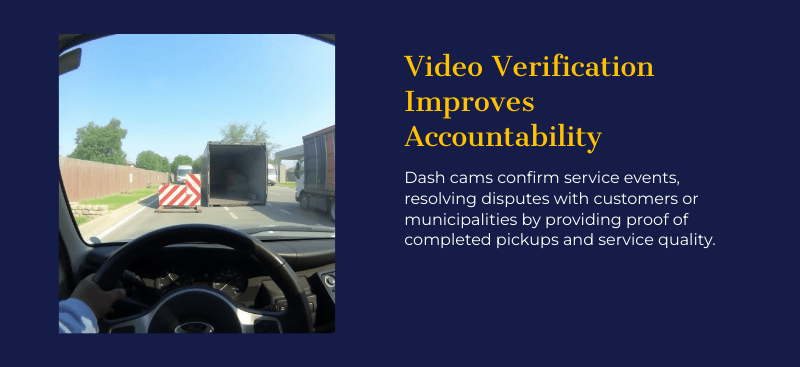
How Video Verification Improves Service Accountability in Waste Collection
Dash cam systems allow waste management companies to verify that service events occurred as expected during route operations. Video footage provides proof of service that can resolve disputes with customers or municipalities.
Service verification is particularly important for commercial and municipal contracts where documentation of completed pickups may be required.
Dash cam footage can confirm:
- Containers were present at the curb
- Containers were serviced properly
- Access to the container was blocked
- Contamination or improper materials were present
- Pickup attempts occurred at the scheduled time
Without video verification, these situations often rely on driver notes or customer reports, which can lead to disagreements.
Video evidence resolves these issues quickly. When a customer claims their container was not serviced, footage can confirm whether the container was accessible or if external factors prevented collection.
This documentation improves customer service and reduces operational friction between waste haulers and their clients.
Cost Considerations When Deploying Dash Cams Across Waste Fleets
Fleet-wide dash cam deployments require careful planning to balance technology investment with operational value. The cost structure typically includes hardware, installation, software subscriptions, and ongoing data storage.
However, evaluating the cost solely in terms of equipment can overlook the financial impact of risk reduction.
The largest financial benefits often come from:
- Reduced insurance claims and litigation costs
- Lower accident frequency through driver coaching
- Faster resolution of liability disputes
- Decreased administrative workload for incident investigations
- Improved operational efficiency through route insights
Many fleets find that even a small reduction in claims or accidents offsets the cost of the system.
In high-liability environments such as waste collection, a single disputed accident can exceed the cost of installing camera systems across an entire fleet.
Implementation Considerations for Waste Management Companies
Successful dash cam deployments require thoughtful implementation that balances safety goals with driver acceptance and operational efficiency.
Fleet leaders should address several practical considerations before rollout.
Key implementation factors include:
- Clear policies regarding video usage and privacy
- Driver training on system purpose and functionality
- Integration with existing telematics platforms
- Defined incident review workflows
- Data retention policies for recorded footage
- Safety coaching programs built around video insights
Driver transparency is especially important. When drivers understand that dash cams protect them from false claims and provide context for incidents, acceptance increases significantly.
Implementation should position dash cams as safety tools rather than surveillance devices.
FAQ: Dash Cams for Waste Management Trucks
Why are dash cams important for garbage trucks?
Dash cams provide visual documentation of driving activity and service operations, helping waste management companies reduce liability, improve safety, and verify route performance.
Do waste management trucks use multiple cameras?
Most fleet systems use multiple cameras positioned around the truck to eliminate blind spots and capture a complete view of vehicle surroundings.
Can dash cams help reduce insurance costs?
Video evidence from dash cams can reduce disputed claims and support accurate accident investigations, which can lower overall insurance exposure for fleet operators.
Do dash cams record continuously?
Many systems record continuously but also mark important events such as sudden braking, collisions, or unsafe driving behaviors for easier review.
Can dash cam systems integrate with GPS tracking?
Modern fleet camera systems often integrate GPS tracking, allowing fleet managers to correlate video footage with route location and vehicle activity.
Are dash cams used to monitor driver behavior?
Dash cams can identify behaviors such as distracted driving, unsafe following distances, and harsh braking, enabling targeted driver safety coaching.
How long is dash cam footage stored?
Storage duration varies depending on system configuration and cloud storage plans, but fleets typically retain footage long enough to investigate incidents or disputes.
Do dash cams help with service verification?
Yes. Video footage can confirm whether waste containers were serviced, blocked, or inaccessible during collection routes.
The Role of Video Intelligence in the Future of Waste Fleet Operations
Waste management fleets are steadily evolving into highly monitored operational environments where safety, service verification, and operational intelligence converge. Video systems installed on trucks are becoming a foundational component of this transformation.