
Fleet Dash Cam Systems: What Buyers Need to Know
A fleet dash cam is a managed video system built for commercial operations
A fleet dash cam is a centrally managed video system designed for business-owned vehicles operating at scale. Unlike consumer cameras, it combines vehicle-mounted hardware with cloud software that governs access, retention, alerts, and operational use. The defining characteristic is not recording capability, but organizational control.
These systems exist to support accountability across drivers, managers, safety teams, and legal stakeholders. Their value is realized when video becomes part of daily fleet operations rather than an isolated data source used only after incidents.
When a dash cam becomes a fleet dash cam
A dash cam becomes a fleet dash cam when video is no longer owned or managed by the driver. Centralized administration, standardized policies, and consistent deployment transform individual recordings into a fleet-wide operational asset. Without those elements, even advanced hardware functions as a standalone device.
This transition matters because scale changes expectations. Fleets require predictable performance, defined governance, and repeatable workflows that consumer-oriented setups cannot sustain.
Fleet dash cam systems exist to manage risk, not just record events
Fleet dash cam systems are implemented to reduce exposure, not to accumulate footage. Video enables faster incident resolution, clearer liability determination, and earlier identification of unsafe patterns. Accident footage is one outcome, but not the primary objective.
The strongest results come from proactive use. Fleets that rely on footage only after collisions tend to miss opportunities for prevention and behavioral improvement.
Fleet dash cam versus consumer dash cam in daily operations
Fleet dash cams differ from consumer dash cams in durability, governance, and operational integration. Commercial dashcam systems are engineered for extended runtime, harsh environments, and frequent vehicle reassignment. Consumer devices are not built for these demands.
More importantly, fleet systems enforce standardized access and retention rules. This prevents inconsistent handling of footage and reduces internal disputes over privacy, accountability, and data ownership.

What a complete fleet dash cam system actually includes
A complete fleet dash cam system includes hardware, connectivity, software, and policy controls. Cameras capture video, but the system’s effectiveness depends on how footage is transmitted, stored, reviewed, and acted upon. Omitting any layer limits real-world usefulness.
The most overlooked components are administrative tools and alert configuration. Without them, managers struggle to extract value from recorded footage at scale.
Front-facing fleet dash cams serve liability and claims resolution
Front-facing fleet dash cams document roadway conditions and third-party behavior. They are primarily used to establish fault, defend against false claims, and clarify disputed incidents. For many fleets, this configuration provides sufficient protection without affecting driver privacy.
These cameras are often the first step in video adoption. They deliver immediate value with minimal cultural friction when deployed transparently.
Driver-facing fleet dash cams address internal risk patterns
Driver-facing fleet dash cams capture in-cab behavior linked to distraction, fatigue, and seatbelt use. Their purpose is corrective insight, not constant surveillance. Effectiveness depends on how footage is reviewed and communicated.
Fleets that deploy driver-facing cameras without clear guidelines often face resistance. When paired with coaching programs and defined review thresholds, acceptance and outcomes improve significantly.
When driver-facing cameras are operationally justified
Driver-facing cameras are justified when internal behavior is a leading contributor to incidents or claims. Fleets experiencing distraction-related events or compliance challenges often benefit from added visibility. The deciding factor is whether footage is used consistently and fairly.
Multi-channel fleet dash cam configurations support specialized operations
Multi-channel systems add side, rear, or cargo views to address blind spots and operational complexity. These configurations are common in delivery, construction, waste, and service fleets. They provide context that front-only systems cannot capture.
The tradeoff is increased installation complexity and data volume. Fleets must assess whether additional perspectives directly support their risk profile and workflows.
What determines fleet dash cam effectiveness in practice
Fleet dash cam effectiveness is determined by alignment between technology, policy, and staffing. Advanced features provide little value if alerts are ignored or footage is never reviewed. Operational capacity matters as much as hardware capability.
Effective programs define clear objectives, limit alert volume, and assign ownership for review and follow-up. Without this structure, systems degrade into passive recorders.

Why alert fatigue undermines fleet dash cam programs
Excessive alerts overwhelm managers and erode trust in the system. When every minor event triggers a notification, meaningful incidents are missed. Alert fatigue is one of the most common causes of program failure.
Successful fleets tune sensitivity to focus on high-confidence events. This preserves attention for situations that warrant action and maintains credibility with drivers.
How installation quality affects fleet dash cam reliability
Installation quality directly impacts footage usability and system uptime. Poor camera angles, unstable mounts, or improper wiring result in obscured views and device failures. These issues often surface only after an incident.
Standardized installation guidelines reduce variability across vehicles. Fleets that invest in proper setup experience fewer support issues and more consistent data.
Fleet dash cam connectivity determines response speed
Fleet dash cams rely on cellular connectivity to upload footage and report system health. Weak signal handling or inadequate data provisioning delays access to critical video. Response speed matters most immediately after incidents.
Reliable systems prioritize event uploads and store footage locally when coverage is limited. Connectivity resilience is more important than peak throughput.
Video retention policies shape legal and operational outcomes
Retention policies define how long footage is stored and when it is deleted. Short retention reduces storage costs but risks losing evidence. Extended retention increases exposure if footage is misused or misunderstood.
Clear, automated policies provide consistency and reduce manual oversight. Fleets should define retention rules before deployment to avoid reactive decisions under pressure.
How fleet dash cams influence insurance discussions
Fleet dash cams often change the tone and speed of insurance claims. Clear footage accelerates resolution and reduces ambiguity. Insurers increasingly expect fleets to have some form of video documentation.
However, cameras alone do not guarantee favorable outcomes. Insurers evaluate how footage is managed and whether it supports proactive safety practices.
Why integration amplifies fleet dash cam value
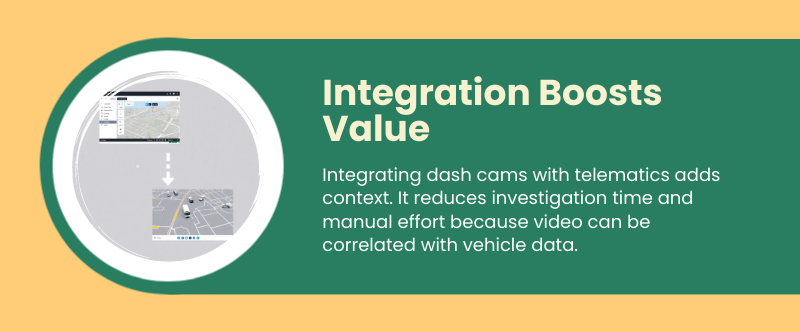
Fleet dash cams deliver greater value when integrated with telematics and operational systems. Correlating video with speed, location, and vehicle data adds context to events. Integration reduces investigation time and manual effort.
Disconnected systems limit insight and increase administrative burden. Fleets benefit most when video triggers defined workflows rather than isolated reviews.
Cost considerations extend beyond camera pricing
Fleet dash cam costs include hardware, installation, connectivity, subscriptions, and ongoing support. Upfront pricing rarely reflects total cost of ownership. Long-term expenses often determine overall value.
Evaluating cost requires comparing operational impact against lifecycle expenses. Systems that reduce claims or administrative workload may justify higher initial investment.
Small fleets and large fleets face different dash cam priorities
Small fleets prioritize simplicity, rapid deployment, and predictable costs. Limited staffing means systems must operate with minimal oversight. Ease of use is often the deciding factor.
Large fleets emphasize scalability, automation, and granular controls. They require platforms that support thousands of vehicles without degrading performance or consistency.
Privacy concerns are resolved through policy, not hardware
Privacy challenges arise from unclear rules rather than camera capability. Fleet dash cams record what they are configured to record. Misuse stems from inconsistent enforcement or ambiguous guidelines.
Defined boundaries around access, review triggers, and off-duty use reduce friction. Transparent communication reinforces trust and compliance.
Regional operations introduce additional fleet dash cam complexity
Fleets operating across regions face varying expectations around data handling and monitoring. Connectivity quality, support availability, and cultural norms differ by location. Uniform assumptions rarely apply.
Systems designed for multi-region deployment simplify expansion. Retrofitting policies and infrastructure later is typically more disruptive.
Evaluating fleet dash cam vendors requires operational realism
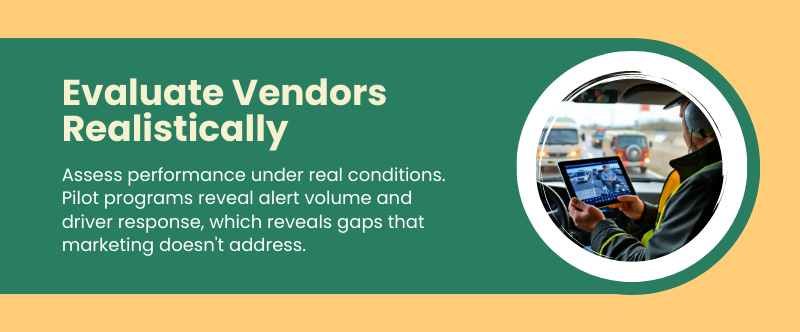
Vendor demonstrations often highlight ideal conditions rather than daily realities. Fleets should assess performance under real workloads, staffing constraints, and coverage limitations. Practical testing reveals gaps marketing materials do not address.
Pilot programs provide insight into alert volume, installation effort, and driver response. Fleets that skip pilots often encounter unexpected friction post-deployment.
Fleet dash cams are a management tool, not a shortcut
Fleet dash cams do not replace leadership, training, or culture. They provide visibility that supports better decisions, but outcomes depend on follow-through. Technology amplifies existing practices rather than correcting weak ones.
Fleets that align video with clear objectives realize sustained improvements. Those seeking quick fixes often underutilize the system.
How fleet dash cams change driver coaching and accountability
Fleet dash cams change driver coaching by replacing subjective feedback with observable behavior. Coaching conversations become anchored in specific events rather than recollections or third-party reports. This shift reduces defensiveness and shortens the time required to reach agreement on what occurred.
Video allows coaching to focus on patterns instead of isolated mistakes. Managers can identify recurring behaviors such as late braking or rolling stops and address them systematically. This pattern-based approach is more effective than reacting to single incidents without broader context.
Accountability also becomes more consistent across the fleet. When all drivers are evaluated using the same criteria and evidence, perceptions of favoritism or uneven enforcement decline. This consistency strengthens internal credibility and reduces grievances tied to disciplinary actions.
Dash cam footage further supports documentation requirements tied to coaching. Fleets can maintain clear records showing when issues were identified and addressed. This documentation becomes valuable when responding to disputes, audits, or escalated safety concerns.
Importantly, effective coaching programs limit how often footage is reviewed. Fleets that review every event often overwhelm managers and dilute the impact of feedback. Focused review thresholds preserve attention for behaviors that meaningfully affect risk.
Why fleet dash cam programs fail without ownership and process
Fleet dash cam programs most often fail because responsibility is unclear. When no individual or team owns review, follow-up, and escalation, footage accumulates without action. Over time, the system becomes a passive archive rather than an operational tool.
Lack of process clarity creates inconsistency. One manager may review footage daily while another reviews only after incidents. Drivers quickly recognize these gaps, which weakens accountability and undermines behavioral impact. Predictable processes matter more than frequency.
Another failure point is unclear escalation paths. When managers do not know when an event requires coaching, discipline, or no action at all, decisions become subjective. This subjectivity leads to uneven treatment and internal friction.
Successful programs define ownership at multiple levels. A designated role reviews alerts, while managers handle coaching and leadership sets policy boundaries. This separation prevents overload and ensures that footage leads to appropriate action.
Process breakdowns also occur when programs are launched without workload planning. Reviewing video takes time, and underestimating that time leads to backlogs. Fleets that align alert volume with staffing capacity sustain engagement longer.
Finally, programs fail when success is undefined. Fleets that do not articulate what improvement looks like struggle to justify continued investment. Clear success criteria anchor the program and guide adjustments as operations evolve.
Frequently Asked Questions About Fleet Dash Cams
What is a fleet dash cam used for?
A fleet dash cam is used to manage safety, liability, and accountability across commercial vehicles. It supports incident resolution, behavior analysis, and risk management.
Are fleet dash cams always recording?
Most systems record continuously while vehicles are operating, but non-event footage is typically overwritten unless retained by policy.
Do fleet dash cams record drivers inside the cab?
Some systems include driver-facing cameras, while others are road-facing only. Use depends on fleet policy and risk considerations.
How long is fleet dash cam footage stored?
Retention depends on configured policies, which balance legal needs, storage capacity, and privacy expectations.
Can drivers access fleet dash cam footage?
Access is controlled by fleet administrators and varies by organization. Many fleets restrict access to designated roles.
Do fleet dash cams require subscriptions?
Most fleet systems operate on subscription models that cover connectivity, storage, and software access.
Are fleet dash cams legal to use?
Legality depends on jurisdiction and deployment practices. Compliance is typically achieved through disclosure and defined policies.