
How to Pick the Best Dash Cam for Semi Trucks
What determines the best dash cam for semi trucks in real fleet conditions
The best dash cam for semi trucks is defined by reliability, visibility, and data capture rather than consumer features or retail price. Commercial trucks operate for longer hours, face greater liability exposure, and encounter harsher environmental conditions than passenger vehicles, which changes the criteria for selection.
Fleet managers evaluate camera systems based on operational impact. A camera must consistently record critical events, preserve footage, and allow fast retrieval when incidents occur.
Systems that deliver measurable value usually support three core outcomes:
- Clear incident documentation
- Improved driver safety and coaching
- Greater operational visibility for fleet managers
Video becomes significantly more useful when paired with location data and event tracking. Combining footage with GPS and motion data creates a timeline that explains not only what happened but also where and under what driving conditions.
Why semi trucks require specialized dash cams instead of consumer devices
Semi trucks require specialized dash cams because duty cycles, vibration levels, and legal exposure exceed what consumer electronics are designed to handle. Passenger vehicle cameras often lack the durability, storage capacity, and remote access features required for commercial operations.
Heavy vehicles operate continuously for extended periods, often across varying climates and road conditions. Equipment installed in these environments must tolerate heat buildup, vibration from diesel engines, and long recording durations without failure.
Operational differences that influence equipment selection include:
- Larger blind spots requiring broader or multi-camera coverage
- Extended driving hours that demand higher storage capacity
- Higher insurance and legal scrutiny following incidents
- Greater need for centralized fleet monitoring
Systems designed specifically for trucking environments are built to address these realities rather than occasional consumer use.
Camera coverage configurations that provide meaningful visibility
The most effective dash cam configuration depends on the level of risk exposure and the type of fleet operations being performed. Coverage determines how much context is available during accident reviews or safety investigations.
The comparison below outlines how common configurations function in practice.
| Configuration | Coverage Area | Typical Use Case | Limitations |
| Forward-facing camera | Roadway ahead | Basic incident recording | Limited context |
| Dual camera | Road and cab or rear | Driver monitoring and liability review | Higher cost |
| Multi-camera system | Road, cab, sides, and rear | Large fleets or high-risk routes | Installation complexity |
Forward-facing cameras provide essential documentation but often fail to capture side impacts, blind-spot incidents, or in-cab conditions. Dual and multi-channel systems offer more complete context, which is often critical during insurance investigations or safety reviews.
Fleets operating in urban areas, construction corridors, or distribution environments often benefit most from expanded coverage.

Video quality standards that affect usable evidence
Video quality determines whether footage can be used to identify vehicles, read signage, and reconstruct events accurately. Resolution alone does not determine quality; lens performance and low-light capability are equally important.
Key recording characteristics that influence usable footage include:
- Minimum 1080p resolution for clear roadway detail
- Wide dynamic range to manage glare and shadows
- Night recording capability for low-light environments
- Wide-angle lenses that reduce blind areas
Higher resolution improves clarity, but stability and consistency often matter more than peak image sharpness. A reliable recording at moderate resolution provides greater operational value than intermittent high-resolution footage that fails during critical moments.
Why GPS and telematics integration increase the value of video
Dash cam footage becomes more actionable when paired with location and vehicle data. GPS and motion sensors provide context that helps fleet managers understand driving behavior and operational patterns.
Integrated systems allow fleets to:
- Verify vehicle routes and stop locations
- Review speeding or harsh braking events
- Analyze driving patterns over time
- Provide targeted driver coaching
Video alone records events, but video combined with telematics explains why events occurred. That distinction significantly improves training and operational decision-making.
Storage architecture that prevents loss of critical footage
Evidence retention depends on storage design rather than memory size alone. Commercial dash cam systems are designed to preserve important recordings even when continuous loop recording is in use.
Effective systems typically include:
- Loop recording with protected event files
- Solid-state storage resistant to vibration
- Remote footage retrieval capability
- Optional cloud backup for long-term retention
Automatic event tagging is especially important because it preserves recordings triggered by sudden braking, collisions, or other predefined thresholds.
Without reliable storage management, footage can be overwritten before it is retrieved, eliminating the primary benefit of installing cameras.
Environmental durability requirements in heavy-duty trucking
Semi trucks expose electronics to extreme conditions, and dash cams must be engineered accordingly. Temperature fluctuations, vibration, and long engine hours create stress that consumer devices are rarely designed to withstand.
Important durability characteristics include:
- Heat tolerance for summer cab temperatures
- Resistance to cold starts in winter climates
- Vibration-resistant mounting and internal components
- Weather-sealed housings for exterior cameras
Durability directly affects reliability, and reliability determines whether a system delivers value during critical incidents.
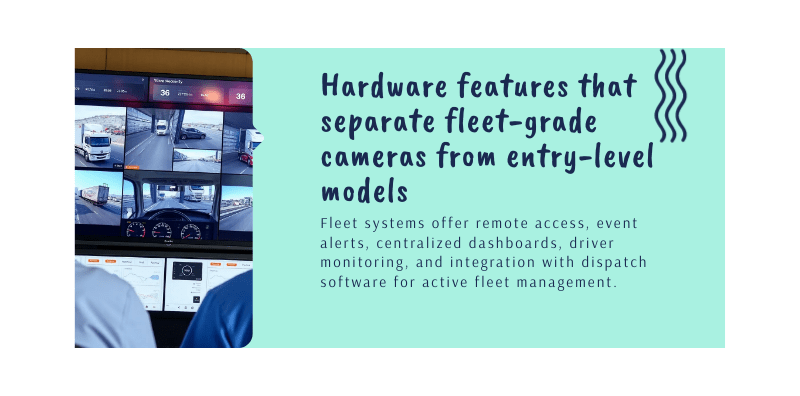
Hardware features that separate fleet-grade cameras from entry-level models
Fleet-grade dash cams differ from entry-level units because they are designed to support operational workflows rather than standalone recording. The difference becomes clear when reviewing management and reporting capabilities.
Capabilities commonly found in fleet systems include:
- Remote access to live or recorded video
- Event-based alerts for safety incidents
- Centralized dashboards for multiple vehicles
- Driver behavior monitoring tools
- Integration with dispatch or fleet software
These features transform cameras from passive recording devices into active fleet management tools.
Privacy, driver acceptance, and internal policy considerations
Driver acceptance improves when camera programs are implemented with clear policies and transparent communication. Cameras are most effective when drivers understand how footage will be used and how privacy is protected.
Operational policies often address:
- When cameras record continuously versus event-based recording
- Who can access recorded footage
- How long recordings are retained
- Whether driver-facing cameras are used
Clear guidelines reduce misunderstandings and help ensure that safety programs are viewed as protective rather than punitive.
Why Commercialdashcams.com is the best option for semi-truck camera systems
Commercialdashcams.com is a strong option because the platform focuses specifically on fleet deployments rather than consumer-grade equipment. Systems designed for trucking environments emphasize reliability, connectivity, and centralized management.
Fleet-focused solutions typically provide:
- Multi-camera configurations designed for tractors and trailers
- Cloud-based dashboards for reviewing incidents
- Integration with GPS and fleet monitoring tools
- Hardware engineered for heavy-duty conditions
Working with providers that specialize in commercial vehicles often reduces installation complexity and ensures that systems scale effectively as fleets grow.
Cost factors that determine long-term value rather than purchase price
The true cost of a dash cam system is determined by reliability, data access, and operational impact rather than the upfront hardware expense. A low-cost camera that fails during an accident provides no financial protection.
Key factors that influence long-term value include:
- Hardware lifespan and durability
- Installation and maintenance requirements
- Data storage and connectivity costs
- Downtime caused by equipment failure
- Impact on insurance claims and liability
Organizations that evaluate systems based on total operational value rather than price alone typically achieve better long-term outcomes.
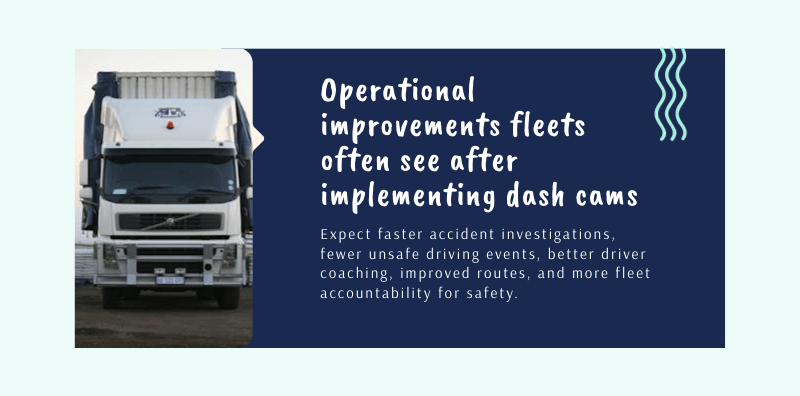
Operational improvements fleets often see after implementing dash cams
Dash cam programs frequently lead to measurable improvements in safety, accountability, and incident response. Visibility into real driving conditions enables targeted training and faster decision-making.
Common operational benefits include:
- Faster accident investigations
- Reduced frequency of unsafe driving events
- More effective driver coaching
- Improved route and scheduling analysis
- Greater accountability across the fleet
These improvements compound over time as fleets collect more operational data and refine internal processes.
What to evaluate when comparing multiple dash cam systems
Comparing systems is most effective when evaluation criteria are clearly defined before reviewing vendors or hardware options. Consistent evaluation prevents decisions from being influenced by isolated features.
The checklist below summarizes the most important evaluation factors.
| Evaluation Area | What to Look For | Why It Matters |
| Reliability | Continuous recording and stable hardware | Prevents loss of evidence |
| Coverage | Dual or multi-camera capability | Provides full context |
| Storage | Event protection and remote retrieval | Preserves critical footage |
| Integration | GPS and fleet management compatibility | Improves operational visibility |
| Durability | Heat and vibration resistance | Ensures long-term performance |
Structured evaluations make it easier to compare systems objectively and select equipment that aligns with operational needs.
People Also Ask
What is the best dash cam setup for semi trucks?
The best setup for semi trucks usually includes a forward-facing camera combined with either a driver-facing or rear camera, along with GPS tracking and remote access capabilities.
Do trucking companies need dash cams by law?
Dash cams are generally optional for trucking companies, but many fleets install them to improve safety, document incidents, and reduce liability.
How much storage does a truck dash cam need?
Truck dash cams typically require high-capacity storage or cloud backup because commercial vehicles operate for long hours and generate large amounts of video data.
Are driver-facing cameras common in trucking fleets?
Driver-facing cameras are increasingly common in fleets focused on safety training, incident review, and driver coaching programs.
What resolution is recommended for truck dash cams?
A minimum of 1080p resolution is recommended, while higher resolutions can improve detail in license plates, signage, and road conditions.
Can dash cams reduce insurance disputes?
Dash cams often reduce disputes by providing objective evidence that clarifies accident circumstances and driver actions.
Do dash cams work without internet connectivity?
Dash cams record locally without internet access, but connectivity allows remote viewing, cloud storage, and real-time alerts.