

Top 7 Benefits of Dash Cams for Commercial Fleets
Every mile a commercial vehicle travels carries risk. From unpredictable drivers to false insurance claims, fleet managers face constant exposure to safety, liability, and operational costs.
That’s why video telematics—specifically dash cams for commercial fleets—have evolved from a “nice-to-have” accessory to a core business investment.
Today, dash cams do far more than record accidents. They provide data that improves performance, reduces costs, and creates measurable ROI.
Below are the seven most powerful benefits fleets gain when they implement dash cams strategically.
1. Accident Reduction and Driver Safety
Summary:
Dash cams dramatically reduce preventable collisions by identifying and correcting unsafe driving habits before they cause an incident.
Why it matters
Accidents are among the highest controllable costs in fleet operations. A single at-fault crash can cost tens of thousands in repairs, downtime, and legal exposure—not to mention reputational damage. Dash cams serve as both a deterrent and diagnostic tool.
How it works
- Behavioral awareness: Drivers adjust their habits knowing their actions are visible.
- AI-powered alerts: Advanced systems detect tailgating, distracted driving, or rolling stops in real time.
- Coaching data: Fleet managers can review footage to deliver targeted, fact-based driver training.
Impact
Fleets that pair dash cams with consistent coaching typically see:
- 30–60% fewer unsafe driving events
- Significant declines in collisions and near-misses
- Higher driver retention due to increased sense of protection
In short, dash cams don’t just record accidents—they help prevent them altogether.
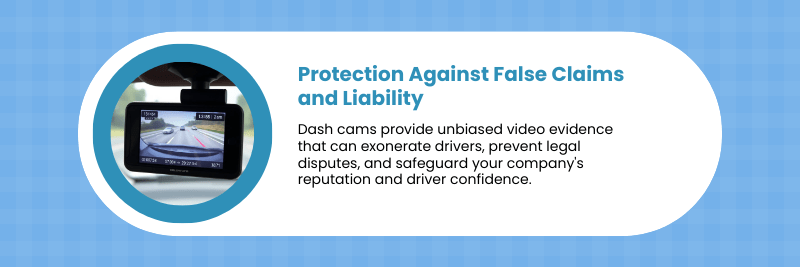
2. Protection Against False Claims and Liability
Summary:
Video evidence can exonerate drivers instantly and prevent costly legal disputes.
Why it matters
Fleet vehicles are often blamed by default in multi-vehicle accidents. Without proof, companies may settle even when not at fault. A dash cam changes that dynamic.
How it works
- Immediate video verification: When an incident occurs, footage provides an unbiased account.
- Claim accuracy: Adjusters and insurers can review evidence within minutes, accelerating resolution.
- Legal defense: Clear video dramatically reduces exposure to lawsuits or inflated claims.
Impact
One exonerated claim can offset the entire cost of a dash-cam program. Beyond financial savings, it also protects brand reputation and driver confidence—two elements critical to long-term retention.
3. Lower Insurance Premiums and Risk Scores
Summary:
Dash-cam footage proves your fleet is lower risk, often leading to better insurance terms and reduced premiums over time.
Why it matters
Insurance is one of the top three operating costs for most fleets. Demonstrating proactive risk management can directly influence rates.
How it works
- Risk transparency: Carriers see verified reductions in incident frequency and severity.
- Evidence-based negotiation: Fleets can present hard data showing safety improvements during renewals.
- Program partnerships: Some insurers now offer premium discounts or rebate programs for fleets using video telematics.
Impact
Savings typically appear within one renewal cycle and compound annually as the fleet’s safety record strengthens.
In many cases, insurance reductions alone can pay for the entire dash-cam deployment in under two years.
4. Reduced Maintenance and Fuel Costs
Summary:
Smoother, safer driving means less wear, fewer repairs, and improved fuel efficiency across your fleet.
Why it matters
Aggressive driving isn’t just risky—it’s expensive. Hard acceleration, abrupt braking, and speeding all drive up fuel and maintenance costs.
How it works
- Behavior tracking: Dash-cam analytics identify inefficient driving patterns.
- Feedback loops: Real-time alerts and post-trip reports guide drivers to smoother operation.
- Fleet longevity: Reduced mechanical strain extends vehicle lifespan and maintenance intervals.
Impact
Small behavioral improvements compound quickly:
- Lower fuel consumption by 5–10%
- Fewer brake, tire, and transmission repairs
- Reduced unscheduled maintenance downtime
These incremental savings contribute directly to ROI and operational efficiency.

5. Enhanced Driver Training and Accountability
Summary:
Dash cams provide an objective, data-driven foundation for driver development.
Why it matters
Traditional training relies on hypothetical scenarios. Video, on the other hand, provides real-world context that resonates. It replaces subjective feedback with factual examples.
How it works
- Coaching clips: Supervisors use actual footage to illustrate best practices and corrections.
- Performance metrics: Each driver’s footage feeds scorecards measuring compliance and improvement.
- Recognition and morale: Video helps highlight positive behavior as much as risk—building trust, not surveillance anxiety.
Impact
When positioned correctly, dash cams become a training ally rather than a monitoring tool. Fleets often report stronger culture, improved driver confidence, and lower turnover because employees feel supported, not punished.
6. Operational Visibility and Efficiency
Summary:
Video telematics give managers a real-time window into field operations—streamlining decisions and resource allocation.
Why it matters
Operational blind spots can cause inefficiency, customer dissatisfaction, or safety gaps. Dash cams integrate visual insight into broader fleet systems, delivering actionable intelligence.
How it works
- Incident detection: Real-time video alerts flag accidents or unsafe behaviors instantly.
- Route verification: Managers confirm stops, deliveries, and service completion.
- Integration with telematics: Combined with GPS and diagnostics, footage becomes a complete operational log.
Impact
With greater visibility, fleets can:
- Verify productivity in real time
- Reduce unauthorized use or idling
- Respond faster to field incidents
- Strengthen accountability across the team
These operational gains often create “soft ROI” beyond direct cost savings—through improved service reliability and decision-making speed.
7. Brand Protection and Customer Trust
Summary:
A documented safety record and rapid incident response build stronger relationships with customers, partners, and regulators.
Why it matters
In industries like logistics, construction, and utilities, reputation drives contract renewals and bids. Dash cams reinforce your credibility as a responsible, transparent operator.
How it works
- Proof of service: Video verifies delivery times, asset handling, and compliance.
- Dispute resolution: Clear footage prevents contract conflicts and customer complaints.
- Regulatory compliance: Demonstrating safety investments satisfies auditors and risk partners.
Impact
Clients view video-equipped fleets as lower-risk, more professional, and easier to work with—often leading to repeat business and preferential contracts.
Quantifying the Combined ROI
While each benefit stands on its own, the true value emerges when they’re viewed together.
For a fleet of 100 vehicles, the financial picture can look like this:
| Category | Annual Impact Estimate | Description |
| Accident reduction | – 40% incidents | Reduced repair & liability costs |
| Claims resolution | $50,000+ saved | Exonerated drivers & faster settlements |
| Insurance premiums | 10–20% lower | Improved risk profile |
| Maintenance/Fuel | 5–10% savings | Gentler driving & efficiency gains |
| Turnover reduction | Lower by 15% | Retained, engaged drivers |
| Operational uptime | +5–8% | Fewer delays, better scheduling |
When combined, these outcomes typically translate to a payback period of 12–18 months and ongoing profitability in Years 2 and 3.
Best Practices to Maximize Dash-Cam Benefits
To achieve full ROI potential:
- Set clear goals – Define success metrics before rollout (accident reduction %, claims savings, premium target).
- Engage drivers early – Communicate that cameras protect, not punish.
- Use the data proactively – Schedule monthly reviews and integrate insights into safety meetings.
- Collaborate with insurers – Share performance data to negotiate better terms.
- Track and report results – Publish safety KPIs internally to maintain program visibility.
The more deliberate the rollout, the faster the measurable impact.
How to Choose the Right Dash Cam for Your Fleet’s Needs
No two fleets are identical. Your dash cam investment should align with your operational environment, safety objectives, and cost structure.
Match Camera Type to Risk Profile
- Local service or delivery fleets may need dual-facing AI cameras for busy urban routes.
- Long-haul or highway fleets may prioritize forward-facing units with event alerts and long storage.
- Specialized vehicles (construction, utility, or hazardous transport) often benefit from multi-angle or 360° coverage.
Evaluate Vendor Support and Reporting
Beyond hardware, assess how well the vendor supports your team:
- Do they provide reporting dashboards and automated alerts?
- How quickly can they deliver incident footage?
- Is their support team experienced in working with insurance carriers?
A vendor that simplifies management and reporting is often worth more than one that merely offers the lowest upfront cost.
Consider Scalability and Subscription Structure
Cloud-based video systems typically operate on monthly subscriptions. Make sure the pricing model scales with your fleet size and includes storage, software updates, and warranty service. Consistent, predictable costs are easier to justify in ROI calculations.
Takeaway:
The best dash cam for your fleet isn’t necessarily the most expensive — it’s the one that fits your operational rhythm, risk profile, and long-term cost goals.

What Features Should a Fleet Dash Cam Have to Maximize ROI
Choosing the right dash cam system determines how much value your fleet will actually see. The right features don’t just record — they provide visibility, accountability, and measurable financial returns.
1. Event-Triggered Recording
Not every second of footage needs saving. Advanced fleet dash cams record only when events occur — such as harsh braking, collisions, or speeding. This selective recording saves storage, provides clear incident context, and ensures you’re capturing what truly matters.
2. Dual-Facing or In-Cab Views
For many fleets, dual-facing cameras (road- and driver-facing) deliver stronger protection. The road view helps with accident verification, while the in-cab view identifies distraction, fatigue, and seatbelt compliance. Together, they create a complete picture of driver and vehicle behavior.
3. Telematics Integration and Analytics Dashboards
A standalone dash cam is useful, but an integrated system is transformative. When video pairs with GPS, telematics, or ELD data, you can see why an event occurred and analyze patterns over time. This turns raw footage into a management tool for coaching, route optimization, and cost control.
4. Cloud Storage and Claims Integration
Look for systems that automatically upload footage to the cloud and connect to your claims workflow. Rapid access to verified video allows faster insurance settlements and reduces downtime. Fleets using cloud-connected systems often report better coordination with insurers and quicker claim closure.
Takeaway:
When selecting dash cams, focus on how each feature connects to business outcomes — not just what looks impressive on paper. The best system for your fleet is one that delivers actionable insights, compliance protection, and measurable ROI.
Frequently Asked Questions
Q: Do dash cams record all the time or only during incidents?
Most commercial systems use event-based recording—capturing video when triggers like harsh braking, collisions, or speeding occur—to save storage while retaining key footage.
Q: Will dash cams increase driver turnover?
Not if managed correctly. When drivers understand footage protects them from false claims, adoption rates and morale actually improve.
Q: Are dual-facing cameras necessary?
Road-facing cameras capture incidents effectively, but driver-facing units add value for coaching and compliance. The right setup depends on your fleet’s risk tolerance and privacy policies.
Q: What about data privacy?
Professional systems encrypt and securely store footage. Fleets should implement clear policies defining access, retention, and usage to stay compliant.
Q: How soon can we expect to see ROI?
Most fleets report measurable returns—fewer claims, insurance credits, and reduced downtime—within 6–18 months after rollout.
Conclusion: From Expense to Asset
Dash cams have moved far beyond simple recording devices. They’ve become strategic instruments of fleet optimization, offering hard financial returns and measurable safety outcomes.
The top seven benefits—safety, liability protection, insurance savings, cost reduction, training, visibility, and brand trust—combine to produce a strong business case that resonates with both finance and operations teams.
For fleets willing to pair technology with disciplined implementation, dash cams deliver something rare in transportation:
a safer operation that also strengthens the bottom line.