
Dash Cam Privacy Laws: Understanding Regulations for Personal and Commercial Vehicle Use
Dash cams are now standard in commercial vehicles because they reduce accident liability, provide driver coaching insights, and protect fleets from fraudulent claims. Yet the legal landscape governing dash cam use is far from uniform. Laws vary not only between countries, but between U.S. states, Canadian provinces, and EU jurisdictions. The complexity increases when audio recording, inward-facing cameras, real-time monitoring, or AI-based driver behavior analytics are involved.
For fleet operators, this isn’t simply a legal checkbox. Mismanaging recorded data, failing to obtain proper consent, or using driver-facing video without documented justification can trigger labor disputes, fines, civil lawsuits, or reputational damage. The fleets that handle dash cam compliance best treat it as part of governance — not technology.
What Dash Cam Privacy Laws Regulate
Dash cam laws typically govern who can be recorded, how they must be notified, and how recorded data may be used and stored. For fleet vehicles, this applies to both drivers and the general public.
Privacy regulations affecting dash cams generally govern four areas:
| Regulation Area | What It Covers | Why It Matters in Fleet Settings |
| Recording Consent | Whether you need permission before recording video and/or audio. | Affects how and when inward-facing cameras or cabin audio can legally operate. |
| Data Storage & Retention | How long footage can be stored and how it must be secured. | Prevents legal exposure from excessive data retention or insecure systems. |
| Data Use & Disclosure | When footage can be shared, with whom, and for what purpose. | Key in insurance claims, legal proceedings, and internal HR reviews. |
| Employee Monitoring & Labor Laws | Rules governing recording and evaluating workers while on duty. | Ensures driver monitoring programs do not violate workplace privacy rights. |
Most legal issues arise not from having a dash cam, but from how it’s used, who is recorded, and what the recorded footage is used for after the fact.
The Core Legal Distinction: Forward-Facing vs. Driver-Facing Cameras
Forward-Facing Only Cameras
These generally record the public road — where individuals have reduced expectations of privacy. In most jurisdictions, these require no additional consent beyond internal policy acknowledgment. They are widely approved for safety and liability reduction.
Driver-Facing or Cabin Cameras
These record drivers while working, often including biometric or behavioral monitoring. Because they record inside the cab, they trigger workplace privacy rules, labor regulations, and consent requirements. Fleet employers must demonstrate legitimate purpose, proportional use, and data security controls.
If your fleet uses AI driver monitoring (distracted driving alerts, eye tracking, drowsiness scoring), this is treated as employee surveillance, which has stricter legal and HR policy implications.
Audio Recording is Regulated More Strictly than Video
Even in regions where video recording is allowed, audio recording may be restricted. Many dash cams are shipped with audio enabled by default, but using this feature without compliance controls can break wiretapping laws.
The legal distinction is typically:
| Recording Type | Legal Treatment |
| Video | Often permitted if used for legitimate safety or security purposes. |
| Audio | Often requires express consent from everyone recorded. |
For fleets:
If your dash cams include microphones, determine whether your jurisdiction is one-party or all-party consent for audio. When operating across multiple states or provinces, configure default audio-off, enable only where permitted, and train drivers accordingly.
State-by-State and Region-by-Region Variations (U.S. Focused)
One-Party Consent States:
Many states allow recording if one party involved in the conversation consents — usually the driver can provide that consent on behalf of the fleet. Examples include Texas, New York, and North Carolina.
All-Party Consent States:
States such as California, Illinois, and Pennsylvania require consent from everyone recorded. If a dash cam captures cabin conversations between multiple employees, documented multi-party consent is required.
Commercial Fleet Consideration:
Because fleets cross state lines, the safest operational standard is to treat all operations as if located in an all-party consent region. This supports compliance continuity and reduces legal risk.
Dash Cams and Employee Privacy: Compliance Requirements for Fleets
Even if the recording itself is legal, the use of the footage must comply with labor and workplace monitoring regulations. Key principles include:
1. Legitimate Business Purpose
The company must be able to clearly state why monitoring is required — typically:
- Reducing collision risk
- Protecting against fraudulent claims
- Improving safety culture
- Meeting insurance underwriting requirements
2. Proportionality
Monitoring should be no more intrusive than necessary. If forward-facing cameras achieve the safety objective, using inward-facing cameras must be justified by operational need.
3. Notice and Transparency
Drivers must be informed:
- That they are being recorded
- Whether AI behavior monitoring is enabled
- When footage may be reviewed (e.g., safety events)
4. Driver Acknowledgment
Consent should be documented through:
- Employee handbooks
- Signed policy forms
- Driver training logs
If challenged, policies must show that drivers were aware and agreed.
Data Retention Standards for Recorded Footage
Fleet operators should establish:
- Clear retention windows (often 30–90 days unless tied to an active incident)
- Controlled access procedures (limit who can review footage)
- Secure storage requirements (encrypted cloud or secured internal servers)
- Automated deletion schedules to prevent over-retention liability
Keeping footage “just in case” increases exposure. The less data retained unnecessarily, the lower the risk.
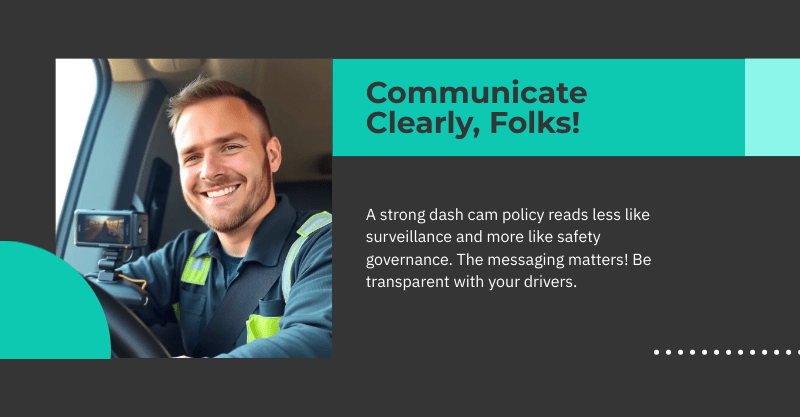
How Fleets Should Communicate Dash Cam Use to Drivers
A strong dash cam policy reads less like surveillance and more like safety governance. The messaging matters.
Key Elements to Include in Driver Communication
- Purpose: safety, liability protection, training
- Whether cameras face inward, outward, or both
- Whether audio is recorded (if applicable)
- When footage may be reviewed and by whom
- Retention timelines
- Disciplinary use rules (clear and consistent)
Policies are most defensible when:
- Shared during driver onboarding
- Reviewed during annual safety training
- Reinforced through safety meetings and signage inside vehicles
Fleet Best Practices for Compliance and Driver Trust
To ensure legal defensibility and maintain driver morale:
1. Publish a Clear Monitoring Policy
Written, signed, and consistently enforced.
2. Minimize Intrusiveness
Disable continuous interior recording unless necessary; use event-triggered recording instead.
3. Use Neutral Language
Position cameras as safety tools, not surveillance devices.
4. Train Supervisors Not Just Drivers
Supervisors must understand policy limits; misuse of footage can be a legal liability.
5. Involve Drivers in Safety Review
Collaborative review sessions build adoption.
6. If Using AI Behavior Monitoring, Provide Coaching Frameworks
AI alerts should guide improvement — not provide grounds for automatic disciplinary action.
How Dash Cam Footage Can and Cannot Be Used in Legal and Insurance Contexts
Fleet footage is commonly used for:
- Collision investigation
- Insurance claims defense
- Claim litigation
- Training and performance improvement
But fleets must avoid:
- Using footage to discipline drivers outside documented policy processes
- Sharing footage unnecessarily with external third parties
- Using footage for purposes unrelated to the stated monitoring objective
When usage deviates from documented purpose, lawsuits follow.
Compliance Checklist for Commercial Fleets
This checklist aligns monitoring programs with legal defensibility:
Recording and Consent
- Document the business justification for dash cams.
- Notify all drivers in writing.
- Obtain signed acknowledgment forms.
- Handle audio as off by default.
Camera Configuration
- Forward-facing required; inward-facing justified.
- AI monitoring settings transparent to drivers.
Data Handling
- Access logs for footage review.
- Defined retention period (30–90 days typical).
- Automated deletion enabled.
Policy Governance
- Reviewed annually by leadership.
- Incorporated into safety training.
- Consistent application in disciplinary processes.
Privacy Compliance is Now a Standard Fleet Capability
Dash cam use is no longer simply an equipment choice. It intersects with labor law, safety governance, data security, and driver relations. Fleets that treat privacy as a compliance discipline — rather than an afterthought to equipment installation — achieve stronger safety outcomes with fewer disputes.
The fleets that perform best follow the same pattern:
- Transparent communication
- Proportional monitoring
- Clear policies and documented consent
- Purposeful, structured use of recorded data
Dash cams create strategic benefit when they reinforce trust and safety — not oversight. The goal is accountability without intrusion, and safety without surveillance culture.

Dash Cam Policies for Unionized or Employee-Represented Fleets
Fleets that employ union drivers or operate under collective bargaining agreements must handle dash cam deployment differently. In these environments, the introduction of monitoring technology often requires:
- Union notification
- Formal review and bargaining before deployment
- Written amendments or side letters acknowledging new monitoring practices
Attempting to implement driver-facing cameras without negotiating impact can trigger labor grievances or arbitration disputes. The most effective approach is to frame dash cams as:
- Safety equipment designed to prevent injuries
- A liability shield that protects drivers from false claims
- A documentation tool that strengthens driver defense post-incident
When positioned in terms of driver protection, adoption resistance drops significantly.
Implementing AI-Based Driver Monitoring in Compliance-Focused Fleets
Newer dash cam systems can detect cell phone use, yawning, off-road glancing, and signs of fatigue. These features sit at the intersection of:
- Workplace surveillance law
- Biometric data governance
- Health and safety compliance
To implement AI monitoring responsibly, fleets should:
- Clarify the purpose: Risk detection and safety coaching — not punitive monitoring.
- Use risk scoring rather than constant performance grading.
- Provide drivers the right to review footage and discuss context.
- Train safety supervisors on coaching-based conversation frameworks.
The legal defensibility increases when AI alerts are treated as training cues, not disciplinary triggers.
Public Roadway Recording and Bystander Privacy
Forward-facing cameras record public spaces, where privacy expectations are limited. Still, fleets must ensure footage is handled responsibly. If footage is shared externally — particularly online — faces, license plates, and identifying details should be blurred to avoid privacy claims. Internal review and insurance submission are generally acceptable uses, while publishing footage to social media is not.
Insurance, Litigation, and Risk Management Implications
Fleet operators are increasingly evaluated on whether they have dash cams, not simply how they use them. Insurers may offer:
- Lower premiums
- Deductible reductions
- Discounted telematics bundles
However, insurers also expect footage to be retrieved and submitted quickly when incidents occur. Fleets must build workflows to:
- Tag events in real time
- Store collision footage
- Provide immediate access to legal counsel
A dash cam program is not just hardware — it is evidence management infrastructure.
Creating a Legally Defensible Dash Cam Program
A dash cam program becomes legally defensible when it has:
- A documented safety purpose
- Transparent communication to drivers
- Consistent enforcement of policies
- Limited and logged access to video data
- Defined retention and deletion rules
- Regular compliance and policy review
This turns dash cams from a security device into part of the fleet’s governance framework.
Frequently Asked Questions About Dash Cam Privacy Laws in Commercial Fleets
This section provides direct, snippet-ready answers to the most common questions fleet operators search for online. Each answer is designed to stand alone and support AI overview and featured snippet visibility.
Are Dash Cams Legal in Commercial Vehicles?
Yes — dash cams are legal in commercial vehicles in most regions when used for legitimate business purposes. Fleets are allowed to record driving conditions, collisions, and roadway activity to prevent accidents and reduce liability. The legal considerations arise in how the cameras are configured, how driver-facing video is used, whether audio is recorded, and how long footage is stored. As long as the fleet notifies drivers, restricts footage access, and applies the technology for safety and operational improvement, dash cams are generally permissible.
Do Drivers Have to Give Consent for Dash Cams?
In many jurisdictions, yes. When the dash cam records inside the cab or collects audio or biometric inputs, drivers must be informed and, in some cases, must sign written consent. This applies particularly to:
- Driver-facing cameras
- Audio recording
- AI-based behavior monitoring (e.g., drowsiness or distraction tracking)
Consent can typically be included as part of the driver onboarding packet, equipment handbook, or union workforce agreement — but it must be clear, documented, and consistently applied across the fleet.
Can Fleets Record Audio Inside the Cab?
It depends on the location where the vehicle is operating. States and provinces fall into two categories:
| Consent Type | Meaning | Impact on Fleets |
| One-Party Consent | Only one participant in the conversation must be aware of the recording. | The driver can provide consent on behalf of the fleet. |
| All-Party Consent | Everyone recorded must be informed and agree. | Audio recording is restricted unless documented multi-party consent exists. |
Because commercial vehicles cross jurisdictional boundaries, many fleets choose to disable audio recording entirely or enable it only during safety-critical events (e.g., severe braking, collision detection) to reduce compliance risk.
Are Driver-Facing Dash Cams Legal?
Driver-facing dash cams are permitted, but they are governed by employee privacy and workplace monitoring rules, not just data regulations. To legally justify inward-facing cameras, fleets must show:
- Clear safety or liability objectives
- Proportional monitoring (only recording what is necessary)
- Transparency with drivers about when and how footage may be reviewed
- No hidden or secret monitoring
Continuous live monitoring is viewed more critically than event-triggered or coaching-based review. Fleets are generally safest using event-based driver-facing recording, where video activates during risky behavior, collisions, or telematics alerts.
How Long Can Fleets Keep Dash Cam Footage?
Most privacy guidance supports minimum necessary retention, such as 30–90 days unless the footage is linked to an ongoing incident, insurance claim, or legal case. Keeping footage longer than needed increases liability. A defensible data retention plan includes:
- Automatic deletion schedules
- Clear criteria for extended storage during litigation
- Restricted administrator access with audit trails
In practice, the strongest fleet policies tie retention periods to incident management workflows rather than arbitrary timelines.