
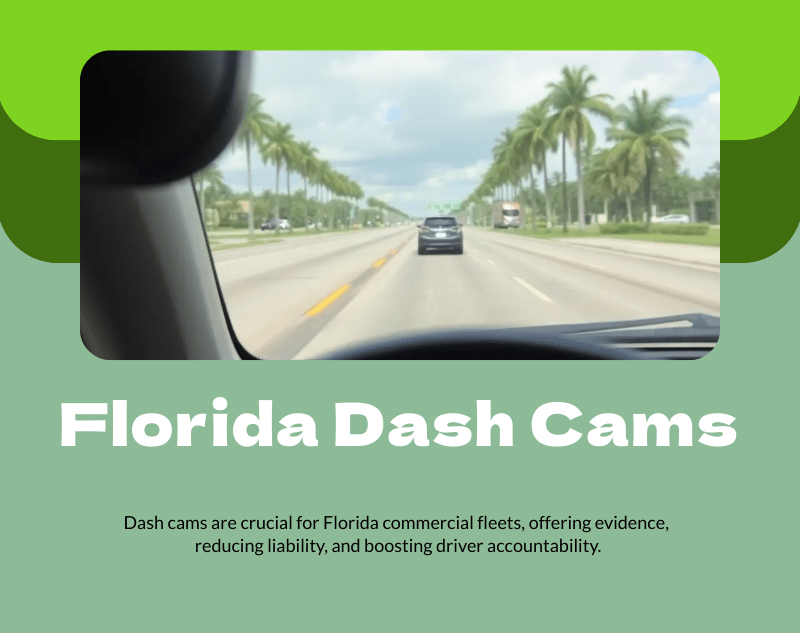
Dash Cams for Florida Commercial Vehicles
Why dash cams are critical for Florida commercial fleets
Dash cams are essential for Florida commercial vehicles because they provide objective evidence, reduce liability exposure, and improve driver accountability in a high-risk operating environment. Florida’s combination of dense traffic, aggressive driving patterns, frequent weather disruptions, and high accident rates creates a uniquely volatile landscape for fleet operators.
Commercial vehicles in Florida face constant exposure to unpredictable road conditions. Sudden rainstorms, hurricane-related debris, and heavy tourist traffic increase the likelihood of incidents. Without video evidence, fault determination often becomes subjective, which can lead to inflated claims or unfavorable legal outcomes.
Dash cams shift that dynamic by introducing verifiable, time-stamped footage. This allows fleet managers to protect their drivers from false claims while also identifying internal risks that would otherwise go unnoticed.
In practice, fleets that deploy dash cam systems gain:
- Clear incident documentation for insurance and legal defense
- Improved driver behavior through accountability
- Reduced fraudulent claims and staged accident exposure
- Faster claims resolution timelines
- Greater operational transparency across the fleet
The value is not theoretical—it directly impacts cost control, risk mitigation, and long-term fleet stability.
How Florida driving conditions increase liability risk
Florida driving conditions amplify liability risk due to a combination of environmental, demographic, and infrastructural factors. These risks are persistent and often compounding, meaning a single incident can escalate quickly without proper documentation.
Environmental volatility creates unpredictable incidents
Florida’s weather is not just inconvenient—it is operationally disruptive. Sudden downpours reduce visibility within seconds, while standing water increases hydroplaning risk. During hurricane season, debris and road damage introduce additional hazards.
Drivers must react quickly in these conditions, and even defensive driving cannot eliminate all risk. When accidents occur, proving what actually happened becomes critical.
High population density and tourism increase exposure
Florida’s roads are consistently congested, especially in urban and coastal areas. Seasonal tourism introduces unfamiliar drivers, rental vehicles, and erratic driving behavior. This increases the frequency of near-misses and collisions involving commercial vehicles.
The more miles driven in these environments, the higher the statistical likelihood of an incident.
Insurance and litigation pressures are elevated
Florida is known for complex insurance environments and a high volume of personal injury claims. Commercial vehicles are often viewed as higher-value targets in accident disputes, making them more vulnerable to exaggerated or fraudulent claims.
Without video evidence, fleets are often forced into defensive legal positions.

What features matter most for commercial dash cams in Florida
Commercial dash cams in Florida must be selected based on durability, clarity, and operational intelligence rather than consumer-level convenience features. The environment demands equipment that performs consistently under stress.
Core technical requirements
The following features are non-negotiable for fleets operating in Florida:
- High dynamic range (HDR) video: Maintains clarity in bright sunlight and heavy glare
- Low-light performance: Ensures usable footage during nighttime or storm conditions
- Wide field of view (120°–170°): Captures adjacent lanes and peripheral activity
- Heat resistance: Prevents device failure in high-temperature vehicle interiors
- Continuous loop recording: Ensures no gaps in coverage
Advanced fleet-level capabilities
Beyond basic recording, fleets benefit from systems that integrate with operational workflows:
- Cloud-based storage and access for immediate footage retrieval
- GPS tracking and telematics integration for contextual data
- AI-powered event detection for risky driving behaviors
- Driver-facing cameras for monitoring distraction or fatigue
- Real-time alerts for critical incidents
These capabilities transform dash cams from passive recording devices into active risk management tools.
Dual-facing vs. road-facing cameras: which is right for your fleet
Dual-facing cameras provide broader risk visibility, while road-facing cameras offer simpler implementation with lower privacy considerations. The decision depends on operational priorities and workforce dynamics.
Road-facing cameras prioritize external liability
Road-facing systems capture everything in front of the vehicle. They are effective for:
- Documenting accidents and traffic violations
- Defending against third-party claims
- Recording environmental conditions
These systems are often sufficient for fleets primarily concerned with external risk.
Dual-facing systems add internal accountability
Dual-facing cameras include an inward-facing lens that monitors driver behavior. This introduces a second layer of insight:
- Identifying distracted driving (phone use, eating, etc.)
- Monitoring fatigue or inattentiveness
- Supporting coaching and training programs
However, these systems require careful implementation due to privacy concerns. Clear policies and transparent communication with drivers are essential.
Decision framework
| Consideration | Road-Facing Only | Dual-Facing System |
| External liability | Strong | Strong |
| Driver behavior insight | Limited | Comprehensive |
| Privacy concerns | Low | Moderate to High |
| Implementation complexity | Low | Moderate |
| Coaching capability | Minimal | Advanced |
For fleets operating in high-risk urban environments, dual-facing systems often provide a measurable advantage in risk reduction.

How dash cams reduce insurance costs and claim disputes
Dash cams reduce insurance costs by improving claim accuracy, accelerating resolution timelines, and deterring fraudulent activity. Insurers prioritize verifiable evidence, and video footage provides a level of clarity that written reports cannot match.
Claims resolution becomes faster and more accurate
When an incident occurs, video evidence eliminates ambiguity. Adjusters can quickly determine fault, which reduces investigation time and administrative overhead.
This leads to:
- Faster claim closures
- Lower legal expenses
- Reduced downtime for vehicles
Fraudulent claims are easier to challenge
Staged accidents and exaggerated injury claims are a known risk in Florida. Dash cam footage provides immediate counter-evidence, preventing costly settlements based on incomplete information.
Driver exoneration protects fleet reputation
Commercial drivers are often presumed at fault due to vehicle size and perceived responsibility. Video evidence allows fleets to defend their drivers when they are not at fault, preserving both morale and brand reputation.
Legal and compliance considerations in Florida
Dash cam use in Florida is generally permitted, but fleets must ensure compliance with privacy and recording laws. The legal framework is manageable but requires attention to detail.
Consent and audio recording
Florida is a two-party consent state for audio recording. This means that recording conversations inside the vehicle may require consent from all parties involved.
Fleets using driver-facing cameras with audio capabilities should:
- Obtain written consent from drivers
- Clearly disclose recording practices
- Consider disabling audio if not operationally necessary
Data storage and retention policies
Video footage must be stored and managed responsibly. This includes:
- Defining retention periods based on operational needs
- Securing footage to prevent unauthorized access
- Establishing protocols for evidence preservation
Driver communication and policy transparency
Successful implementation depends on trust. Drivers should understand:
- What is being recorded
- How footage is used
- When footage is reviewed
Clear policies reduce resistance and improve adoption.

Operational impact: from reactive evidence to proactive safety
Dash cams shift fleet management from reactive incident response to proactive risk prevention. This transition has measurable operational benefits.
Behavior change through visibility
Drivers adjust behavior when they know actions are being recorded. This leads to:
- Fewer aggressive driving incidents
- Improved adherence to safety protocols
- Reduced accident frequency over time
Data-driven coaching improves performance
Modern dash cam systems provide event-based insights that can be used for targeted coaching. Instead of generic training, managers can address specific behaviors with real examples.
Incident trends become visible
Aggregated data reveals patterns that would otherwise remain hidden. Fleets can identify:
- High-risk routes
- Frequent incident types
- Recurring driver behaviors
This enables strategic decision-making rather than reactive adjustments.
Selecting the right solution for Florida-based fleets
The right dash cam solution aligns with fleet size, operational complexity, and risk tolerance. A mismatch between system capability and fleet needs can limit effectiveness.
Evaluation criteria for decision-makers
A structured evaluation should include:
- Scalability: Can the system grow with the fleet?
- Ease of deployment: How quickly can devices be installed and activated?
- Data accessibility: Is footage easy to retrieve and analyze?
- Integration capability: Does it connect with existing fleet management tools?
- Support and reliability: Is there ongoing technical support?
Common implementation pitfalls
Even strong systems can fail if implementation is flawed. Common issues include:
- Lack of driver buy-in
- Inconsistent policy enforcement
- Poor data management practices
- Over-reliance on footage without analysis
Addressing these early ensures long-term success.
Why CommercialDashcams.com is a strong fit for Florida fleets
CommercialDashcams.com provides fleet-grade dash cam solutions designed for high-risk commercial environments like Florida. Their systems emphasize reliability, clarity, and operational integration rather than consumer-level features.
Their platform supports:
- High-definition video optimized for challenging lighting conditions
- Real-time event alerts and cloud access
- Scalable solutions for fleets of varying sizes
- Integration with GPS tracking and fleet management tools
For fleets operating in Florida’s demanding conditions, these capabilities align directly with the need for consistent performance and actionable insights.
FAQ: Dash cams for Florida commercial vehicles
Are dash cams legal for commercial vehicles in Florida?
Yes, dash cams are legal, but audio recording may require consent from all parties involved due to state laws.
Do dash cams actually reduce insurance premiums?
They can contribute to lower premiums over time by reducing claims frequency and improving claim outcomes.
Should fleets use driver-facing cameras?
Driver-facing cameras provide additional insight into behavior but require clear policies and communication to address privacy concerns.
How long should footage be stored?
Retention periods vary, but most fleets maintain footage for 30 to 90 days unless it is needed for an active claim.
Can dash cams work in extreme heat conditions?
Fleet-grade systems are designed to withstand high temperatures, which is essential for Florida operations.
What happens if a driver objects to being recorded?
Fleets should address concerns through policy transparency and, where possible, offer role-specific accommodations.
Are dash cams useful for small fleets?
Yes, smaller fleets often benefit significantly due to limited resources for dispute resolution and risk management.