
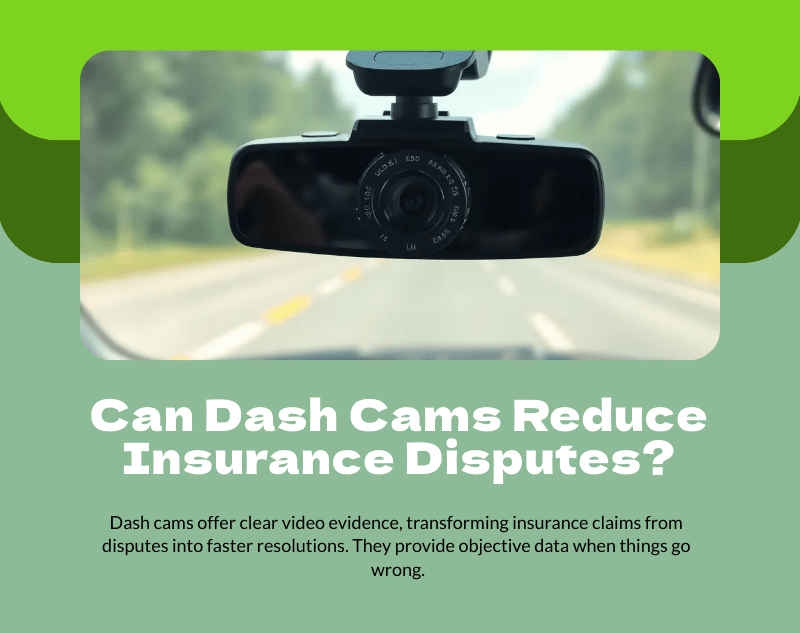
Can Dash Cams Reduce Insurance Disputes?
The main insurance problem after a commercial vehicle accident is rarely the crash itself — it is the uncertainty that follows. Dash cams replace competing accounts with evidence, and evidence is what determines how quickly and fairly a claim gets resolved.
The bottom line: Dash cams reduce insurance disputes by narrowing uncertainty — replacing competing driver accounts, memory gaps, and post-accident photos with video evidence of lane position, traffic signals, vehicle movement, and driver behavior. For commercial fleets, that narrowing is often the difference between a fast claim review and a long liability investigation.
The Main Insurance Problem Is Often Not the Crash, But the Uncertainty Afterward
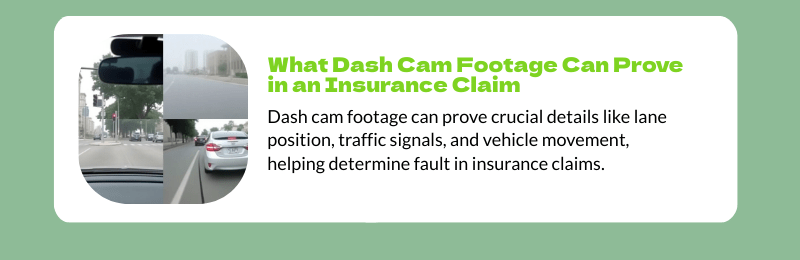
Insurance disputes commonly begin when available evidence doesn’t clearly show what caused the accident. Dash cam footage captures the sequence of events rather than only the aftermath — the seconds before impact that fault decisions actually depend on.
Insurance disputes commonly begin when the available evidence does not clearly show what caused the accident. Two drivers may describe the same event differently. A rear-end crash may involve sudden braking, unsafe merging, or a staged maneuver. A side-impact collision may depend on who entered the intersection first. A parking lot incident may have no independent witness.
Dash cam footage helps by capturing the sequence of events rather than only the aftermath. That sequence can show:
What Footage Captures Before Impact
- Whether another vehicle cut in suddenly
- Whether a traffic light was red, yellow, or green
- Whether a driver maintained lane position
- Whether road debris, weather, or visibility contributed
- Whether the insured driver had time to react
What Footage Captures Around the Event
- Whether a vehicle reversed into another vehicle
- Whether a pedestrian, cyclist, or third vehicle was involved
- Surrounding conditions at the moment of impact
- Speed, spacing, and trajectory of all vehicles
- The full sequence rather than only the point of contact
What Dash Cam Footage Can Prove in an Insurance Claim
Dash cam footage is most useful when it answers a specific question that affects liability. The strongest footage does not merely show that a crash occurred — it shows how the crash developed and what each vehicle was doing in the moments that led to it.
| Dispute Issue | How Dash Cam Footage Helps |
|---|---|
| Fault determination | Shows vehicle movement, lane changes, braking, and traffic control devices |
| Staged accident concerns | Captures unusual maneuvers such as sudden cut-ins, reverse impacts, or coordinated behavior |
| Hit-and-run claims | May record the vehicle, plate, direction of travel, or identifying details |
| Injury or damage disputes | Helps compare actual impact severity with the claim narrative |
| Commercial driver defense | Shows whether the driver was operating responsibly before the incident |
| Parking incidents | Records impact while the vehicle is stopped or unattended if parking mode is active |
| Weather or road conditions | Documents rain, snow, low visibility, debris, or traffic congestion at the time |
For fleets, the footage can also support internal incident review. A company can compare the driver’s report against video, GPS data, speed information, and telematics records — helping the business respond more accurately to the carrier, claims adjuster, broker, or legal team.
Dash Cams Are Especially Valuable When Fault Is Being Shifted
Many insurance disputes become expensive because one party tries to shift fault after the fact. A driver may claim the commercial vehicle changed lanes first. Another motorist may say they were stopped when the video shows they reversed. A claimant may describe a severe impact when footage shows low-speed contact. Dash cams are useful in these situations because they create an independent record — the camera is not relying on stress, memory, or self-interest.
Commercial vehicles are often viewed as attractive claim targets because businesses are expected to carry higher insurance limits. This matters most in:
Dash Cams May Help Speed Up the Claims Process
Dash cams can shorten the claims process when footage clearly supports or contradicts a liability narrative. Adjusters generally need evidence before making a determination — video can reduce the time spent gathering statements, comparing stories, waiting for police reports, or reconstructing the incident from incomplete information.
A faster claim decision helps a business control several downstream problems:
Operational Costs of Delayed Claims
- Extended vehicle downtime
- Rental or replacement vehicle costs
- Delayed repairs and scheduling disruption
- Customer service disruption from reduced fleet capacity
- Administrative back-and-forth with adjusters
Why Connected Systems Are Faster
- Cloud access eliminates physical card retrieval
- Event tagging surfaces the right clip immediately
- GPS data and time stamps provide instant context
- Footage is shareable directly with adjusters or brokers
- No risk of overwrite before the clip is retrieved
Video Quality Matters More Than Simply Having a Camera

A low-quality recording may show that an accident happened without showing the plate, signal, lane marking, or vehicle movement that actually determines fault. Resolution, night performance, and cloud backup all determine whether footage is admissible and useful.
A dash cam only reduces insurance disputes if the footage is clear, complete, and usable. The most important features for insurance documentation go beyond just having a camera mounted on the windshield.
| Feature | Why It Matters for Insurance Claims |
|---|---|
| High-resolution video | Captures plates, traffic lights, lane markings, and vehicle positions clearly |
| Wide-angle road coverage | Shows full lane context without distortion that obscures position |
| Night vision / low-light | Critical for early morning, evening, and overnight commercial routes |
| GPS tracking | Documents location, route, speed, and timing alongside the video |
| Event-triggered recording | Locks footage from hard braking, impact, or sudden movement automatically |
| Cloud upload | Preserves evidence even if the camera or vehicle is damaged or stolen |
| Parking mode | Covers unattended vehicle incidents, vandalism, and loading-area damage |
| Tamper resistance | Reduces concerns about missing or altered footage in disputed claims |
Road-Facing, Driver-Facing, and Dual-Facing Cameras Serve Different Claim Purposes
Not every insurance dispute requires the same camera angle. The right configuration depends on the type of claims the fleet is most likely to face.
Proving traffic conditions, lane position, signals, cut-ins, and the crash sequence from the vehicle’s perspective
Reviewing distraction, fatigue, phone use, seat belt use, and driver reaction time during the incident
Combining exterior event evidence with in-cab behavior context — the strongest setup for most commercial dispute situations
Supporting larger trucks, vans, and vehicles with blind spots — covers rear impacts, side clearance, cargo area incidents, and tailgating patterns
Driver-Facing Camera Policy Considerations
- Explain clearly what is recorded and when footage is reviewed
- Define who can access driver-facing video and for what purposes
- Document how long footage is retained before deletion
- Use footage consistently for safety coaching, not only when something goes wrong
- Drivers are more likely to accept cameras when policies are transparent and fair
GPS Dash Cams Add Context That Video Alone May Not Show
GPS-enabled connected dash cams strengthen insurance documentation by pairing video with location and movement data. A video clip may show the crash, while GPS data shows the route, vehicle speed, direction of travel, and time of the event. This context is especially valuable when a dispute involves:
GPS Data Resolves Disputes About
- Whether the vehicle was on its assigned route
- Whether speed is being exaggerated in the claim
- Whether the vehicle was stopped or moving at impact
- Whether the driver was near the reported location
- Whether the incident happened during business use
Operational Intelligence GPS Also Provides
- Identifying repeat-risk locations across the fleet
- Flagging high-incident intersections or loading areas
- Adjusting routing based on documented hazard patterns
- Supporting driver coaching with objective location context
- Verifying incident timelines in multi-party claims
Dash Cams Can Help Defend Against Staged Accident Claims
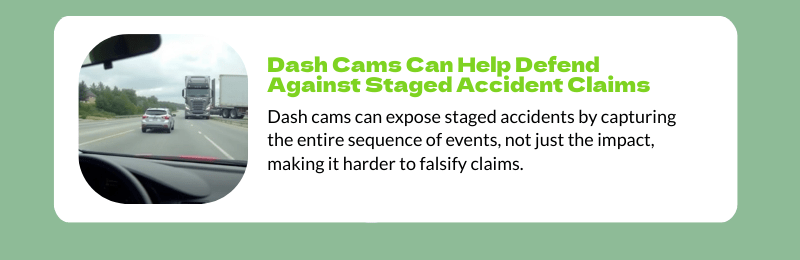
Commercial operators may be targeted for staged accidents because of perceived insurance coverage. Dash cam footage exposes staged behavior by showing the full sequence rather than only the final point of impact.
Staged accidents are a significant reason businesses invest in fleet safety technology. Common patterns include sudden braking, a vehicle cutting in and stopping, coordinated passengers claiming injury, or a vehicle reversing into another vehicle after creating a confusing scene.
Dash cam footage can expose staged behavior by showing the full sequence rather than the final point of impact. A dash cam cannot prevent every staged crash. The real value is deterrence and documentation — a visible camera may discourage some bad actors, and recorded footage gives the insurer, police, or legal team the evidence needed to challenge a suspicious claim.
Dash Cams Do Not Replace Good Claims Procedures
A dash cam is not a complete insurance strategy by itself. Footage is strongest when it is part of a disciplined post-incident process. The most common mistake is waiting too long to retrieve footage — many dash cams overwrite older clips when storage fills up.
- Driver safety and medical response first — nothing else takes priority before ensuring everyone is safe
- Police notification when appropriate to the severity and location of the incident
- Immediate supervisor reporting so the fleet manager can begin the evidence preservation process
- Photo documentation of vehicles, plates, road conditions, and visible damage
- Witness information collection while witnesses are still present at the scene
- Dash cam footage preservation — lock the clip or confirm cloud upload before overwrite can occur
- Prompt notice to the insurance carrier or broker with footage attached or access provided
- Internal incident review comparing driver statement against GPS, video, and telematics data
Insurance Discounts Are Possible, but Dispute Reduction Is the More Reliable Value
Some insurers may offer discounts, credits, or favorable underwriting consideration for fleets that use dash cams, telematics, GPS tracking, or driver safety technology. However, insurance savings vary by carrier, state, fleet size, claims history, vehicle type, and how the technology is used.
Legal and Privacy Considerations Should Be Addressed Before Installation
A clear dash cam policy protects both the business and the driver — and makes footage easier to defend as routine business documentation rather than selective surveillance if it is ever challenged in a claim or legal proceeding.
Dash cams are widely used, but installation and recording practices still require care. Commercial vehicles must avoid obstructing the driver’s view. Audio recording rules also vary by state, especially where two-party consent requirements apply. A strong dash cam policy should address:
What a Dash Cam Policy Should Cover
- Where cameras are mounted in each vehicle type
- Whether the camera records audio
- Whether driver-facing video is included
- When recording occurs and under what conditions
- Who can access footage and for what purposes
- How long footage is stored before deletion
How Footage May Legally Be Used
- Insurance claims and adjuster documentation
- Driver safety coaching and performance review
- Internal incident investigations
- Police or legal proceedings when relevant
- Defending against false or inflated claims
- Demonstrating due diligence in fleet safety programs
What Businesses Should Look for in a Fleet Dash Cam System
The best fleet dash cam system for insurance dispute reduction is not necessarily the most expensive. The best option is the system that consistently captures usable evidence and makes that evidence easy to retrieve when an incident occurs.
| Evaluation Criteria | What to Confirm |
|---|---|
| Coverage | Does the camera capture the road, lanes, signals, and nearby vehicles clearly in both day and night conditions? |
| Data | Does the system include GPS, speed, time stamps, and event details alongside video? |
| Storage | Are important clips locked, uploaded to the cloud, and protected from overwrite automatically? |
| Access | Can managers retrieve and share footage quickly after an incident without physical retrieval? |
| Scalability | Can the system support multiple vehicles, drivers, and vehicle types across the fleet? |
| Reliability | Does the camera perform in heat, cold, vibration, low light, and extended operating hours? |
| Integration | Can footage support broader fleet management, safety review, and claims workflows? |
Dash Cams Reduce Disputes Best When They Are Used Proactively
Dash cams are often thought of as post-accident tools, but their value is stronger when they are part of a proactive safety program. Footage can help managers identify hard braking, close following, distracted driving, harsh cornering, rolling stops, and recurring route hazards — creating a feedback loop where the same system that helps resolve a claim also helps prevent the next one.
For fleets, that means dash cams should not sit unused until a crash occurs. The business should review event clips, coach drivers fairly, track recurring risk patterns, and use video as an objective teaching tool. Drivers are more likely to accept cameras when the footage is used consistently, not only when something goes wrong.
Dash Cams and Insurance Disputes — Frequently Asked Questions
Can dash cam footage be used for an insurance claim?
Yes. Dash cam footage can usually be submitted to an insurance company as supporting evidence. The insurer will decide how much weight to give the footage based on its clarity, relevance, completeness, and whether the clip helps determine fault. A connected system with cloud upload and GPS data provides the most complete evidence package.
Will a dash cam prove I was not at fault?
A dash cam may prove that you were not at fault if the footage clearly shows the other party caused the accident. However, some claims still require police reports, witness statements, damage review, policy analysis, or legal evaluation. Dash cam footage is strong supporting evidence, not an automatic resolution.
Do insurance companies give discounts for dash cams?
Some insurers may consider dash cams, GPS tracking, or telematics when evaluating risk, but discounts are not guaranteed. The availability depends on the carrier, policy type, state, fleet size, and claims history. The more reliable financial value comes from avoiding disputed claims, not from expecting an automatic premium reduction.
Are dash cams useful for commercial fleets?
Dash cams are especially useful for commercial fleets because business vehicles face higher exposure, more road time, more drivers, and greater claim severity. Video evidence can help defend drivers, document incidents accurately, and support proactive fleet safety programs that reduce future claims.
What happens if dash cam footage hurts my claim?
Dash cam footage can work against a driver or company if it shows speeding, distraction, unsafe following distance, or another contributing behavior. This is why dash cams should always be paired with driver training, clear safety expectations, and regular footage review — not installed and ignored until a claim occurs.
Is a GPS dash cam better for insurance disputes?
A GPS dash cam can be significantly better because it adds location, speed, route, and timing context to the video. This information helps resolve disputes where the timeline, vehicle position, assigned route, or speed is questioned — providing a complete evidence record rather than video alone.
Do dash cams record when the vehicle is parked?
Some dash cams include parking mode, which records impact, motion, or activity when the vehicle is off. This can help document hit-and-run claims, vandalism, loading-area incidents, and unattended vehicle damage — situations where no driver is present to witness the event.
Replace Uncertainty With Evidence. Protect Your Fleet on Every Route.
GPS tracking, cloud video, event-triggered recording and U.S.-based support — no long-term contracts, free lifetime warranty.