
Dash Cam With GPS Tracking: Essential Features, Fleet Uses, and Modern Performance Standards
The Role of GPS-Enabled Video in Commercial and Personal Vehicle Operations
A dash cam with GPS tracking provides synchronized visual and location documentation of vehicle trips. The system connects video frames to map-accurate coordinates, offering a clearer, more defensible record of events. Operators adopt these systems to understand real-world driving conditions with greater precision. Fleets rely on them for oversight, and individual drivers use them to strengthen accountability when traveling in unpredictable environments.
GPS-linked video changes the evidentiary value of dash cam footage. A standard camera shows what occurred, but location data clarifies where, when, and how fast an event unfolded. This combination produces a complete operational record that supports incident verification, compliance, route management, and driver transparency.
Why GPS Tracking Matters in Video Documentation
GPS tracking enhances the reliability of dash cam evidence by anchoring footage to time-stamped positional data. This improves the accuracy of incident reviews and enables more detailed analyses of driving patterns. Fleets handling high-movement routes across cities, highways, or rural stretches gain a measurable advantage when their video system integrates geospatial intelligence.
The technology also strengthens continuity during travel. GPS data confirms speed changes, stop points, detours, and route deviations. These metrics assist supervisors in diagnosing delays or disruptions and enable drivers to demonstrate accurate adherence to assigned routes. The combined data set reduces ambiguity during operational reviews.
Core Functions of a Dash Cam With GPS Tracking
A GPS-enabled dash cam supports several functional layers that extend beyond basic video recording. Systems vary in complexity, but most high-utility devices provide the following core capabilities:
- Precise location logging that ties each video segment to a mapped travel path.
- Speed verification that reflects real-time motion during an event.
- Trip summaries that outline mileage, movement duration, and stop locations.
- Timestamped incident markers that identify harsh braking, sudden turns, or impacts.
- Route reconstruction tools that allow supervisors to examine a vehicle’s movement with accuracy.
When these capabilities are combined with connected storage or cloud upload, fleets gain near-real-time oversight without the delays associated with manual data retrieval.
Operational Environments Where GPS Dash Cams Provide the Highest Value
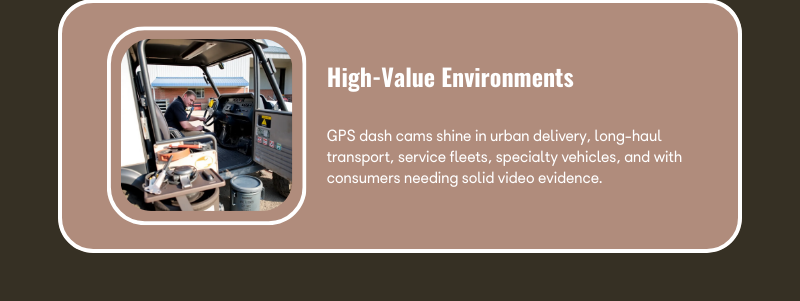
Some sectors depend more heavily on GPS-integrated dash cams due to the nature of their routes, risk exposure, or documentation requirements. The following environments demonstrate the strongest operational alignment with these systems:
Urban Delivery and Final-Mile Networks
Dense streets and unpredictable traffic patterns increase the likelihood of unexpected events. GPS tracking confirms that delivery personnel followed the intended route through congested areas while providing video evidence if disputes occur at intersections, loading zones, or customer sites.
Long-Haul and Regional Transportation
Trucks traveling across wide geographic areas face changing terrain, variable speed limits, and high-risk highway interactions. GPS-linked video enables dispatchers to review the accuracy of recorded incidents and maintain a consistent log of route compliance.
Service and Repair Fleets
Utility vehicles, mobile technicians, and tradespeople frequently reposition throughout the day. Location-anchored footage validates service arrival times, route efficiency, and time spent on each job site.
Specialty Commercial Vehicles
Towing companies, construction fleets, government units, and hazardous-material transporters all benefit from robust documentation. GPS data establishes a verifiable sequence of movement that supports regulatory needs and liability protection.
Consumer Drivers Seeking Evidence-Ready Video
Individual motorists adopt GPS dash cams for clarity in disputed accidents or insurance conflicts. Location-confirmed footage provides stronger proof than standalone video and minimizes room for interpretation during investigations.
Essential System Requirements That Separate High-Quality GPS Dash Cams
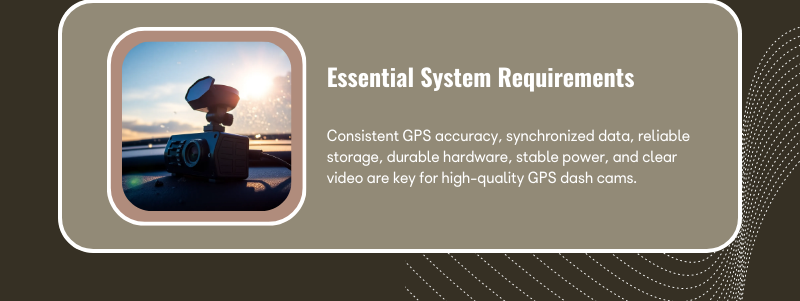
GPS capability alone does not determine system quality. Performance depends on how well the camera integrates location intelligence with other essential attributes. The following requirements define a reliable, modern solution:
Consistent Location Accuracy
A strong GPS module maintains stable connection even in challenging environments such as urban canyons, mountainous regions, or dense tree coverage. Inconsistent signal acquisition reduces the evidentiary value of the footage. Systems must lock onto satellite positioning quickly and hold the signal during rapid movement or weather shifts.
Synchronized Data Matching
The best devices align GPS points with video frames at a consistent interval. This ensures that movements captured visually correlate precisely with recorded coordinates. Well-designed systems automate this pairing, reducing error during reviews.
Reliable Storage Management
GPS-enabled video requires efficient data handling. Systems must preserve critical location logs even during storage cycles or overwrites. Cloud-connected backups add resilience, especially for fleets that depend on preserved route histories.
Durable Hardware Built for Constant Motion
A dash cam with GPS tracking must withstand vibration, interior heat, sun exposure, and long periods of continuous operation. Hardware durability determines the long-term reliability of both video and GPS components.
Stable Power Management
Power interruptions can break the continuity of GPS logs. High-quality systems protect against sudden loss of power and maintain consistent recording during engine shutoff, idling, or transitions between ignition states.
Clear Day and Night Video Quality
Location data must pair with video that reliably captures road markings, license plates, and traffic behaviors. Cameras that lose clarity in low light or during glare conditions offer limited value when incident analysis depends on visual detail.

How GPS Dash Cams Improve Accountability Across Vehicle Networks
GPS-integrated footage strengthens accountability by creating an objective, time-anchored record of trips. This benefits all stakeholders involved in transportation activities.
Driver Accountability
Drivers gain support when incidents occur because GPS data validates their version of events. At the same time, supervisors use the combined data set to verify safe conduct behind the wheel. The system balances protection and oversight without relying on subjective interpretation.
Operational Oversight for Fleet Managers
Fleets use GPS dash cams to pinpoint inefficiencies or deviations. If a vehicle takes an unexplained detour, slows unexpectedly, or encounters a delay, supervisors can investigate without guesswork. The technology reduces uncertainty by supplying context for every movement.
Customer-Facing Verification
Businesses dependent on precise arrival times or confirmed service stops benefit from verifiable records. Location-stamped video clarifies when a driver reached a client location and how long they remained onsite.
Incident Reconstruction
When a collision occurs, the combination of video and location logs clarifies the dynamics surrounding impact. Reviewers understand the speed, position, and travel path in the seconds leading up to and immediately following the event. This reduces disputes and accelerates resolution.
Choosing a Dash Cam With GPS Tracking for Commercial Use
Commercial buyers evaluate GPS dash cams differently than individual motorists. Fleets require systems that integrate with larger operational structures and withstand higher usage volumes.
Key considerations include:
- Peripheral compatibility such as cabin cameras, rear cameras, or sensors.
- Data accessibility through web dashboards, mobile apps, or API connections.
- Scalability for fleets that expand their vehicle count over time.
- Data retention control that allows supervisors to preserve footage for investigations or audits.
- Serviceability in the event of hardware damage or multi-shift usage.
Commercial buyers also focus on consistency. A fleet cannot rely on a system that intermittently loses GPS lock, resets without warning, or stores data unpredictably.
A System That Combines GPS Tracking With Reliable, Connected Video
One system that offers GPS tracking as part of a simple, dependable connected dash cam is the GPS Vehicle Tracking Dash Cam from CommercialDashcams.com. The design supports continuous video recording while pairing travel paths with mapped coordinates. Its goal is to give fleets a straightforward method to review movement, confirm route accuracy, and capture incident footage with precise location anchors.
The system links footage with speed readings and positional data, allowing fleets to reconstruct trip histories with clarity. Its cloud-connected model helps supervisors access recordings and route logs without waiting for manual retrieval. While not overloaded with unnecessary features, it emphasizes consistency, usability, and accurate GPS reporting—qualities valued in operational environments where uptime is essential.
The unit fits fleets seeking a practical GPS-enabled dash cam without adopting large enterprise software ecosystems. It gives operators access to the information they need—video evidence, location tracking, and synchronized trip data—without adding complexity.
How GPS Dash Cams Support Risk Reduction
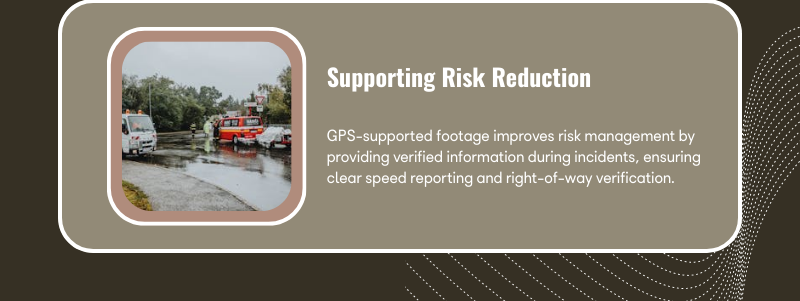
Vehicle operations involve unpredictable interactions with traffic patterns, road conditions, and environmental variables. GPS-supported footage improves risk management by supplying verified information during unexpected events.
Clear Speed Reporting
Speed controversies often arise during collisions. GPS verification reduces disputes by displaying the vehicle’s exact movement at the time of the event. This level of clarity helps during liability evaluations.
Right-of-Way and Lane-Position Verification
Video alone does not always reveal whether a vehicle drifted, changed lanes, or altered position. When paired with location data, reviewers understand the approach angle and direction of travel with higher precision.
Dispute Resolution Between Drivers and Third Parties
Conflicts involving brake-checks, aggressive merging, or unpredictable pedestrian behavior become easier to resolve when footage includes GPS-anchored timestamps. This improves fairness and reduces friction during investigations.
How GPS Tracking Enhances Driver Development Programs
Driver development programs rely on accurate, context-rich information. Video alone shows behavior but does not reveal path, timing, or situational constraints. When GPS data is integrated, the record becomes far more actionable. Trainers can isolate specific segments of a route where habits require improvement, such as abrupt stops, excessive acceleration, or inefficient detours.
This enriched data supports constructive coaching. Supervisors gain objective insights into how a driver handles congestion, merges onto highways, or approaches loading zones. Because the footage is tied to precise coordinates, each scenario can be reviewed in relation to the physical environment. This reduces speculation and strengthens driver feedback sessions.
GPS-linked video also establishes a clear baseline for consistent evaluation. When operators assess drivers across large fleets or multiple regions, standardized location data ensures that reviews are fair and based on identical metrics. This consistency strengthens safety programs and supports long-term performance improvement.
The Role of GPS Dash Cams in Route Optimization and Efficiency Planning
Operational efficiency depends on understanding the real path a vehicle travels, not the theoretical or scheduled route. GPS-enabled dash cams reveal the granular movements of each trip, exposing delays, bottlenecks, and opportunities for optimization.
Supervisors analyze travel histories to identify patterns that influence timing. These patterns help adjust dispatch schedules, reroute vehicles around recurring problem areas, or distribute workloads more evenly. Even small inefficiencies—unplanned stops, unnecessarily long detours, or repeated slowdowns—become visible when both video and GPS logs are available.
For service-based fleets, GPS-anchored video clarifies the actual time spent at job sites. This helps refine appointment windows, improve customer expectations, and eliminate scheduling conflicts. Over time, this data supports a more predictable and efficient operational model.
Strengthening Compliance and Documentation
Industries that depend on precise recordkeeping benefit significantly from GPS-supported dash cams. Regulatory authorities often require detailed logs of vehicle activity, and GPS-integrated video provides a reliable method for documenting compliance.
This system supports audits of service windows, movement across controlled areas, and adherence to designated travel zones. Businesses operating in regulated environments—such as hazardous materials transport, passenger services, or municipal fleets—gain additional protection through a defensible record of vehicle activity.
GPS data also helps verify break periods, operating hours, and designated rest stops. When paired with video, these records create a transparent, chronological account of driver conduct. This improves regulatory alignment without manual data entry.

How GPS Dash Cams Impact Insurance and Liability Outcomes
Insurers and legal teams depend on clear, indisputable evidence to evaluate claims. GPS-enabled footage minimizes ambiguity by supplying detailed positional data alongside video documentation. This combination significantly strengthens the accuracy of incident interpretation.
Establishing Factual Timelines
GPS logs confirm when a vehicle entered an intersection, merged into a lane, or came to a stop. The timeline is anchored to exact coordinates, which makes claims easier to validate. This level of clarity reduces the likelihood of conflicting reports.
Proving Operational Integrity
When disputes arise over whether a vehicle was speeding or operating recklessly, GPS data provides a definitive record. This protects drivers from unfounded accusations and presents an objective defense during claims evaluation.
Reducing Fraud Exposure
Fraudulent claims often rely on ambiguous circumstances or manufactured reports. GPS-integrated video disrupts these attempts by verifying the location and behavior of a vehicle at the time of the alleged event. A verifiable record discourages false claims and accelerates legitimate case resolution.
Integrating GPS Dash Cams Into a Multi-Vehicle Fleet Structure
Large fleets require consistent, scalable deployment strategies. A dash cam with GPS tracking becomes more effective when integrated into a unified system that organizes data across every vehicle.
Centralized Access
Cloud dashboards allow supervisors to review footage, GPS logs, and incident alerts in one location. This removes the need for manual data retrieval and improves communication between departments. A supervisor can access any vehicle’s route history within seconds.
Cohesive Policy Management
Uniform equipment helps enforce consistent driver policies. When all vehicles utilize identical GPS-linked video, behavioral expectations are clearly defined and objectively monitored.
Data Consistency Across Regions
Fleets that operate in multiple states or territories benefit from alignment across their vehicle network. GPS-based data standardizes reporting so that fleet managers in different regions rely on the same format and criteria.
Maintenance and Replacement Efficiency
Standardized hardware simplifies troubleshooting and reduces downtime. When all GPS dash cams share the same structure, replacements, repairs, and updates occur without disrupting operational flow.
A Practical GPS Dash Cam Option Built for Reliable, Connected Oversight
For fleets and operators seeking a straightforward GPS-linked dash cam, the GPS Vehicle Tracking Dash Cam from CommercialDashcams.com provides a functional, dependable solution. The system pairs high-quality video with accurate location tracking, enabling fleets to review route histories and incident footage with precision.
Its connected model supports easy access to recordings and GPS logs through a remote dashboard. This removes the need for on-vehicle retrieval and aligns well with multi-vehicle operations that require fast data availability. The unit is built for simplicity—its design emphasizes durability, predictable performance, and consistent GPS lock rather than unnecessary complexity.
Fleets that need a reliable GPS-supported dash cam without adopting a large enterprise platform find value in this streamlined approach. The system provides the essential tools required for modern route oversight: synchronized video, accurate positional tracking, and dependable hardware performance.
Evaluating GPS Dash Cams for Harsh or Demanding Operating Conditions
Vehicles operate in environments that challenge electronic equipment. A GPS dash cam must withstand vibration, temperature swings, and continuous movement.
Heat and Sun Exposure
Cabs exposed to prolonged sunlight can reach elevated interior temperatures. A high-quality dash cam must continue functioning reliably without camera distortion, module shutdown, or GPS signal degradation.
Vibration and Surface Impact
Commercial vehicles such as box trucks, tow trucks, and flatbeds experience constant vibration. Hardware must remain stable to prevent corrupted footage, inaccurate GPS logs, or loose mounting.
Rapid Acceleration and Deceleration
Frequent stops or sudden changes in momentum challenge the stability of the camera module. Rugged construction prevents the lens from shifting or the GPS module from dropping signal.
Night and Low-Visibility Conditions
Video quality must remain clear even when paired with GPS records. A system that captures limited detail at night reduces the usefulness of location-linked footage.
What to Look for in Software Interfaces and Reporting Tools
The value of a GPS dash cam depends not only on the device but on the accessibility of the data. Well-designed software enables efficient review and fast decision-making.
Timestamped Map Playback
Reviewers should be able to replay footage with a synchronized map display. This allows evaluators to visualize both the video and the corresponding GPS trail, creating a unified view of each trip.
Searchable Trip Logs
Fleets benefit from logs that can be filtered by date, vehicle, route segment, or incident tag. This organization accelerates investigations and routine audits.
Speed and Movement Indicators
Interfaces that clearly display speed readings help validate driving behavior and clarify conditions leading up to an incident.
Simple Export Options
Exportable clips with embedded GPS data are essential for legal reviews, insurance discussions, and customer-facing communications. Systems must provide accessible download formats without excessive processing.
The Connection Between GPS Dash Cams and Broader Telematics Systems
GPS dash cams can serve as standalone units or as part of a broader telematics infrastructure. Fleets with existing systems sometimes integrate GPS-supported video into their operational pipeline to enhance depth of insight.
Supplementing Telematics With Visual Context
Telematics platforms provide metrics such as fuel usage, idling time, and movement patterns. GPS-linked dash cam footage complements this data by adding visual clarity to events.
Real-Time Event Analysis
Connected GPS systems allow fleets to investigate critical events shortly after they occur. Managers can access video and location data remotely, reducing the delay between incident and evaluation.
Strategic Decision-Making
When telematics metrics and video are combined, fleets gain a holistic understanding of performance. This helps guide policy updates, route planning, maintenance scheduling, and safety initiatives.
Trackability and the Need for Future-Proof Dash Cam Design
Technology evolves rapidly, and a dash cam with GPS tracking must maintain relevance as operational demands increase. Future-proof designs rely on adaptable components and scalable software.
Firmware Updates
Systems must support periodic updates that improve GPS accuracy, add review features, or strengthen device stability. This ensures longevity without hardware replacement.
Expandable Ecosystems
Dash cams that allow add-on cameras or complementary sensors remain useful as fleets grow. Expansion options create flexibility and long-term operational value.
Cloud Capacity Scaling
As fleets increase their stored footage, cloud platforms should accommodate longer retention windows or larger storage tiers without disruption.
Consistent Support Infrastructure
A reliable service model keeps the system active and responsive. This includes accessible troubleshooting resources and practical repair or replacement options.
Why Simplicity Often Outperforms Complex Systems in Real-World Use
Some fleets adopt advanced telematics ecosystems that exceed their operational needs. While these platforms offer sophisticated insights, they may introduce unnecessary complexity.
GPS-enabled dash cams that focus on accuracy, durability, and consistent performance frequently deliver better outcomes. Fleets gain the information they need—route verification, speed clarity, incident context—without managing oversized interfaces or redundant data layers.
The GPS Vehicle Tracking Dash Cam from CommercialDashcams.com reflects this streamlined philosophy. It prioritizes usable features that support clarity and operational awareness. By anchoring footage to precise location logs, it delivers high-value information in a format that suits a wide range of vehicle operations.
FAQ: Dash Cams With GPS Tracking
What does a dash cam with GPS tracking record beyond video?
It records positional data such as location, speed, and route history alongside footage. This creates a synchronized record that supports accurate analysis of trips and incidents.
Is GPS tracking useful for personal drivers or mainly for fleets?
Both benefit. Fleets use GPS data for oversight, while personal drivers rely on it for clarity in disputes, route verification, and accurate documentation of travel events.
Does a GPS dash cam need cellular connectivity to function?
The core GPS function does not require cellular service. However, connected features such as cloud uploads and remote access use a data connection.
How does GPS improve the accuracy of incident investigation?
GPS timestamps reveal precise speed and location at the time of an event. When combined with video, this eliminates uncertainty and supports factual interpretation.
Can a GPS dash cam help optimize routes?
Yes. GPS-linked video exposes travel inefficiencies and identifies areas where schedules or routes can be refined.
Do all dash cams maintain GPS lock in difficult environments?
No. Performance varies. High-quality modules retain signal in dense urban areas, mountainous regions, and during rapid vehicle movement.
Why do fleets prefer GPS-linked video instead of basic dash cams?
It provides stronger documentation, simplifies oversight, and reduces ambiguity when reviewing driver behavior or incident conditions.
Is a GPS dash cam valuable if the fleet already has telematics?
Yes. Video adds necessary visual context that telematics alone cannot provide, producing a more complete picture of operations.