
How to Wire a Dashcam That Turns Off With Ignition
What Does It Mean for a Dashcam to Shut Off With Ignition?
A dashcam that shuts off with ignition is powered through a circuit that only receives electricity when the vehicle’s ignition is in the accessory or run position. When the key is turned off or the vehicle is shut down, power to that circuit stops and the camera powers down automatically.
This wiring method prevents the camera from draining the vehicle battery and eliminates the need to manually power the device on and off. It also ensures the camera records whenever the vehicle is operating without requiring driver intervention.
Most professional dashcam installations use this approach because it creates a clean, automated recording workflow that mirrors the vehicle’s operational state.
Which Power Source Allows a Dashcam to Turn Off With the Vehicle?
A switched fuse circuit is the most common power source used to ensure a dashcam shuts off with the ignition. A switched circuit only receives power when the ignition is turned on.
Common switched circuits include:
- Radio
- Cigarette lighter / accessory outlet
- Power windows
- Climate control system
- Sunroof circuit
- Infotainment system
When a dashcam is wired to one of these circuits, the camera begins recording when the vehicle starts and shuts down shortly after the ignition is turned off.
The fuse box inside the vehicle typically contains multiple switched circuits, making it the safest and most reliable connection point.
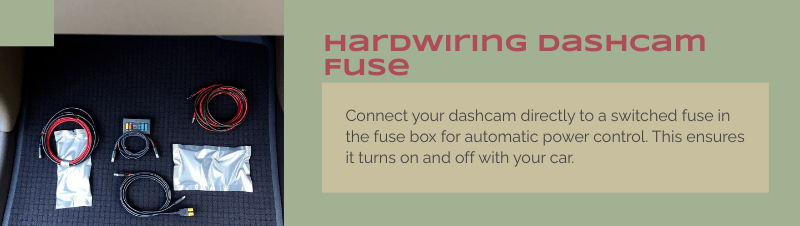
Hardwiring a Dashcam to the Fuse Box
Hardwiring to the fuse box is the most reliable way to connect a dashcam so it powers off with ignition. This installation method uses a fuse tap adapter that connects the dashcam’s power cable directly into a switched fuse slot.
The process involves routing the power cable from the dashcam to the interior fuse box and tapping into an accessory circuit.
Basic Hardwire Components
A standard installation requires the following components:
- Dashcam hardwire kit
- Add-a-fuse (fuse tap)
- Correct fuse type for the vehicle
- Ground wire connector
- Trim removal tool
- Voltage tester or multimeter
Most dashcam hardwire kits include a voltage converter that reduces the vehicle’s 12V power to the lower voltage required by the camera.
Step-by-Step Wiring Process
A proper hardwire installation follows a structured sequence to ensure safe electrical integration.
Step 1: Locate the interior fuse box
The interior fuse box is commonly located:
- Under the dashboard
- In the driver-side footwell
- Behind a side panel near the steering column
- Inside the glove compartment
Consult the vehicle’s fuse diagram to identify accessory circuits.
Step 2: Identify a switched fuse
Use a voltage tester to determine which fuse only receives power when the ignition is on.
- Turn ignition off → test fuse
- Turn ignition on → test fuse again
A switched fuse will show voltage only when the vehicle is on.
Step 3: Install a fuse tap
Remove the original fuse and insert it into the lower slot of the fuse tap. Install the dashcam fuse in the upper slot.
The fuse tap is then inserted into the original fuse location.
Step 4: Connect the power wire
Attach the dashcam hardwire power lead to the fuse tap connector.
This supplies ignition-controlled power to the dashcam.
Step 5: Connect the ground wire
Attach the ground wire to a nearby metal chassis bolt.
The ground connection is essential for completing the electrical circuit.
Step 6: Route the power cable
Run the cable from the fuse box up the A-pillar and across the headliner toward the dashcam.
Proper cable routing ensures a clean installation and prevents interference with airbags.
Fuse Tap Wiring Layout
| Component | Purpose |
| Switched Fuse | Provides ignition-controlled power |
| Fuse Tap Adapter | Allows connection without altering factory wiring |
| Hardwire Kit | Converts 12V vehicle power to dashcam voltage |
| Ground Connection | Completes the electrical circuit |
| Dashcam Power Cable | Supplies power to the camera |
This layout preserves the vehicle’s original wiring while safely adding the dashcam power supply.
Differences Between Ignition-Switched and Constant Power Wiring
Dashcams can be wired in two different ways depending on how the owner wants the camera to behave.
| Wiring Type | Behavior | Use Case |
| Ignition-Switched | Camera turns on/off with vehicle | Standard driving recording |
| Constant Power | Camera remains powered after vehicle shuts off | Parking mode monitoring |
| Hybrid Hardwire | Switches between driving mode and parking mode | Advanced fleet or security setups |
Ignition-switched wiring is preferred when the goal is simple automated recording without parking surveillance.
Constant power installations are more complex because they require battery protection modules to prevent vehicle battery depletion.
Where to Route the Dashcam Power Cable Safely
Proper cable routing is critical for safety and appearance. The power cable should follow existing trim paths so it remains hidden and protected.
Recommended routing path:
- Dashcam mount on windshield
- Across headliner toward driver side
- Down the A-pillar trim
- Behind dashboard panels
- Into the fuse box area
Key installation precautions include:
- Avoid routing cables across airbag deployment zones
- Secure loose wiring with clips
- Keep wires away from moving pedals
- Ensure trim panels fully reseat after installation
- Maintain slack near connection points to avoid tension
A clean cable route prevents rattling and preserves the vehicle’s interior appearance.
Risks of Incorrect Dashcam Wiring
Improper installation can introduce electrical or safety problems inside the vehicle.
Common installation mistakes include:
- Connecting to constant power instead of switched power
- Using the wrong fuse rating
- Failing to install proper grounding
- Routing wires across side curtain airbags
- Overloading existing circuits
- Using low-quality fuse taps
Electrical issues caused by poor installation can result in blown fuses, camera malfunctions, or interference with vehicle electronics.
Using the correct wiring method avoids these risks.
Evaluation Criteria When Choosing a Dashcam Hardwire Kit
Not all hardwire kits provide the same level of reliability or electrical protection. Selecting the correct kit improves installation safety and camera performance.
A high-quality hardwire kit should include:
- Integrated voltage regulator
- Low-voltage battery protection
- Temperature protection circuitry
- Compatible fuse tap connectors
- Adequate cable length
- Noise suppression for stable power delivery
These features protect both the camera and the vehicle’s electrical system.
Professional Fleet Installations Often Use Ignition-Controlled Wiring
Commercial fleets frequently wire dashcams through ignition-controlled circuits because the configuration simplifies fleet operations and eliminates battery drain concerns.
When vehicles start their daily routes, cameras begin recording automatically. When vehicles shut down, the cameras power off and preserve the vehicle battery.
Fleet safety managers often prefer this setup because it standardizes behavior across large vehicle groups and reduces driver interaction with camera systems.
In commercial environments, ignition-controlled wiring also aligns with operational recording policies and compliance documentation.
When Parking Mode Requires a Different Wiring Approach
Parking surveillance requires constant power rather than ignition-switched power. In these installations, the dashcam continues operating after the vehicle is turned off.
Parking mode systems typically rely on:
- Battery protection modules
- Voltage cutoff systems
- Dedicated dashcam battery packs
- Intelligent power management
Without these safeguards, constant power wiring can drain the vehicle battery if the car remains parked for extended periods.
For drivers who only want recording during driving, ignition-controlled wiring remains the simpler and safer configuration.
Professional Installation vs DIY Hardwiring
Both professional installation and do-it-yourself wiring can produce reliable results when performed correctly.
| Installation Type | Advantages | Considerations |
| DIY Hardwire | Lower cost, immediate installation | Requires electrical knowledge |
| Professional Installation | Clean wiring, guaranteed compatibility | Higher installation cost |
| Fleet Installations | Standardized across vehicles | Often performed by specialists |
Vehicle owners comfortable working with fuse panels can typically complete the installation within 30–60 minutes.
Complex vehicles with difficult fuse access may benefit from professional installation.
Hardwiring a Dashcam – People Also Ask
How do I make my dashcam turn off with the car?
Connect the dashcam to a switched fuse circuit in the vehicle’s fuse box using a fuse tap and hardwire kit. A switched fuse only receives power when the ignition is on, causing the camera to shut off when the vehicle is turned off.
Can I wire a dashcam to the cigarette lighter fuse?
Yes. Many cigarette lighter or accessory outlet circuits are ignition-switched. Tapping into this fuse allows the dashcam to power on when the vehicle starts and shut down when the ignition turns off.
Do dashcams automatically turn off with ignition?
Dashcams only turn off automatically if they are connected to an ignition-controlled power source. Cameras plugged into constant power sources may remain on unless configured with power management settings.
Is hardwiring a dashcam safe for the car battery?
Hardwiring to an ignition-switched fuse is safe because the circuit only receives power while the vehicle is running. The camera stops drawing power when the vehicle shuts off.
What fuse should I use for a dashcam?
Dashcams typically require a 2–5 amp fuse depending on the hardwire kit. The correct fuse rating should match the camera’s power requirements and the fuse tap configuration.
Can a dashcam drain the car battery?
A dashcam wired to constant power can drain the battery if no voltage cutoff system is installed. Ignition-switched wiring eliminates this risk because the camera powers off with the vehicle.
Do all vehicles have switched fuse circuits?
Yes. Vehicles contain multiple ignition-controlled circuits designed for accessories such as radios, power outlets, and infotainment systems. These circuits are commonly used for dashcam installations.
Forward-Looking Considerations for Dashcam Power Integration
Dashcam systems continue to integrate more closely with vehicle electronics, including telematics, driver monitoring systems, and advanced safety platforms. As vehicle electrical architectures become more complex, ignition-controlled power integration will remain a foundational installation method that ensures reliability, automation, and protection of the vehicle’s electrical system.