Dash Cams for New York Fleets: Safety, Compliance & ROI
Why Dash Cameras Have Become Essential Technology for New York Fleet Operations
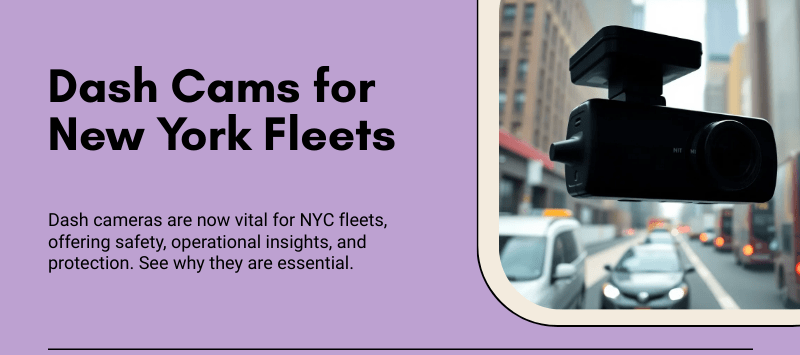
Dash cameras have evolved into a core safety and operational management tool for commercial fleets. In complex traffic environments such as New York, fleets operate under constant exposure to congestion, unpredictable road behavior, and high accident frequency.
A modern fleet dash cam system records the driving environment continuously while capturing contextual data around vehicle operation. The result is a visual record that provides clarity when incidents occur and accountability when questions arise about driver behavior or road conditions.
The impact extends well beyond accident documentation. Video data provides operational insight that supports driver coaching, safety training, and incident prevention programs. Fleets that implement video telematics often see improvements in both safety culture and operational transparency.
In dense urban environments where disputes are common and traffic conditions change rapidly, a dash camera system becomes an operational safeguard that protects drivers and the business simultaneously.
What New York Fleet Operators Must Understand About Dash Cam Compliance
Dash cameras are legal for commercial fleet use in New York, but installation and usage must comply with safety and privacy considerations.
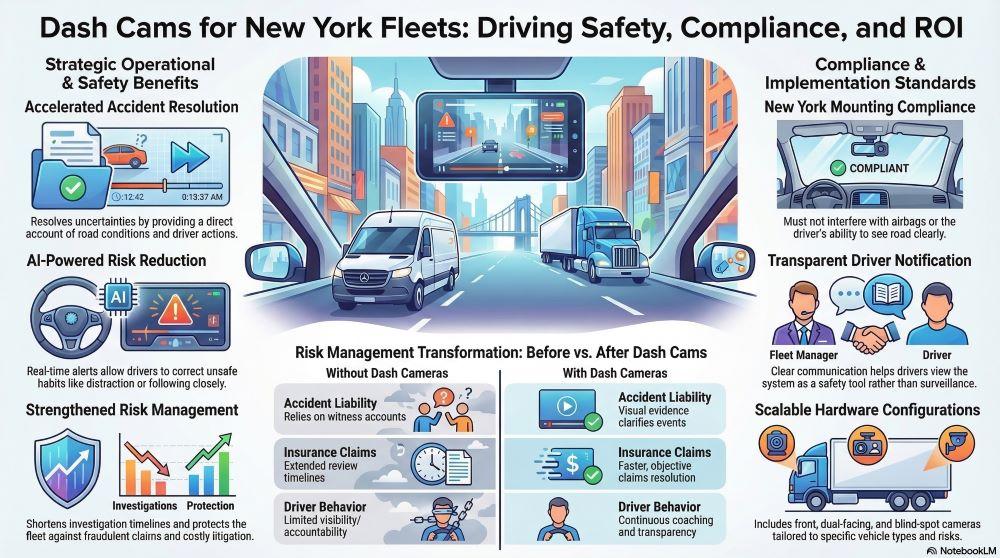
The most important requirement concerns windshield obstruction. Cameras must be mounted in a way that does not interfere with the driver’s ability to see the road clearly. Placement behind the rearview mirror or near the upper passenger-side area of the windshield is typically considered acceptable because it minimizes visibility interference.
Fleet operators must also address employee monitoring considerations. When cameras are used in commercial vehicles, drivers should be informed that recording technology is present and understand the purpose of the system.
Several practical compliance considerations shape how fleets deploy camera systems.
- Cameras must not obstruct driver visibility.
- Drivers should receive clear written notice of monitoring.
- Installation must not interfere with airbags or vehicle safety equipment.
- Audio recording policies must follow applicable consent requirements.
- Data collected by cameras should be governed by company privacy policies.
Clear communication with drivers reduces confusion and helps ensure the technology is perceived as a safety tool rather than a surveillance system.

How Dash Cam Footage Strengthens Accident Investigations
Video evidence significantly improves the accuracy of accident analysis and liability determination. When collisions occur, footage provides a chronological record of the events leading up to the incident.
Fleet accidents often involve multiple vehicles, conflicting testimony, and incomplete police reports. Dash cam footage resolves many of these uncertainties by providing a direct visual account of road conditions and driver actions.
Footage captured before, during, and after a collision can reveal several critical factors.
- Traffic signal status at the time of impact
- Vehicle speed and lane positioning
- Road hazards or environmental conditions
- Behavior of surrounding vehicles
- Driver reaction prior to the collision
This visual context allows insurance providers, legal teams, and fleet safety managers to reconstruct incidents accurately.
For fleets operating in busy metropolitan areas, the ability to quickly establish the sequence of events surrounding a crash often prevents prolonged disputes and costly litigation.
Operational Benefits That Extend Beyond Accident Documentation
Dash camera technology produces operational advantages that reach far beyond incident reporting. Modern systems function as a real-time behavioral and environmental monitoring platform.
Video telematics systems analyze driving patterns, detect risky behavior, and generate alerts that allow drivers to correct unsafe habits immediately. Over time, this visibility strengthens driver training programs and reduces preventable incidents.
Several operational improvements commonly emerge when fleets deploy camera systems.
Improved driver accountability
Drivers become more conscious of safe driving practices when actions are documented objectively.
Targeted safety coaching
Video clips of real driving events allow managers to coach drivers with concrete examples.
Faster incident review
Managers can review footage quickly instead of relying solely on written reports.
Operational transparency
Recorded footage provides insight into daily driving conditions, delivery challenges, and route obstacles.
Reduced claims disputes
Video evidence shortens investigation timelines and clarifies responsibility.
These operational advantages compound over time as fleets accumulate meaningful driving data that informs safety policy and operational planning.
Fleet Dash Camera Configurations and What Makes Them Different
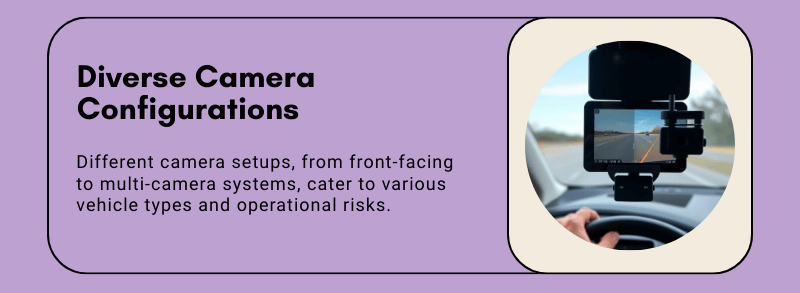
Commercial fleet camera systems come in several configurations designed to address different operational risks. Choosing the right configuration depends on vehicle type, operating environment, and safety priorities.
Front-Facing Cameras
Front-facing cameras record the roadway ahead of the vehicle and capture traffic conditions, signals, and surrounding vehicles.
This configuration is the most widely used across commercial fleets because it provides critical evidence during collisions and traffic incidents.
Dual-Facing Cameras
Dual-facing systems record both the roadway and the driver simultaneously. This configuration allows safety managers to analyze driver behavior alongside road conditions.
Driver-facing footage can identify behaviors such as distraction, fatigue, and seatbelt noncompliance.
Multi-Camera Systems
Larger fleet vehicles often require additional camera coverage to eliminate blind spots and monitor vehicle surroundings.
Multi-camera setups may include cameras positioned at:
- Rear of the vehicle
- Side blind spots
- Cargo areas
- Cabin interiors
- Loading zones
This expanded visibility is particularly valuable for trucks, buses, construction vehicles, and municipal fleets operating in tight urban environments.
Key Evaluation Criteria When Selecting a Fleet Dash Cam System
Selecting a fleet camera system requires evaluating both hardware performance and platform capabilities. The value of the system depends on how effectively it integrates into daily fleet operations.
Fleet managers often assess technology platforms using several practical criteria.
| Evaluation Factor | Operational Importance |
| Video resolution | Clear footage improves incident reconstruction |
| Cloud storage access | Enables remote retrieval of video clips |
| AI safety alerts | Identifies risky driving behaviors in real time |
| System reliability | Ensures continuous recording across all vehicles |
| Fleet management dashboard | Allows centralized monitoring of events |
| Installation flexibility | Supports deployment across multiple vehicle types |
| Data security | Protects recorded footage and sensitive information |
A platform that combines durable hardware with intuitive fleet management tools provides the greatest operational value.
Risk Management Advantages Created by Fleet Dash Cameras
Fleet operators face constant exposure to liability risks related to accidents, driver behavior, and fraudulent claims. Dash camera systems reshape how these risks are managed.
The presence of video evidence changes the dynamics of accident investigations and claims processing.
Operational Risk Comparison
| Risk Category | Without Dash Cameras | With Dash Cameras |
| Accident liability disputes | Relies on witness accounts | Visual evidence clarifies events |
| Insurance investigations | Extended review timelines | Faster claims resolution |
| Fraudulent claims | Difficult to challenge | Video evidence protects fleet |
| Driver behavior monitoring | Limited visibility | Continuous accountability |
| Incident reporting accuracy | Dependent on memory | Objective documentation |
For fleets operating in high-density urban environments, this visibility significantly improves risk management outcomes.
How CommercialDashcams.com Supports Fleet Video Safety Programs
CommercialDashcams.com provides fleet-grade dash camera systems designed specifically for commercial vehicle environments. The platform focuses on reliability, operational visibility, and scalable deployment across fleet operations.
Commercial fleets require camera systems that can withstand long operating hours, vehicle vibration, and extreme environmental conditions. Systems must also provide remote access to footage and centralized oversight tools for fleet managers.
CommercialDashcams.com addresses these operational needs through a range of capabilities commonly required by fleet safety programs.
Key capabilities include:
- High-definition recording optimized for road visibility
- Cloud-based video access for incident review
- AI-powered safety alerts for risky driving behaviors
- Centralized fleet management dashboards
- Multi-camera configurations for large vehicles
- Scalable deployment across growing fleets
These capabilities allow fleet managers to monitor safety events, review incidents quickly, and manage video data through a unified platform.
For organizations expanding driver safety initiatives or implementing video telematics for the first time, platforms such as CommercialDashcams.com provide a structured path toward fleet-wide video oversight.
Implementation Challenges Fleets Must Solve Before Deployment
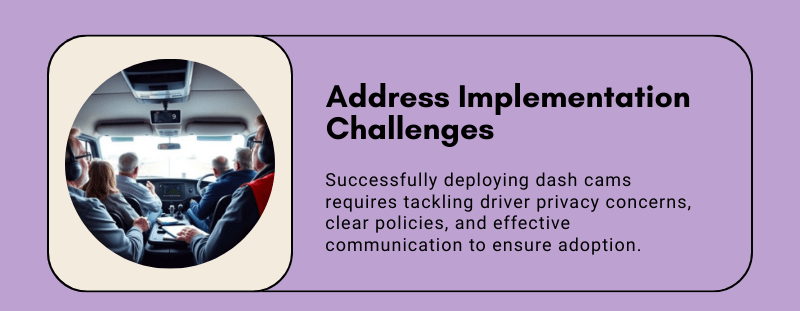
Dash camera programs succeed when technology deployment is paired with clear operational policies and driver engagement.
Several challenges frequently emerge when fleets introduce video systems without proper planning.
- Driver concerns about privacy
- Inconsistent installation across vehicles
- Lack of training for safety managers
- Unclear disciplinary policies for recorded events
- Poor communication about program objectives
- Inadequate video storage procedures
Addressing these issues early improves adoption and helps drivers understand that cameras are designed to protect them from false claims while improving road safety.
Organizations that communicate clearly and incorporate video footage into constructive safety coaching typically see stronger driver acceptance.
Data Management Policies Every Fleet Should Establish
Dash camera systems generate significant volumes of video data, which requires structured management practices. Without clear policies, fleets can quickly accumulate large video archives that are difficult to organize and retrieve.
Effective governance frameworks address several key questions.
- How long should video footage be retained?
- Which personnel are authorized to access recordings?
- How are incident clips preserved for investigation?
- What procedures protect sensitive footage?
- How are driver privacy concerns addressed?
Cloud-based video systems simplify storage and indexing, but policy oversight remains essential. Well-defined governance ensures the technology remains a safety tool rather than a liability.
Why Video Telematics Is Becoming Central to Fleet Safety Strategy
Video telematics technology is reshaping how fleets manage driver safety and operational visibility. Modern camera systems combine video recording with artificial intelligence that detects risky behavior in real time.
Safety alerts can notify drivers of dangerous actions such as distraction, following too closely, or lane drift. These alerts allow drivers to correct behavior immediately before an incident occurs.
When integrated with telematics systems, video data also contributes to a broader operational intelligence platform that tracks driving patterns, environmental conditions, and vehicle performance.
For fleets operating in demanding traffic environments such as New York, these capabilities transform dash cameras from simple recording devices into a comprehensive safety and operational management system.
Frequently Asked Questions – Dashcams for NY Fleets
Are dash cameras legal for commercial fleets in New York?
Yes. Dash cameras are legal provided they are mounted in a way that does not obstruct the driver’s view and comply with applicable privacy considerations.
Where should dash cameras be mounted in fleet vehicles?
Cameras should be mounted behind the rearview mirror or in the upper corner of the windshield where they do not block the driver’s line of sight.
Do fleet drivers need to be informed about dash cameras?
Drivers should be informed that recording systems are present and understand how the footage is used for safety and operational purposes.
Can dash cam footage help defend fleets in accident claims?
Yes. Video footage often provides clear evidence that helps determine liability and resolve claims disputes quickly.
Are driver-facing cameras necessary for fleet operations?
Driver-facing cameras are optional but commonly used to monitor distraction, fatigue, and seatbelt usage.
How long do fleets typically retain dash cam footage?
Retention policies vary, but many fleets store footage for a defined period while preserving specific clips related to incidents.
Can dash cameras improve fleet safety performance?
Yes. Video telematics systems provide data and behavioral insights that support driver coaching and safety program improvements.