GPS Tracking for Commercial Vehicles with Dashcam Integration
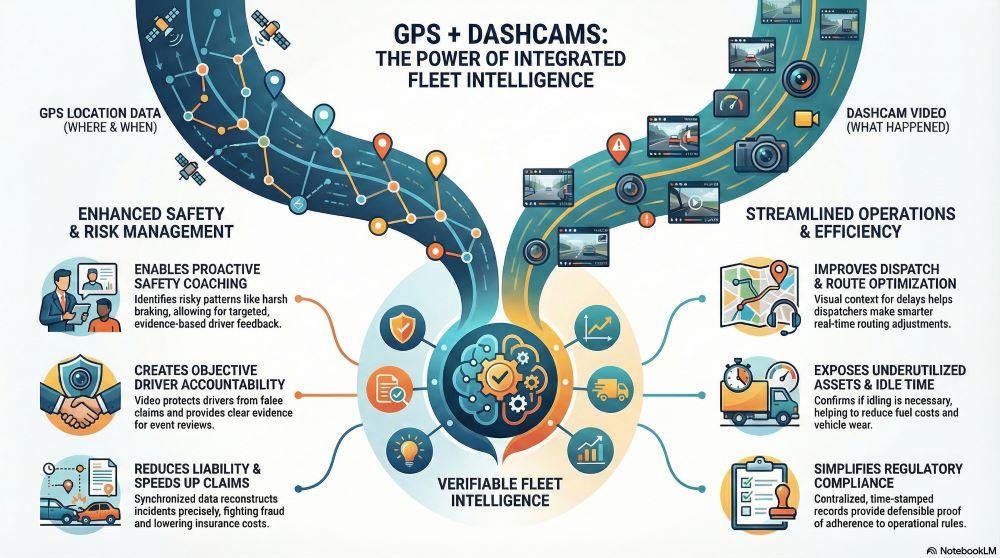
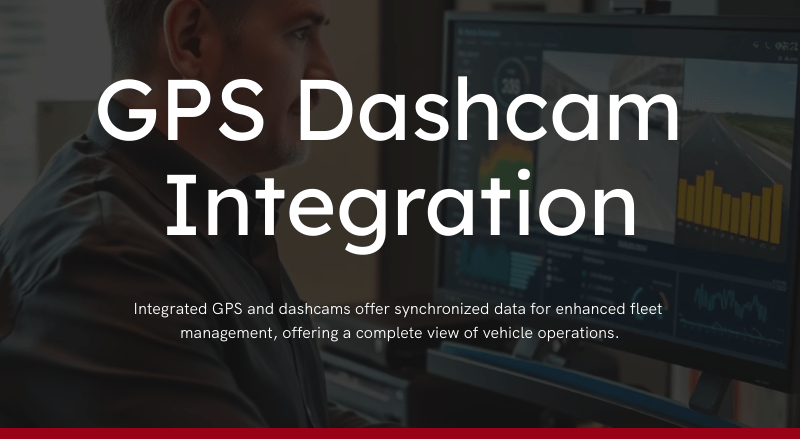
GPS tracking with dashcam integration combines continuous location data with synchronized video capture to create a unified, time-stamped record of vehicle movement and driver behavior. The system links where a vehicle is, how it is being driven, and what occurred visually at any given moment. This fusion turns raw telematics into verifiable operational intelligence rather than isolated data points.
The core value lies in correlation rather than novelty. Location, speed, braking, idling, and route data gain context when paired with forward-facing or dual-facing video, allowing fleets to validate events instead of inferring them. Decision-making improves because incidents, inefficiencies, and risks can be reviewed with certainty rather than assumption.
Why fleets adopt integrated GPS and dashcam systems
Fleets adopt integrated systems to reduce uncertainty across safety, compliance, and cost control. When location data and video evidence live in the same platform, investigations move faster and disputes are resolved with fewer internal resources. The operational burden of managing separate systems disappears.
Adoption is also driven by scale. As fleet size grows, manual oversight breaks down and anecdotal reporting becomes unreliable. Integrated systems create standardized visibility across hundreds or thousands of vehicles without increasing managerial headcount.
Operational visibility gains beyond basic vehicle location
Integrated GPS and dashcams provide continuous operational awareness rather than periodic check-ins. Dispatch teams see not only where vehicles are, but whether they are stopped for legitimate reasons, delayed by traffic, or deviating from assigned routes. Video verification eliminates guesswork when exceptions occur.
This visibility extends to service quality. Fleets can confirm arrival times, on-site activity, and departure without relying on driver self-reporting. Over time, patterns emerge that expose route inefficiencies, scheduling gaps, and underutilized assets.
How dashcam integration changes driver accountability
Dashcam integration creates objective accountability by documenting driving events as they occur. Hard braking, sharp turns, collisions, and near misses are captured visually and tied directly to telematics triggers. This reduces reliance on subjective reports and conflicting recollections.
Accountability also becomes more balanced. Drivers are protected from false claims and unfair blame when video confirms proper behavior. The presence of objective evidence often de-escalates disputes before they reach management or legal review.
Safety outcomes tied to synchronized video and telematics
Safety improvements emerge when risky behaviors are identified early and addressed consistently. Integrated systems flag patterns such as repeated harsh braking or distracted driving, allowing intervention before incidents escalate. Video context ensures coaching is accurate rather than generalized.
Over time, fleets see safer driving norms take hold. Drivers adjust behavior when they know events are reviewed fairly and consistently. The result is fewer severe incidents and a clearer understanding of root causes when accidents do occur.
GPS and dashcam data as a risk management asset
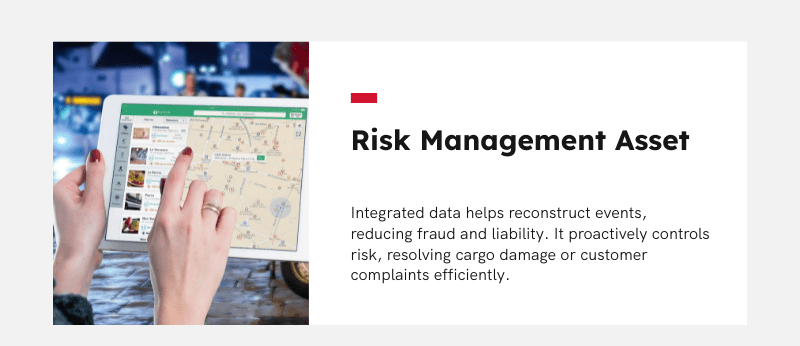
Integrated data serves as a risk mitigation layer rather than a passive record. When incidents happen, fleets can reconstruct events precisely, reducing exposure to fraudulent claims and exaggerated liability. Video aligned with GPS timelines establishes factual narratives.
This asset value extends beyond accidents. Claims involving cargo damage, property disputes, or customer complaints can be resolved quickly when objective evidence is available. Risk management shifts from reactive defense to proactive control.
Real-world impact on insurance and claims handling
Claims handling improves when insurers receive immediate access to synchronized GPS and video evidence. Investigations conclude faster because timelines are clear and fault assessments are supported visually. This reduces prolonged disputes and administrative overhead.
Over the long term, fleets with documented safety programs and verified incident data often gain leverage in insurance negotiations. Demonstrated risk controls and transparent records signal operational maturity and reduced uncertainty.
Compliance advantages for regulated fleets
Integrated GPS and dashcams simplify compliance by centralizing records required for audits, investigations, and regulatory reviews. Time-stamped data shows adherence to routes, schedules, and operational rules without manual logs. Video supports compliance narratives when violations are alleged.
For fleets operating across jurisdictions, standardized data collection ensures consistency despite varying requirements. Compliance becomes repeatable and defensible rather than fragmented and reactive.
Dispatch efficiency and route optimization outcomes
Dispatch decisions improve when GPS data is reinforced by visual confirmation. Traffic delays, job-site access issues, and unexpected stops are easier to diagnose when location anomalies are paired with video. Adjustments can be made in near real time.
Route optimization benefits from historical analysis. Reviewing GPS tracks alongside event footage highlights where routes consistently break down or where driving conditions cause delays. Over time, routing strategies evolve based on evidence rather than intuition.
Asset utilization and idle-time reduction
Integrated systems expose underutilized vehicles and excessive idle time with clarity. GPS shows duration and location, while video confirms whether idling is operationally necessary. This distinction matters when setting policies and coaching drivers.
Reducing unnecessary idle time lowers fuel costs and mechanical wear. Fleets gain a clearer picture of how assets are actually used, enabling smarter allocation and replacement planning.
Driver coaching grounded in objective evidence
Driver coaching becomes more effective when feedback is tied to specific, documented events. Video clips aligned with telematics triggers allow managers to discuss behavior without ambiguity. Conversations shift from accusation to improvement.
This approach supports consistency across the organization. Coaching standards can be applied evenly because events are measured the same way for every driver. Trust improves when discipline and recognition are both evidence-based.
Balancing monitoring with driver trust and retention
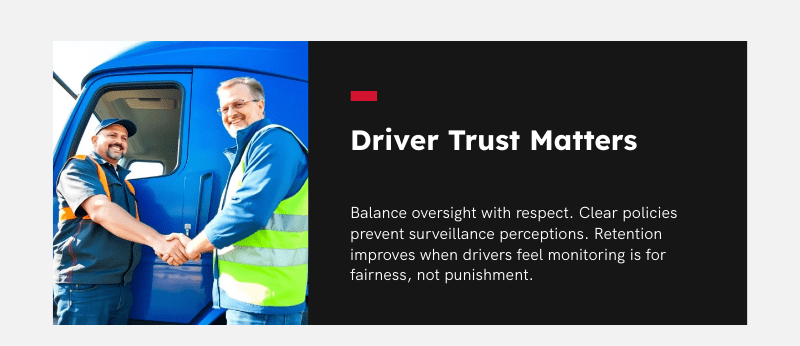
Successful deployments balance oversight with respect for drivers. Clear policies explaining when video is reviewed and how data is used prevent perceptions of constant surveillance. Transparency reduces resistance and improves acceptance.
Retention benefits when drivers feel protected rather than policed. Integrated systems often exonerate drivers in disputed incidents, reinforcing the perception that monitoring exists for fairness and safety, not punishment.
Data management and storage considerations
Integrated systems generate significant volumes of data, requiring thoughtful storage and retention policies. Fleets must decide how long to keep video, which events warrant long-term retention, and how access is controlled. Poor data governance can undermine system value.
Effective platforms streamline this process with automated rules tied to events and risk thresholds. Data becomes manageable rather than overwhelming when retention aligns with operational and legal priorities.
Evaluating hardware durability and vehicle compatibility
Hardware selection determines reliability in real-world conditions. GPS units and dashcams must withstand vibration, temperature extremes, and continuous operation. Poorly matched hardware leads to downtime and data gaps.
Compatibility across vehicle types also matters. Fleets operating mixed assets require flexible mounting, power options, and camera configurations. A system that scales across vehicles avoids fragmented deployments.
Software integration and usability as a decision factor
Software usability often determines adoption success. Dashcam and GPS data must be accessible through a single interface that supports rapid review and reporting. Complex workflows discourage consistent use.
Integration with existing fleet management tools further enhances value. When data flows seamlessly into dispatch, safety, and maintenance workflows, the system becomes part of daily operations rather than an isolated add-on.
Cost structure and return expectations
Costs extend beyond hardware acquisition. Connectivity, storage, maintenance, and administrative time all factor into total ownership. Evaluating return requires understanding how integrated data reduces incidents, claims, and inefficiencies.
Returns are typically realized through avoided losses rather than direct revenue. Fewer severe accidents, faster claims resolution, and improved utilization compound over time, making the investment defensible at scale.
Scaling integrated systems across large fleets
Scaling requires consistency in installation, policy enforcement, and training. Rolling out systems incrementally without standardized practices creates uneven results. Central governance ensures data remains comparable across locations.
Large fleets benefit from centralized dashboards that aggregate insights without losing vehicle-level detail. Scalability depends on balancing high-level oversight with the ability to drill into specific events when needed.
Common misconceptions about GPS and dashcam integration
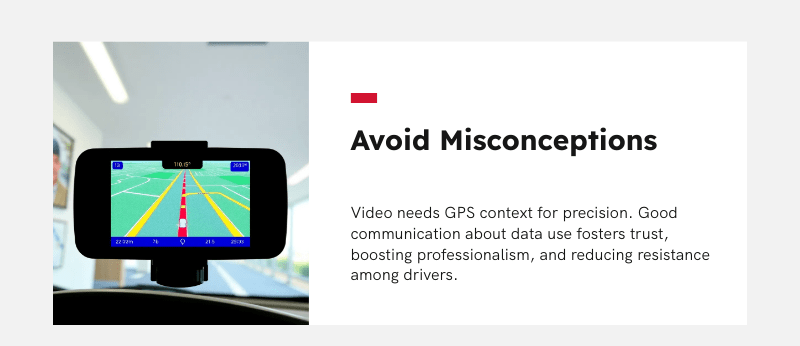
A common misconception is that video alone delivers sufficient insight. Without GPS and telematics, video lacks context and timing precision. Integration is what transforms footage into actionable intelligence.
Another misconception is that monitoring automatically harms morale. In practice, fleets that communicate intent and apply data fairly often see improved trust and professionalism rather than resistance.
Implementation risks that undermine system value
Poor policy definition is a frequent risk. Without clear guidelines on data use, review triggers, and consequences, systems generate confusion rather than clarity. This erodes trust and consistency.
Technical missteps also matter. Inadequate connectivity, poor camera placement, or fragmented software lead to unreliable data. Early planning and testing prevent long-term frustration.
Future direction of integrated fleet intelligence
Integrated GPS and dashcam systems are evolving toward predictive insight rather than retrospective review. Pattern recognition across location and video data will increasingly highlight risk before incidents occur. Fleets will act earlier and more precisely.
The long-term trajectory favors consolidation. As platforms mature, integrated systems will serve as the operational backbone for safety, compliance, and efficiency rather than specialized tools.
GPS Tracking for Commercial Vehicles – Frequently Asked Questions
What is GPS tracking with dashcam integration?
GPS tracking with dashcam integration links real-time vehicle location data with synchronized video footage to provide a unified record of driving events, routes, and incidents.
Do fleets need both GPS tracking and dashcams?
Fleets gain the most value when both are combined, because location data explains where events happened while video shows what actually occurred.
How does dashcam integration help with accident disputes?
Integrated video and GPS timelines reconstruct incidents accurately, reducing uncertainty and resolving disputes faster with objective evidence.
Will drivers resist GPS and dashcam monitoring?
Resistance is lower when fleets communicate clear policies and emphasize protection and fairness rather than surveillance.
Is integrated GPS and dashcam data hard to manage?
Data volume can be managed effectively with automated retention rules and event-based storage strategies.
Can small fleets benefit from integrated systems?
Smaller fleets benefit through improved accountability, faster claims resolution, and clearer operational oversight without adding staff.
Does integration improve fleet efficiency or just safety?
Efficiency improves through better routing, reduced idle time, and clearer asset utilization, alongside safety gains.