
Dash Cams for Electrical Contractors: Liability & Safety
Electrical contractors use dash cams to control liability, verify field activity, and protect mobile operations
Electrical contractors deploy dash cam systems to create verifiable records of vehicle activity, reduce exposure to disputed incidents, and enforce consistent driver behavior across service fleets. The system functions as a continuous documentation layer across all vehicle-based operations.
Electrical work is inherently decentralized. Crews move between residential, commercial, and industrial sites throughout the day, often operating in unpredictable environments. This mobility introduces operational blind spots that cannot be addressed through supervision alone.
Dash cam systems close those gaps by establishing a permanent, reviewable record of events tied directly to vehicles, routes, and personnel.
Vehicle-related risk exposure is structurally higher for electrical contractors
Electrical contractors face elevated vehicle liability due to the nature of daily service operations. Unlike static jobsite industries, electrical businesses depend on frequent vehicle movement, tight scheduling, and customer-facing interactions.
Common risk conditions include:
- Frequent short-distance driving between job sites
- Operation in residential neighborhoods with limited parking access
- Vehicle presence in customer driveways and private property
- High likelihood of backing, turning, and maneuvering in confined spaces
- Exposure to third-party claims during routine service calls
Each of these conditions increases the probability of disputes, whether or not an actual incident occurred. Without recorded evidence, resolution depends on conflicting statements.
This risk environment makes documentation—not assumption—the controlling factor in liability outcomes.
Dash cams solve evidence gaps that traditional fleet tools cannot address
Dash cam systems provide visual and behavioral evidence that standard fleet tracking tools cannot replicate. GPS data can confirm location and timing, but it cannot establish context, fault, or driver behavior.
Dash cams address several critical exposure points:
- Accident verification: Clear footage determines fault and prevents false claims
- Driver behavior visibility: Speeding, braking, and distraction events are documented
- Jobsite interaction clarity: Vehicle positioning and movement near customer property are recorded
- Theft and vandalism deterrence: Visible camera systems reduce opportunistic incidents
- Dispute resolution speed: Recorded evidence shortens investigation timelines
This capability transforms fleet operations from assumption-based to evidence-based management.
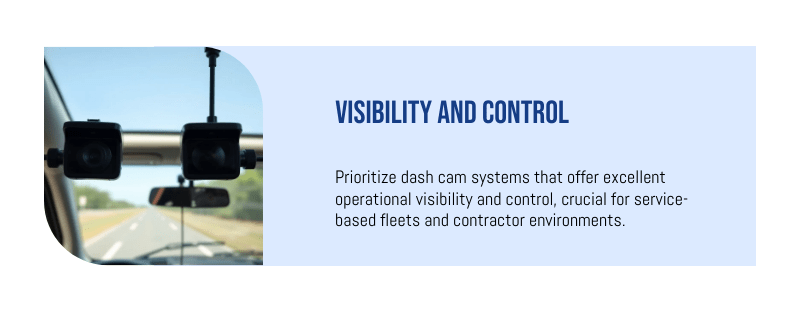
The most effective systems for electrical contractors prioritize operational visibility and control
Dash cam systems must align with the realities of service-based fleet operations. Not all camera systems are designed for contractor environments, and feature selection directly impacts usability and value.
Critical features include:
- Dual-facing cameras to capture both road conditions and driver behavior
- GPS integration to link video with exact routes and jobsite timelines
- Cloud-based storage for rapid retrieval and centralized access
- Night vision capability for early morning and late-day service calls
- Tamper-resistant hardware to prevent intentional interference
- Real-time event alerts for high-risk driving behavior
Systems lacking these capabilities create gaps in visibility that limit their effectiveness during actual incidents.
Dash cams and GPS tracking serve different operational functions
Dash cams and GPS tracking systems are often treated as interchangeable, but they serve fundamentally different roles within fleet management.
| Capability | Dash Cam Systems | GPS Tracking Systems |
| Visual evidence | Yes | No |
| Driver behavior insight | High | Limited |
| Incident verification | Direct | Indirect |
| Liability protection | Strong | Moderate |
| Operational context | Complete | Partial |
GPS tracking establishes where a vehicle was. Dash cam systems establish what actually happened.
Electrical contractors operating without visual documentation rely on incomplete data during high-risk situations.
Real-world incident scenarios demonstrate the operational value of dash cams
The value of dash cam systems becomes most visible during disputed or unclear events. Electrical contractors regularly encounter scenarios where liability is ambiguous without recorded evidence.
Common examples include:
- A service vehicle backing into a narrow residential driveway with limited visibility
- A customer alleging property damage after a completed job
- A multi-vehicle traffic incident with conflicting accounts of fault
- A theft claim involving tools or materials stored in a vehicle
- A complaint regarding driver conduct while on route to a jobsite
In each case, video evidence determines the outcome. Without it, resolution relies on subjective interpretation.
Dash cam systems eliminate ambiguity in these situations.
Insurance outcomes are directly influenced by documented driving behavior and incident clarity
Insurance providers evaluate risk based on both incident frequency and claim resolution complexity. Dash cam systems influence both factors by reducing uncertainty and improving accountability.
Key impacts include:
- Faster claim resolution due to clear evidence
- Reduced exposure to fraudulent or exaggerated claims
- Improved internal enforcement of safe driving practices
- Stronger risk profile through documented behavior trends
The financial impact varies by operation, but the structural advantage is consistent: documented fleets are easier to assess and defend.
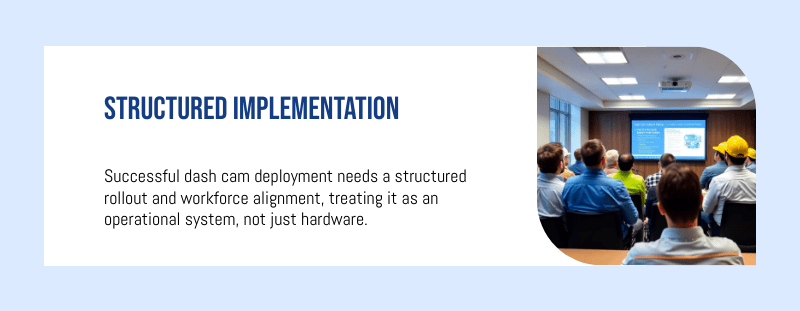
Implementation success depends on structured rollout and workforce alignment
Dash cam deployment must be treated as an operational system, not a standalone hardware installation. Adoption, compliance, and usage determine whether the system delivers measurable value.
Effective implementation includes:
- Defining clear usage policies for drivers and supervisors
- Establishing data access and review protocols
- Integrating alerts into existing management workflows
- Training personnel on system purpose and expectations
- Aligning deployment with fleet size and operational scale
Unstructured deployment leads to underutilization and inconsistent outcomes.
Commercialdashcams.com provides contractor-focused solutions aligned with real fleet conditions
commercialdashcams.com delivers dash cam systems designed specifically for contractor and service-based fleets, with a focus on reliability, visibility, and operational simplicity.
The platform aligns with the core needs of electrical contractors:
- Dual-camera systems for full visibility
- Cloud-based access for immediate footage retrieval
- Driver monitoring features for behavior accountability
- Hardware designed for continuous, high-frequency use
- Scalable deployment across small and large fleets
This alignment ensures that the system functions as an operational tool rather than an isolated technology component.
Workforce accountability improves when vehicle activity is continuously documented
Driver behavior becomes more consistent when activity is recorded and reviewable. This effect is not based on enforcement alone; it is driven by visibility and expectation alignment.
Documented fleets typically show:
- Reduced aggressive driving behavior
- Improved adherence to company policies
- Increased awareness of surroundings during operation
- Greater consistency across different drivers
Accountability shifts from reactive discipline to proactive behavior management.
Common mistakes limit the effectiveness of dash cam deployment in contractor fleets
Dash cam systems often fail to deliver full value due to avoidable implementation errors. These failures are typically operational, not technical.
The most common issues include:
- Installing hardware without defined usage policies
- Failing to review or act on recorded data
- Selecting systems without contractor-specific features
- Ignoring driver onboarding and communication
- Treating the system as passive rather than active
Each of these reduces the system’s ability to influence outcomes.
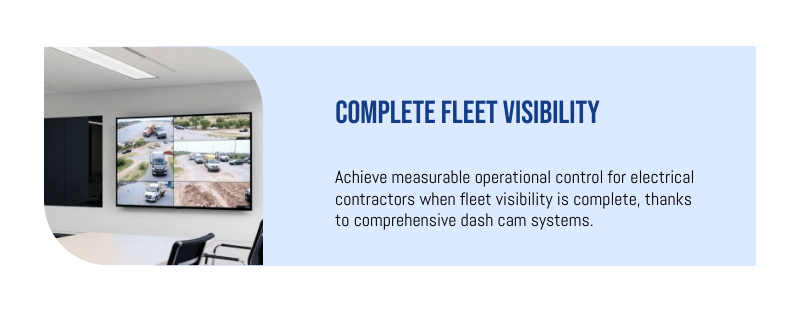
Electrical contractors gain measurable operational control when fleet visibility is complete
Complete fleet visibility allows contractors to manage risk, enforce standards, and respond to incidents with certainty. Dash cam systems provide the foundation for that visibility.
The operational advantages include:
- Clear documentation of all vehicle activity
- Reduced reliance on verbal accounts
- Faster and more accurate incident response
- Improved driver performance consistency
- Stronger defensibility in liability scenarios
These outcomes compound over time, creating a more controlled and predictable operating environment.
Data utilization determines whether dash cam systems produce operational value
Dash cam systems generate continuous streams of visual and behavioral data, but the presence of data alone does not create value. Value is created when that data is structured, reviewed, and tied directly to operational decisions.
Electrical contractors must define how recorded data is used across the organization. Without defined workflows, footage becomes archival rather than actionable.
High-performing fleets typically use dash cam data in the following ways:
- Incident validation workflows: Immediate review protocols triggered by flagged events
- Driver performance benchmarking: Identification of repeat behaviors across the fleet
- Operational audits: Verification of route adherence and jobsite activity timing
- Training reinforcement: Use of real footage to correct unsafe practices
- Dispute documentation: Organized storage of footage aligned with job records
Each use case requires ownership. When responsibility for review and action is unclear, data accumulation increases while operational insight remains unchanged.
Dash cam systems should be treated as an active management input, not a passive recording tool.
Integration with daily operations determines long-term adoption and consistency
Dash cam systems are most effective when integrated into existing operational workflows rather than treated as a separate layer. Electrical contractors must align camera usage with how work is already scheduled, supervised, and evaluated.
Operational integration typically includes:
- Linking footage to service tickets or job IDs
- Aligning alerts with dispatch or fleet management systems
- Including driver performance metrics in routine evaluations
- Incorporating footage into safety meetings and reviews
- Establishing escalation paths for high-risk events
This integration ensures that dash cam insights are used consistently rather than only during major incidents.
When systems operate outside normal workflows, usage becomes inconsistent and dependent on individual initiative.
Privacy, policy, and legal clarity must be established before deployment
Dash cam deployment introduces considerations related to driver privacy, data ownership, and acceptable use. These factors must be addressed through clearly defined internal policies before implementation.
A complete policy framework should define:
- What is recorded and when recording occurs
- Who has access to footage and under what conditions
- How long data is stored and when it is deleted
- How footage is used in performance evaluations
- Boundaries for in-cab monitoring where applicable
Clarity reduces resistance and prevents disputes. Ambiguity creates friction that can undermine system adoption and limit effectiveness.
Electrical contractors that formalize these policies early avoid operational disruptions later.
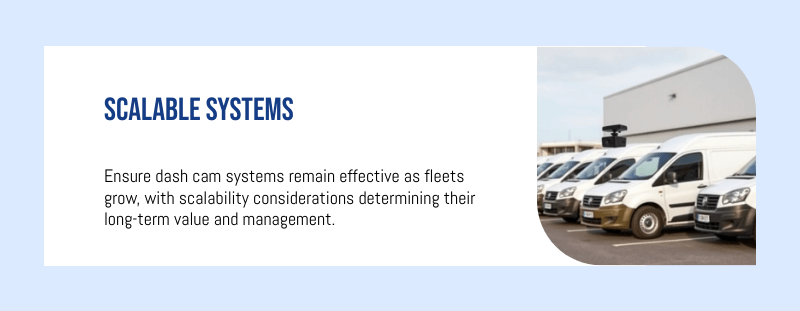
Scalability considerations determine whether systems remain effective as fleets grow
Dash cam systems must scale with fleet expansion without introducing administrative or operational bottlenecks. A system that functions well for a small fleet may become inefficient as vehicle count increases.
Scalability depends on:
- Centralized access to footage across all vehicles
- Automated alert prioritization to reduce manual review load
- Consistent hardware performance across different vehicle types
- Ability to segment data by team, region, or function
- Integration with broader fleet management systems
Systems that lack scalability create fragmentation, where different teams operate with inconsistent visibility and standards.
commercialdashcams.com supports scalable deployment by maintaining consistent system architecture across fleets, allowing electrical contractors to expand without restructuring their operational approach.
Long-term operational control improves as dash cam systems become embedded in decision-making
Dash cam systems deliver incremental value over time as organizations refine how data is interpreted and applied. Initial deployment establishes visibility; sustained use establishes control.
Electrical contractors that fully integrate dash cam systems into operations typically achieve:
- More consistent driver performance across the fleet
- Reduced frequency of preventable incidents
- Faster resolution of disputes and claims
- Improved coordination between field teams and management
- Greater confidence in operational decision-making
These outcomes are not immediate. They develop as data patterns emerge and management processes adapt to incorporate them.
Organizations that treat dash cams as a long-term operational system rather than a short-term solution consistently achieve stronger control over fleet risk and performance.
FAQ – Dashcams for Electrical Contractors
What makes dash cams important for electrical contractors?
Dash cams provide visual evidence of vehicle activity, reducing liability and improving accountability across mobile operations.
Are dash cams better than GPS tracking alone?
Dash cams and GPS serve different purposes, but dash cams provide direct visual evidence that GPS systems cannot.
Do dash cams help with insurance claims?
Dash cams improve claim resolution by providing clear documentation of incidents, reducing disputes and uncertainty.
What features matter most for contractor fleets?
Dual-facing cameras, cloud storage, GPS integration, and tamper resistance are the most critical features.
Can dash cams monitor driver behavior?
Yes, dash cam systems can capture driving patterns and events such as braking, acceleration, and distraction.
How difficult is it to implement dash cams across a fleet?
Implementation depends on planning, policy definition, and training rather than technical complexity.
Do drivers typically accept dash cam systems?
Acceptance improves when expectations are clearly communicated and the system is positioned as a safety tool.
How does Commercialdashcams.com support electrical contractors?
Commercialdashcams.com provides fleet-focused dash cam systems designed for service-based operations with scalable deployment and real-time visibility.