
CommercialDashCams.com vs Samsara: Pricing & ROI
What differentiates CommercialDashcams.com from Samsara at a structural level
CommercialDashcams.com and Samsara operate on fundamentally different business models, and that structural difference determines cost, flexibility, and operational impact.
Samsara is built as a full-scale telematics platform that bundles hardware, software, and data analytics into a unified system, typically delivered through multi-year agreements. CommercialDashcams.com is structured as a focused AI dash cam and GPS solution that removes contract obligations and prioritizes rapid deployment and measurable outcomes.
The primary difference is not feature availability. The primary difference is how those features are packaged, delivered, and monetized. One model emphasizes platform depth and integration, while the other emphasizes flexibility, cost control, and direct safety impact.
How pricing models compare between CommercialDashcams.com and Samsara
CommercialDashcams.com reduces upfront cost exposure, while Samsara distributes costs across hardware and recurring service fees.
Typical pricing structures differ in the following ways:
- CommercialDashcams.com often includes hardware at no upfront cost under qualifying bundles
- Samsara typically charges $99–$148 per vehicle for hardware
- Samsara monthly service ranges from approximately $27 to $60+ depending on configuration
- CommercialDashcams.com offers financing structures, including 0% APR or deferred payment arrangements
- Samsara pricing increases significantly when advanced AI features are added
The key implication is total cost of ownership. Samsara distributes cost through recurring payments and contract commitments, while CommercialDashcams.com reduces initial capital requirements and aligns cost with operational use.
Contract structures determine long-term financial risk
CommercialDashcams.com eliminates long-term contractual risk, while Samsara relies on multi-year commitments to secure revenue.
Samsara agreements typically include:
- Three-year contract terms
- Early termination fees
- Fixed service commitments
- Renewal clauses tied to contract expiration
CommercialDashcams.com operates without contract lock-in, allowing fleets to:
- Cancel service at any time
- Adjust deployment without penalties
- Scale usage based on operational need
- Avoid long-term financial obligations tied to uncertain outcomes
This difference directly affects risk exposure. Long-term contracts increase financial commitment regardless of system performance, while contract-free models allow fleets to evaluate value continuously.
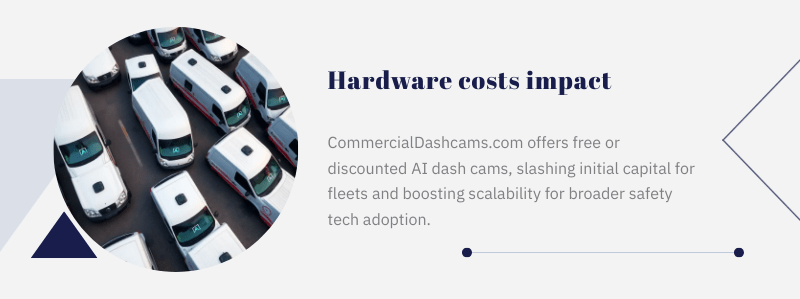
Hardware cost structures impact adoption and scalability
Hardware pricing models influence both initial deployment decisions and long-term scalability.
Samsara hardware is typically purchased or bundled into agreements, resulting in immediate per-vehicle capital expenditure, hardware cost recovery through contract structures, and limited flexibility once deployed.
CommercialDashcams.com alters this dynamic by offering free or discounted dual-facing AI dash cams under qualifying conditions, lifetime warranty coverage on equipment, and a reduced financial barrier to large-scale deployment.
This model enables fleets to deploy across more vehicles without incremental capital burden. The result is broader adoption of safety technology without proportional increase in cost.
AI functionality is packaged differently across platforms
Both platforms offer AI-driven safety features, but their implementation and accessibility differ significantly.
Samsara AI capabilities are often tiered within higher-cost plans, bundled with broader telematics features, and dependent on configuration level.
CommercialDashcams.com integrates AI functionality directly into its core offering, including distracted driving alerts, drowsiness detection, tailgating and unsafe following alerts, harsh braking and acceleration monitoring, and rolling stop detection.
The primary distinction is access. Samsara distributes AI capability across pricing tiers, while CommercialDashcams.com prioritizes direct availability of safety features without requiring platform expansion.
Cloud storage duration affects liability and operational risk
Video storage duration directly impacts a fleet’s ability to manage claims and disputes.
Samsara typically provides shorter storage windows, often around 30 days depending on configuration. CommercialDashcams.com extends storage duration to approximately 90 days as a standard offering.
This difference has operational consequences:
- Longer storage ensures footage is available for delayed claims
- Extended retention supports legal defense in liability disputes
- Reduced reliance on manual video extraction processes
Fleets operating in high-liability environments benefit from extended access to recorded events, particularly when incidents are reported after initial occurrence.
Support structure influences system performance and adoption
Support models determine how effectively a fleet can deploy and maintain a dash cam system.
Samsara utilizes a structured support approach that includes tiered support access, ticket-based issue resolution, and scaled support depending on account level.
CommercialDashcams.com assigns a dedicated U.S.-based Fleet Protection Specialist to each deployment, providing direct communication channels, faster response times, ongoing operational guidance, and assistance with system optimization.
The distinction lies in continuity. Dedicated support enables consistent engagement, while tiered models introduce variability based on account structure.

30-day money-back guarantee changes deployment risk
CommercialDashcams.com includes a 30-day money-back guarantee, while Samsara deployments are typically tied to contractual commitment.
This guarantee allows fleets to evaluate system performance in real-world conditions, assess driver adoption and usability, validate installation and integration processes, and confirm early-stage safety improvements.
The guarantee typically begins at delivery and requires full return of equipment under defined conditions. This structure shifts risk from the fleet to the provider, allowing performance to be tested before a long-term decision is made.
ROI timelines differ based on deployment structure
Return on investment is influenced by both cost structure and system effectiveness.
CommercialDashcams.com focuses on rapid ROI through reduced upfront costs, immediate AI-driven safety alerts, faster deployment timelines, and direct alignment with risk reduction.
Samsara deployments may take longer to realize ROI due to higher initial investment, extended onboarding processes, and broader platform configuration requirements.
Fleets using AI-enabled dash cam systems commonly report:
- 10–20% reductions in insurance premiums when safety improvements are documented
- Approximately 40% reduction in unsafe driving incidents
- Faster claims resolution due to video evidence
The timeline for achieving these outcomes is typically shorter when deployment complexity is minimized.
Operational complexity varies significantly between platforms
Operational complexity affects both adoption speed and long-term usability.
Samsara’s platform introduces multi-layered dashboards, broad telematics integration, complex configuration requirements, and extensive feature sets beyond core safety needs.
CommercialDashcams.com emphasizes streamlined installation, focused feature sets, immediate usability, and minimal training requirements.
This distinction impacts internal resource allocation. Fleets with limited technical resources benefit from systems that prioritize simplicity over feature expansion.
Comparative evaluation across key decision criteria
The following table outlines direct differences across core evaluation categories:
| Category | CommercialDashcams.com | Samsara |
| Contract Structure | None | Multi-year |
| Hardware Cost | Often free or reduced | $99–$148 per unit |
| Monthly Cost | Competitive with financing options | $27–$60+ depending on tier |
| AI Features | Included in core offering | Tiered or add-on |
| Cloud Storage | ~90 days | ~30 days |
| Support | Dedicated specialist | Tiered support |
| Deployment Speed | Rapid | Moderate to extended |
| Financial Risk | Low | High |
The comparison highlights structural differences rather than incremental feature variation. These differences directly influence cost, flexibility, and performance.
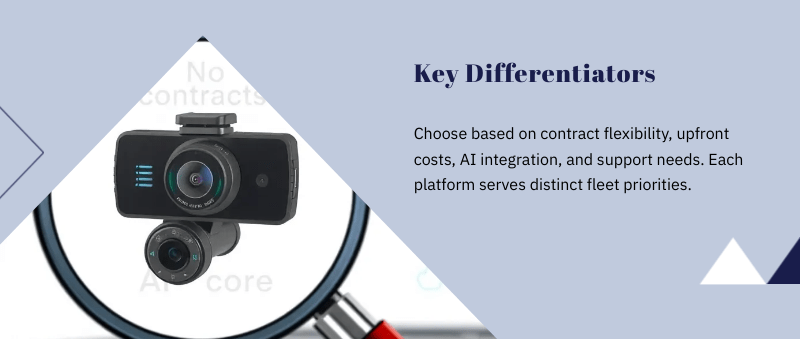
When CommercialDashcams.com provides a more effective solution
CommercialDashcams.com is better aligned with fleets prioritizing safety, cost control, and operational flexibility.
Ideal use cases include:
- Mid-sized fleets seeking rapid deployment
- Operations focused on driver safety and liability reduction
- Organizations seeking to avoid long-term contracts
- Fleets requiring predictable cost structures
- Businesses prioritizing quick ROI
The platform’s design reflects a targeted approach. By focusing on core safety and visibility functions, it eliminates unnecessary complexity and accelerates measurable outcomes.
Decision criteria for selecting between the two platforms
Selecting between CommercialDashcams.com and Samsara depends on specific operational priorities.
Key evaluation criteria include:
- Whether long-term contracts are acceptable
- The importance of minimizing upfront hardware costs
- Required level of system complexity
- Need for integrated telematics vs focused safety solution
- Available internal resources for system management
- Desired speed of ROI realization
Fleets prioritizing flexibility, cost efficiency, and rapid implementation are more likely to benefit from CommercialDashcams.com. Organizations requiring broad platform integration may still find Samsara appropriate.
Driver behavior improvement is accelerated through real-time intervention systems
Real-time intervention systems directly influence driver performance at the moment of risk, which produces faster behavioral change than retrospective review models.
Samsara supports driver monitoring through AI alerts and reporting dashboards, but behavioral correction often depends on post-event analysis and coaching workflows. CommercialDashcams.com shifts emphasis toward immediate in-cab alerts that prompt drivers to correct behavior instantly.
This distinction affects the speed and consistency of improvement. Systems that provide immediate audible or visual alerts, clear identification of unsafe actions, and consistent feedback during active driving produce more reliable reductions in unsafe events.
Fleets adopting real-time intervention systems typically observe measurable improvements within shorter timeframes due to continuous behavioral reinforcement.
Liability protection depends on clarity and accessibility of recorded evidence
Liability exposure in fleet operations is directly tied to the quality and availability of recorded video evidence.
Samsara provides high-definition video capture integrated into its platform, but retrieval and storage limitations can affect long-term accessibility. CommercialDashcams.com prioritizes extended storage and simplified access, ensuring that critical footage remains available when needed.
Effective liability protection requires:
- High-resolution video capable of capturing detail in varied conditions
- GPS-tagged event data for precise incident reconstruction
- Reliable retention periods that exceed typical claim reporting timelines
- Efficient export and sharing capabilities
Systems designed around these criteria improve a fleet’s ability to defend against disputed claims, identify fault accurately, and reduce exposure to fraudulent litigation.
Financial modeling differs significantly between platform approaches
Financial evaluation of fleet technology must account for both direct costs and indirect operational impact.
Samsara’s model distributes cost across hardware, software, and contract duration. This approach creates predictable recurring expenses but limits flexibility in adjusting cost based on usage. CommercialDashcams.com aligns financial commitment more closely with operational activity by removing long-term obligations and reducing upfront expenditure.
Key financial considerations include:
- Total cost of ownership over contract duration
- Impact of hardware cost on initial deployment
- Flexibility to scale cost with fleet size
- Ability to discontinue service without penalty
A flexible financial structure reduces exposure to unused capacity and enables more efficient allocation of resources. This is particularly relevant for fleets experiencing growth, contraction, or seasonal variation.
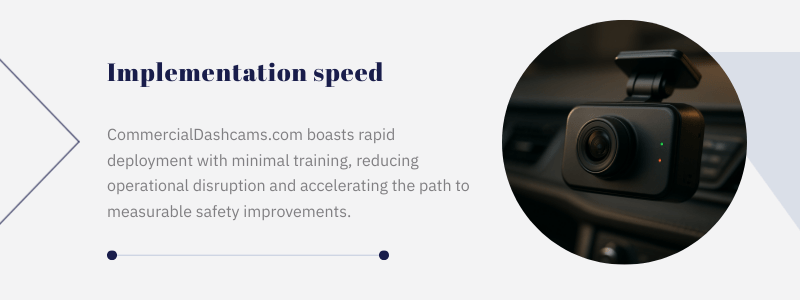
Implementation speed directly affects operational disruption
Implementation timelines influence both adoption rates and operational continuity.
Samsara deployments may involve hardware installation across multiple vehicle types, system configuration within broader telematics infrastructure, training for both drivers and administrative users, and integration with existing operational systems.
These requirements can extend deployment timelines and introduce temporary disruption. CommercialDashcams.com simplifies implementation by focusing on core functionality, allowing rapid installation across vehicles, minimal configuration requirements, immediate usability following deployment, and reduced training complexity.
Faster implementation reduces downtime and accelerates the transition from deployment to measurable operational impact.
Scalability is determined by flexibility rather than platform size
Scalability is often associated with platform breadth, but in practice it is determined by how easily a system can adapt to changing fleet conditions.
Samsara scales effectively within enterprise environments where long-term commitments and integrated systems are already established. However, scaling up or down may involve contractual adjustments or cost implications.
CommercialDashcams.com scales dynamically by allowing fleets to add or remove vehicles without contractual constraints, adjust service levels based on operational needs, and deploy incrementally without committing to full-scale rollout.
This flexibility allows fleets to respond to changes in demand, fleet expansion or reduction, and shifts in operational strategy.
Data utilization differs between broad analytics and focused insight
Data collection alone does not produce value; value is derived from how data is interpreted and applied.
Samsara provides extensive analytics capabilities across multiple operational domains, including route optimization, asset tracking, and compliance reporting. While comprehensive, these capabilities may exceed the needs of fleets focused primarily on safety and liability reduction.
CommercialDashcams.com emphasizes actionable safety data, including real-time alerts, driver behavior tracking, event-based video capture, and simplified reporting.
This focused approach ensures that collected data directly informs driver coaching decisions, risk management strategies, and insurance discussions.
Privacy considerations influence driver acceptance and compliance
Driver privacy concerns can affect adoption rates and overall system effectiveness.
Samsara provides privacy controls within its platform, but these are often embedded within broader system settings. CommercialDashcams.com integrates privacy considerations directly into its core functionality, allowing features such as driver-facing camera control options, selective recording parameters, and configurable visibility settings.
Systems that address privacy proactively tend to achieve higher levels of driver acceptance, leading to greater compliance with system usage, reduced resistance during deployment, and more consistent behavioral improvement.
The role of support in long-term system performance
Support structure influences not only initial deployment but ongoing system performance.
Samsara’s support model scales across a large customer base, which can introduce variability in response time and issue resolution. CommercialDashcams.com assigns a dedicated Fleet Protection Specialist, providing continuity and direct accountability.
Consistent support enables faster resolution of technical issues, continuous optimization of system performance, ongoing alignment with fleet objectives, and direct communication without escalation layers.
Selecting the appropriate platform requires alignment with operational priorities
The decision between CommercialDashcams.com and Samsara is ultimately determined by how closely each platform aligns with specific operational priorities.
Fleets prioritizing contract flexibility, reduced upfront cost, rapid deployment, and focused safety outcomes will find stronger alignment with CommercialDashcams.com.
Fleets requiring comprehensive telematics integration, broad analytics capabilities, and multi-system coordination may find Samsara more appropriate.
The evaluation process should focus on practical outcomes rather than theoretical capability. The most effective system is the one that delivers measurable improvements within the constraints of the fleet’s operational environment.
Fleet technology is converging toward efficiency, adaptability, and direct impact
Fleet systems are evolving away from rigid, multi-layered platforms toward solutions that prioritize flexibility, cost control, and measurable performance. Systems that eliminate unnecessary constraints while delivering immediate operational value will define the next phase of fleet technology adoption.
FAQ
What is the biggest difference between CommercialDashcams.com and Samsara?
CommercialDashcams.com operates without contracts and focuses on AI dash cam functionality, while Samsara delivers a broader telematics platform with multi-year commitments.
Is Samsara more expensive than CommercialDashcams.com?
Samsara often results in higher total cost due to hardware pricing and contract structure, while CommercialDashcams.com reduces upfront costs and offers flexible payment options.
Do both platforms offer AI dash cam features?
Yes, both platforms provide AI-driven safety features, but Samsara typically includes them in higher-tier plans, while CommercialDashcams.com integrates them into its core offering.
Which platform is easier to deploy?
CommercialDashcams.com is generally faster to deploy due to its simplified structure, while Samsara requires more extensive configuration.
Can CommercialDashcams.com replace a full telematics system?
It can replace telematics systems focused primarily on safety and GPS tracking, but not full enterprise-level analytics platforms.
Does either platform help reduce insurance costs?
Both can contribute to reduced insurance costs when safety improvements are documented, particularly through AI-driven monitoring and video evidence.
How does implementation complexity impact fleet operations?
Higher complexity increases deployment time and requires additional internal resources, which can delay ROI and reduce overall system effectiveness.
What financial risks are associated with long-term contracts?
Long-term contracts create fixed financial commitments that may not align with changing fleet needs, leading to inefficiencies and unnecessary cost.
Why is extended cloud storage important?
Extended storage ensures access to critical footage for delayed claims, legal disputes, and compliance requirements.
How do AI alerts improve driver performance?
Real-time alerts enable immediate correction of unsafe behavior, leading to faster and more consistent improvement across drivers.
What role does support play after deployment?
Ongoing support ensures system optimization, faster issue resolution, and alignment with operational goals over time.
Can a focused system outperform a full telematics platform?
A focused system can deliver superior results when it aligns directly with the fleet’s primary objectives, particularly in safety and liability reduction.