
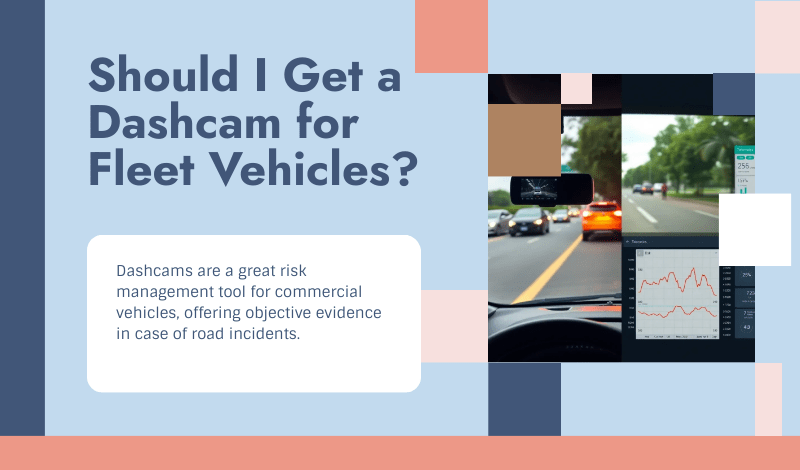
Should I Get a Dashcam for Fleet Vehicles?
For a personal vehicle, a dashcam is often a convenience. For a commercial vehicle, it is a risk-management tool — the difference between a documented event and an expensive, unresolvable dispute. Here is how to decide whether your fleet needs one, which type fits, and what to look for before you buy.
Should I Get a Dashcam for a Commercial Vehicle?
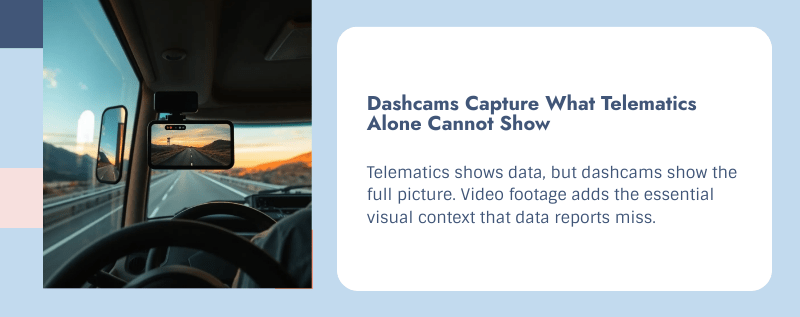
A dashcam’s value scales with a vehicle’s road exposure. The more time a vehicle spends on public roads — and the more it represents your business — the stronger the case for video documentation.
A commercial vehicle should usually have a dashcam if the vehicle is driven frequently, operated by employees, exposed to public roads or used in an industry where accidents, cargo claims or liability disputes are realistic business risks. The decision depends on exposure — a lightly used company car has a different risk profile than a box truck, service van, delivery vehicle or tractor-trailer.
A fleet vehicle represents both an asset and a liability point. The asset value includes the vehicle, equipment, cargo and driver productivity. The liability point includes injuries, property damage, insurance claims, lawsuits and reputational harm. A fleet dashcam does not eliminate those risks, but it gives your business better control over the facts when something goes wrong.
Commercial dashcams are especially valuable for:
Dashcams Capture What Telematics Alone Cannot Show
Telematics data can show speed, braking, location and vehicle movement — but dashcam footage shows context. A GPS report may show hard braking, but it cannot show whether the driver was tailgating or avoiding a pedestrian who stepped into traffic. Video adds the missing visual layer that transforms a data point into a defensible fact.
| Situation | Telematics May Show | Dashcam Footage Clarifies |
|---|---|---|
| Hard braking | Sudden deceleration event | Whether the driver avoided a crash or was following too closely |
| Harsh cornering | High lateral force or sharp turn | Whether road design or an evasive action caused the event |
| Collision | Time, location and impact force | Fault, lane position and the behavior of surrounding vehicles |
| Speeding event | Vehicle speed | Traffic flow, weather and actual road conditions |
| Driver complaint | Route and timestamp | Whether the complaint accurately reflects what occurred |
| Vehicle damage | Location history | When and how the damage actually occurred |
Dashcams are most powerful when paired with telematics, but they are still useful on their own. A standalone camera can capture roadway events, license plates, impact footage and parked-vehicle incidents. An integrated fleet camera system connects video with driver scorecards, alerts, route data and centralized reporting.
Road-Facing and Driver-Facing Cameras Solve Different Problems
Documents external events. Easiest starting point for most fleets. Less privacy-sensitive and effective for most accident disputes.
Captures both road and driver. Identifies distraction, phone use, fatigue and seat belt noncompliance. Requires clear policy.
Side, rear and exterior views. Best for trucks, buses, waste vehicles and larger commercial equipment with blind spots.
Documents interior events for delivery, passenger or specialized operations. Requires strict privacy and access controls.
Records when the vehicle is parked. Valuable for job sites, overnight lots and vehicles prone to hit-and-run damage.
Detects distraction, tailgating, fatigue and unsafe following distance in real time. Alerts driver and logs events automatically.
A fleet does not need the most intrusive system to gain value. Many businesses begin with road-facing video, then add driver-facing or side-view cameras when the risk profile justifies added visibility. The key is proportionality — match the camera configuration to the actual exposure of each vehicle type.
The Biggest Benefit Is Liability Protection After a Disputed Incident
Commercial vehicles are often assumed to be at fault because they are larger, branded and associated with a business. Video evidence changes that assumption into a documented fact.
Commercial vehicles are often assumed to be at fault when a collision involves a passenger car — they are larger, branded, insured and associated with a business. Without video, a fleet may have to rely on driver statements, police reports and incomplete physical evidence. With video, a business can show exactly what happened.
Dashcams Improve Safety When Video Is Used for Coaching
Dashcams improve safety most effectively when footage is used to identify patterns, coach drivers and prevent repeat incidents — not as a constant surveillance tool. Drivers are more likely to accept dashcams when the system is framed as protection rather than monitoring. Many professional drivers understand that video can defend them after a false accusation; resistance increases when they believe every minor mistake will be punished.
- Focus on specific behaviors rather than vague criticism during reviews
- Keep review sessions short and focused on one or two examples at a time
- Apply consistent rules across all drivers — inconsistency undermines trust
- Use footage to recognize safe defensive driving, not only to flag problems
- Define privacy boundaries and footage review procedures in writing before launch
- Establish clear escalation steps for repeated violations vs. one-time events
What a Written Dashcam Policy Should Cover
- Camera locations and recording conditions (continuous vs. event-triggered)
- Audio recording status and disclosure
- Who can access footage and under what circumstances
- How long clips are stored and when they are deleted
- How footage may be used in coaching, discipline or legal proceedings
A Dashcam Can Help With Insurance, But Savings Are Not Guaranteed
Some insurers view dashcams favorably because video can reduce claim uncertainty and help resolve disputes faster. In some cases, commercial fleets may receive premium credits or improved underwriting consideration when cameras are part of a documented safety program. However, a dashcam should not be purchased only because a business expects an automatic insurance discount.
Where Dashcams May Reduce Costs
- Faster claim resolution with clear evidence
- Fewer unresolved disputes and legal costs
- Stronger defense against false or exaggerated claims
- Reduced accident frequency through driver coaching
- Lower vehicle downtime after incidents
- Better documentation for internal investigations
What Affects Insurance Impact
- The specific carrier and underwriting approach
- Fleet history and current loss ratios
- Vehicle type and operational environment
- How consistently video is used for coaching
- Whether a formal safety program is documented
- How footage is used in claim submissions
The best step is to ask your fleet’s insurance provider directly how camera footage affects underwriting, claims handling and safety-program evaluation. A dashcam sitting passively in a vehicle may have limited insurance value. A dashcam connected to a documented safety process has a much stronger business case.
Privacy Concerns Are Manageable When Fleet Policies Are Clear
Driver privacy concerns are manageable when a business explains what the dashcam records, why the system is used and how footage will be accessed. A dashcam policy should be written before installation — not after a dispute — so drivers know what to expect from day one.
Privacy expectations can vary by state, industry and vehicle type. Passenger transportation, school transportation, medical transport and unionized workforces may require additional review before deployment. See our knowledge base for state-specific guidance on audio recording consent and windshield placement rules. Treat privacy as a compliance and trust issue, not just a technical setting.
The Right Dashcam Depends on Vehicle Type, Route Risk and Fleet Size
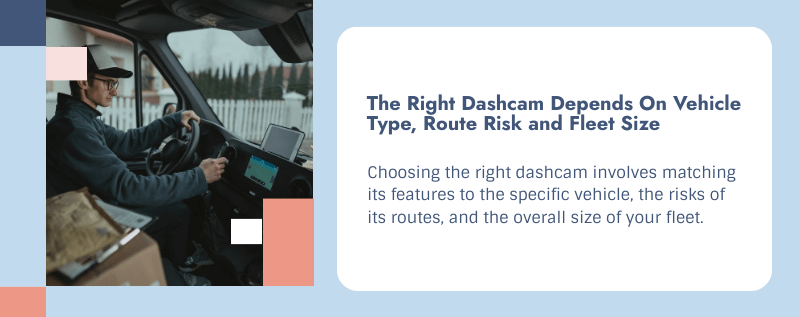
A one-size-fits-all camera strategy can lead to overspending in low-risk vehicles and underprotection in high-risk ones. Match camera configuration to each vehicle’s actual exposure.
Some Fleets Need Dashcams More Urgently Than Others
A business does not need to wait for a major crash to justify video protection. The need often becomes clear from operational patterns: frequent near misses, customer complaints, unexplained vehicle damage, rising insurance costs or inconsistent driver behavior are all signs that video evidence may provide immediate value.
High-Priority Vehicles
- Vehicles operating in dense urban traffic
- Trucks with large blind spots
- Vehicles making frequent deliveries or stops
- Branded vehicles visible to the public
- Vehicles driven by multiple employees
- Vehicles parked overnight in unsecured areas
- Vehicles with prior claims or recurring complaints
Starting With a Pilot Program
- Install in highest-risk vehicles first
- Review results and refine driver policies
- Assess footage quality and installation needs
- Gather driver feedback before full rollout
- Confirm cloud access and reporting workflows
- Expand across the fleet once the process is solid
Should You Get a Dashcam? — Frequently Asked Questions
Should I get a dashcam if I only have one commercial vehicle?
A dashcam can still be valuable for a single commercial vehicle because one incident can create insurance, legal and downtime costs that far exceed the camera investment. Owner-operators and small businesses may benefit most from having objective evidence when no claims team or fleet manager is available after an incident.
Are driver-facing cameras necessary for every fleet?
Driver-facing cameras are not necessary for every fleet. Road-facing cameras may be enough for businesses primarily focused on accident documentation. Driver-facing cameras are more useful when distraction, fatigue, passenger safety or repeated driver behavior concerns are significant operational issues.
Do dashcams record all the time?
Some commercial dashcams record continuously, while others record only when triggered by motion, impact, hard braking or driver behavior events. Fleet systems may also offer parking mode, live remote access and cloud-based clip storage depending on the system configuration.
Can a dashcam hurt a business if the driver is at fault?
A dashcam can reveal driver fault, but that visibility still helps a business respond quickly, assess liability accurately and prevent repeat incidents through coaching. The risk of unfavorable footage is usually outweighed by the value of knowing exactly what happened and being able to act on it.
Do fleet dashcams reduce insurance costs?
Fleet dashcams may support insurance savings, but discounts are not guaranteed. Insurance impact depends on the carrier, fleet history, vehicle type, safety program and how consistently video is used for coaching and claim resolution. Ask your insurer directly how camera use affects underwriting.
What features matter most in a commercial dashcam?
The most important commercial dashcam features are reliable video quality, strong night visibility, secure cloud storage, GPS data, AI event detection, durable hardwired installation, easy footage access and fleet-level management tools for multi-vehicle operations.
Are dashcams legal in commercial vehicles?
Dashcams are generally legal in commercial vehicles, but legality depends on camera placement, audio recording rules, privacy expectations and state-specific requirements. Businesses should avoid obstructing the windshield, disclose driver-facing recording where required and create a written policy before installation.
Protect Your Fleet With Objective Video Evidence
AI-powered dashcams, GPS tracking, cloud storage and fleet management — no contracts, free lifetime warranty.