
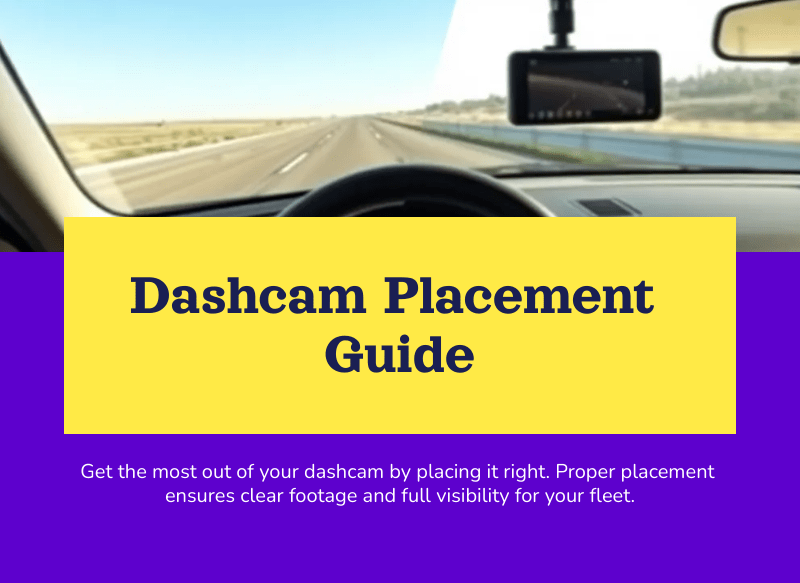
Where to Place Dashcam — Placement for Commercial & Fleet Vehicles
Where to place dashcam systems in commercial and fleet vehicles for complete operational visibility
Dashcam placement in commercial vehicles must prioritize unobstructed road visibility, accurate driver monitoring, and full-context event capture without interfering with driver sightlines or violating regulations. Effective placement is not a cosmetic decision—it determines whether recorded footage is admissible, actionable, and operationally useful.
Fleet operators require more than basic forward footage. A properly placed system captures multiple perspectives: road conditions, driver behavior, cabin activity, and in some cases, cargo or rear exposure. These perspectives collectively support accident reconstruction, insurance defense, and driver safety programs.
In practice, most commercial fleets deploy multi-channel systems from providers such as CommercialDashcams.com, which are designed to integrate these perspectives into a unified recording framework. Placement strategy must align with that capability to avoid blind spots and incomplete data.
Where to place dashcam forward-facing cameras for liability protection and road visibility
Forward-facing cameras should be mounted high on the windshield, centered horizontally, and positioned just below or behind the rearview mirror to maximize field of view while minimizing driver obstruction. This position ensures the camera captures the full roadway, including adjacent lanes, traffic signals, and sudden hazards.
Improper placement—such as mounting too low or too far to one side—can limit depth perception and exclude critical visual evidence. In accident scenarios, partial footage often fails to establish fault, which reduces the evidentiary value of the system.
Key placement considerations include:
- Clear line of sight through the windshield without tint distortion
- Alignment with the vehicle’s center axis
- Avoidance of windshield curvature that distorts footage
- Minimal intrusion into the driver’s viewing area
- Stable mounting surface to reduce vibration artifacts
Commercial trucks and service vehicles may have different windshield geometries, requiring slight adjustments. However, the principle remains consistent: maximize forward coverage without compromising driver visibility.

Where to place dashcam interior-facing cameras for driver monitoring and incident validation
Interior-facing cameras should be mounted to capture the driver’s upper body, hands, and line of sight while maintaining a balanced field of view that avoids unnecessary intrusion. The primary objective is behavioral visibility, not surveillance.
In fleet environments, interior cameras serve several operational functions:
- Verifying driver attentiveness during incidents
- Monitoring distraction, fatigue, or unsafe behavior
- Providing context for harsh braking or collision events
- Supporting coaching and training programs
- Reducing false claims through behavioral evidence
Placement must ensure the camera captures facial orientation and steering activity without being obstructed by sun visors or cabin equipment. Angling the camera slightly downward often improves visibility of both hands and steering wheel interaction.
Privacy considerations must also be accounted for. Systems from CommercialDashcams.com typically include configurable privacy settings, allowing fleets to balance visibility with driver trust.
Where to place dashcam rear-facing and exterior cameras for full situational awareness
Rear and exterior cameras should be positioned to capture blind zones, cargo areas, and rear traffic flow, particularly in larger commercial vehicles where rear visibility is limited. These cameras are critical for documenting rear-end collisions, unsafe following distances, and loading zone incidents.
Common placement locations include:
- Rear window or exterior rear panel for traffic visibility
- Side mirrors or body panels for blind spot monitoring
- Cargo compartments for load verification
- Trailer connections for articulated vehicles
Fleet vehicles operating in dense urban environments benefit significantly from side-mounted cameras, which capture lateral movement and cyclist or pedestrian interactions. Without these angles, many liability scenarios remain unresolved.
Proper integration ensures that all camera feeds align temporally, allowing operators to review events from multiple perspectives simultaneously.
What regulatory and safety constraints affect where to place dashcam systems
Dashcam placement must comply with federal and state visibility regulations, which restrict obstruction within the driver’s field of vision. Non-compliant placement can result in fines or invalidate recorded footage in legal proceedings.
Key regulatory considerations include:
- Windshield obstruction limits defined by state law
- Mounting zones permitted near rearview mirrors
- Restrictions on electronic device placement
- Requirements for driver visibility clearance
- Industry-specific safety standards for commercial fleets
Fleet managers must also consider internal safety policies. For example, placement that interferes with airbags, sensors, or driver controls introduces operational risk.
A compliant placement strategy ensures that dashcam systems enhance safety rather than introduce new liabilities.

How different vehicle types change where to place dashcam systems
Dashcam placement varies significantly depending on vehicle class, cabin design, and operational use. A uniform approach across all fleet vehicles often leads to suboptimal coverage.
Light-duty fleet vehicles
Passenger-style vehicles allow standard windshield mounting for forward-facing cameras and simple cabin placement for interior monitoring. These vehicles typically require fewer external cameras.
Medium-duty service vehicles
Utility vans and service trucks often require additional side or rear cameras due to limited rear visibility and frequent stop-and-go operation in populated areas.
Heavy-duty trucks and tractor-trailers
Large commercial vehicles require multi-angle systems. Forward cameras must account for elevated driver positions, while side and rear cameras address extensive blind zones. Trailer-mounted cameras may also be necessary.
Specialized fleet vehicles
Vehicles used in construction, logistics, or hazardous environments may require ruggedized camera placement to withstand vibration, dust, and extreme weather conditions.
Adapting placement to vehicle type ensures consistent coverage quality across the fleet.
What placement mistakes reduce the effectiveness of commercial dashcam systems
Incorrect placement reduces footage quality, creates blind spots, and limits the system’s ability to support real-world decision-making. These failures often go unnoticed until an incident occurs.
The most common placement mistakes include:
- Mounting too low on the windshield, limiting road visibility
- Off-center positioning that skews perspective
- Obstruction by mirrors, visors, or equipment
- Poor angle alignment that misses critical activity
- Failure to secure mounts, leading to vibration distortion
- Ignoring lighting conditions that cause glare or washout
Each of these issues directly impacts footage reliability. In liability scenarios, incomplete or distorted footage often carries little value.

How to evaluate whether dashcam placement is operationally effective
Effective dashcam placement is measurable through footage clarity, coverage completeness, and usability during incident review. Placement should not be considered final until validated under real driving conditions.
Evaluation criteria include:
| Evaluation Factor | What to Verify |
| Field of View | Full coverage of road, driver, and surroundings |
| Image Stability | Minimal vibration or motion blur |
| Lighting Balance | Clear visibility in day and night conditions |
| Obstruction-Free Recording | No interference from mirrors or cabin elements |
| Multi-Angle Synchronization | Consistent timing across all camera feeds |
Fleet operators should conduct periodic audits to confirm that placement remains effective as vehicles undergo maintenance or configuration changes.
How CommercialDashcams.com systems support optimized dashcam placement
CommercialDashcams.com systems are designed to accommodate multi-angle placement strategies while maintaining centralized control and synchronized recording. These systems allow fleet operators to deploy forward-facing, interior, and auxiliary cameras within a unified platform.
Key capabilities include:
- Multi-channel recording for complete situational coverage
- Configurable camera angles to match vehicle design
- Real-time event detection and alerting
- Cloud-based access to synchronized footage
- Flexible mounting options for diverse fleet types
These features allow placement strategies to evolve alongside operational needs without requiring full system replacement.
How placement decisions influence liability, insurance, and fleet performance
Dashcam placement directly affects how incidents are interpreted by insurers, legal teams, and internal safety programs. Incomplete or unclear footage weakens the ability to defend drivers or identify root causes.
Well-positioned systems provide:
- Clear evidence in disputed accidents
- Accurate reconstruction of events
- Reduced insurance claim costs
- Improved driver accountability
- Data-driven safety improvements
Poor placement, by contrast, introduces ambiguity. In high-cost incidents, ambiguity often leads to unfavorable outcomes regardless of actual fault.

FAQ – Dashcam Placement
Where should a dashcam be placed on the windshield in a commercial vehicle?
A dashcam should be mounted high and centered near the rearview mirror to capture the road clearly without obstructing the driver’s view.
Do fleet vehicles need interior-facing dashcams?
Interior-facing cameras are not mandatory but are widely used to monitor driver behavior and provide context during incidents.
Can dashcam placement affect legal compliance?
Yes. Incorrect placement that obstructs the driver’s view can violate regulations and impact the admissibility of footage.
Should commercial fleets use multiple dashcams?
Most fleets benefit from multi-camera systems that capture forward, interior, and rear perspectives to ensure complete coverage.
How do you test if dashcam placement is correct?
Placement should be validated by reviewing recorded footage for clarity, coverage, and absence of obstructions under real driving conditions.
Are side cameras necessary for all fleet vehicles?
Side cameras are particularly valuable for larger vehicles with blind spots but may not be required for smaller fleet vehicles.
Does dashcam placement impact insurance outcomes?
Yes. Clear, well-positioned footage can reduce liability and improve claim resolution outcomes.